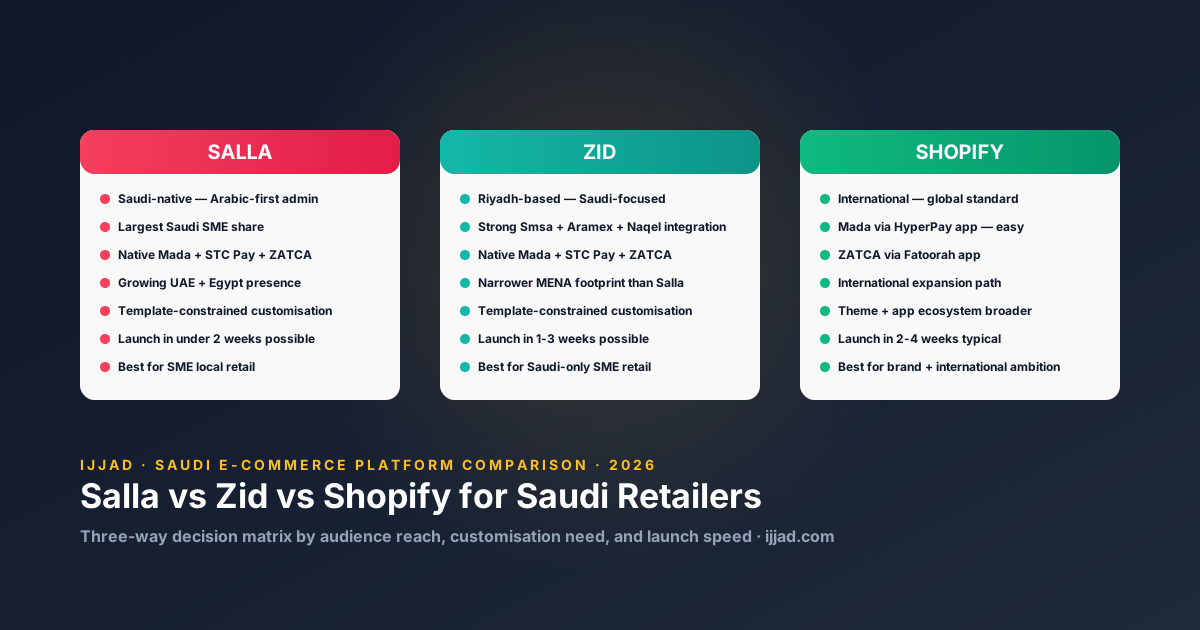
Salla vs Zid vs Shopify for Saudi e-commerce in 2026 — three-way decision matrix. Saudi-native platforms vs international standard. Audience reach, customisation depth, launch speed, ZATCA handling, and which fits which Saudi retailer profile.
Salla, Zid, or Shopify for a Saudi e-commerce store in 2026?
Salla, Zid or Shopify: each is a legitimate Saudi e-commerce platform, but none is an Ijjad build service. Ijjad only builds custom websites and custom e-commerce systems; use this comparison to decide whether a hosted platform is enough or whether your business needs a custom build.
- Salla: Saudi-native, largest Saudi SME share, growing UAE + Egypt reach, Arabic-first admin
- Zid: Riyadh-based, Saudi-only focus, strongest Saudi shipping integration, fastest launch
- Shopify: International standard, brand + design flexibility, global expansion path
- All three handle Mada + STC Pay + ZATCA Phase 2 + Tabby/Tamara — Salla/Zid built-in, Shopify via apps
- Decision factors: audience reach, customisation depth, shipping operations, admin language preference
Last reviewed by Karam Abdalqader
Saudi e-commerce retailers in 2026 face three legitimate platform options for SME and mid-tier launches: Salla, Zid or Shopify. The right choice depends on customisation depth, operations, shipping integrations, and admin-team language. This page compares those constraints and references an anonymized first-party Jeddah case in which Ijjad reports a 340% conversion-rate lift; underlying analytics are private.
One thing upfront: this is a three-way comparison, not a binary. Most Saudi platform-choice content treats Saudi-native vs international as an either-or, and it is not. Each of the three platforms fits a different Saudi retailer profile, and getting the right match upfront saves the migration headache later. Ijjad does not build or configure these hosted platforms; this guide is buyer education for deciding whether a hosted platform is enough or a custom build is justified.
Why Saudi-native platforms hold meaningful share
Salla and Zid are the two Saudi-built platforms, and Zid alone reports more than 13,500 merchants on its own homepage (zid.sa, read 10 September 2026); Salla does not publish a comparable count on a page we could verify. Saudi-native platforms are not a niche option, they are a primary choice for Saudi SME retailers, and their share concentrates in SME local retail where the Saudi-specific features matter most: Mada, STC Pay, ZATCA Phase 2 e-invoicing, Saudi shipping integration (Smsa, Aramex Saudi, Naqel), and Arabic-first admin interface.
What Saudi-native platforms get right that international platforms have to add via apps and plugins:
- Default Saudi readiness. Mada, STC Pay, ZATCA Phase 2, Tabby, Tamara all built in by default — zero plugin configuration. Shopify requires apps for each (still clean integrations, but extra setup).
- Arabic-first admin UX. Dashboard, settings, orders, products, customers, reports all present in Arabic as the primary UI language. Shopify\'s admin is English-first with Arabic available.
- Saudi-specific shipping depth. Smsa, Aramex Saudi, Naqel and the smaller regional couriers all integrate natively with order workflow. Shopify integrates these via Saudi-specific apps with slightly less workflow depth.
- Faster launch. Salla and Zid SME stores can launch in 1-2 weeks because the platform handles more of the Saudi-market integration work upfront.
Where Saudi-native platforms have constraints: customisation depth is template-bounded, theme and app ecosystems are narrower than Shopify, international expansion beyond MENA is harder, and brand-distinctive design within Salla or Zid template constraints requires accepting some design compromise that Shopify themes do not impose.
Salla’s strengths and limits
Salla works well for Saudi SME retailers with broader MENA expansion ambition. The platform is the largest Saudi-native e-commerce option with significant UAE and Egypt presence growing through 2024-2026. Localised payment integrations for UAE (CBUAE-licensed gateways) and Egypt (NBE-licensed gateways) make Salla the natural Saudi-MENA expansion platform.
Where Salla shines: largest Saudi SME share with strong network effects (Saudi designer plugins, themes, agency support), Arabic-first admin UX, default Saudi readiness (Mada + STC Pay + ZATCA + Tabby/Tamara built-in), growing MENA expansion path beyond Saudi, fast launch (1-2 weeks for SME stores), strong Saudi-language customer support, regular feature updates aligned with Saudi market needs (Vision 2030 retail expansion, ZATCA Phase 2 updates, Saudi shipping carrier integrations).
Where Salla limits work: template-constrained customisation (custom design needs work within template framework, not against it), narrower theme library than Shopify, narrower app and integration ecosystem, international expansion beyond MENA is harder (limited multi-currency support outside Saudi/UAE/Egypt), brand-distinctive design within Salla constraints requires accepting some compromise, custom workflows for unusual product types or B2B-style ordering are limited.
Zid’s strengths and limits
Zid works well for Saudi-only SME retailers prioritising fastest launch and tightest Saudi shipping integration. Riyadh-based and Saudi-focused, Zid has the deepest native integration with Saudi shipping carriers (Smsa, Aramex Saudi, Naqel, plus smaller regional couriers) and strong native support for Saudi-specific operational patterns.
Where Zid shines: strongest Saudi shipping integration depth (Smsa, Aramex Saudi, Naqel, plus smaller couriers all integrate natively with order workflow and label generation), Arabic-first admin UX comparable to Salla, default Saudi readiness (Mada + STC Pay + ZATCA + Tabby/Tamara), fastest launch potential (1-2 weeks for SME stores), strong support for Saudi-specific product categories and operational patterns, Riyadh-based support team familiar with Saudi market specifics.
Where Zid limits work: narrowest MENA footprint of the three (Saudi-focused; UAE and Egypt expansion harder than Salla), narrowest theme library, narrowest app ecosystem of the three, smaller agency partner network than Salla or Shopify, customisation more template-constrained than Shopify, less brand-distinctive design possible within Zid template framework.
Shopify’s strengths and limits
Shopify works well for Saudi brand-driven retailers, internationally-ambitious merchants (expansion beyond MENA), and retailers prioritising customisation depth or theme and app ecosystem breadth. International standard with the largest theme library, broadest app ecosystem, and strongest brand-customisation capability of the three.
Where Shopify shines: broadest theme library (thousands of designs including premium Arabic-RTL-tested themes), broadest app ecosystem (thousands of integrations from major SaaS platforms), strongest customisation depth via Liquid templating + apps, native multi-currency support for international expansion beyond MENA, Shopify Plus tier extends to enterprise scale (B2B wholesale, custom checkout, multi-currency native), global brand recognition supports trust signal for international audiences.
Where Shopify limits work for Saudi: Mada, STC Pay, ZATCA Phase 2, Tabby, Tamara all require official apps (still clean integrations but extra setup vs built-in on Salla/Zid), English-first admin (Arabic available but secondary), launch timeline longer than Salla/Zid (2-4 weeks vs 1-2 weeks for SME), monthly platform fee plus transaction fees grow with order volume.
The full 12-dimension three-way matrix
| Dimension | Salla | Zid | Shopify | Verdict |
|---|---|---|---|---|
| Native Mada integration | Built-in, zero config | Built-in, zero config | Via HyperPay or Network International app | Salla/Zid easier |
| Native STC Pay integration | Built-in, zero config | Built-in, zero config | Via STC Pay official app | Salla/Zid easier |
| ZATCA Phase 2 e-invoicing | Built-in, automatic | Built-in, automatic | Via Fatoorah app | Salla/Zid easier |
| Tabby/Tamara BNPL native | Built-in, native | Built-in, native | Official apps | All tied |
| Arabic-first admin interface | Yes, primary UI | Yes, primary UI | English-first, Arabic available | Salla/Zid for KSA SME teams |
| Saudi-specific shipping (Smsa, Aramex Saudi, Naqel) | Native integrations | Native integrations, strongest | Via Saudi-specific Shopify apps | Zid edge for Saudi shipping |
| Launch speed (SME first store) | 1-2 weeks possible | 1-2 weeks possible | 2-4 weeks typical | Salla/Zid fastest |
| Customisation depth | Template-constrained | Template-constrained | Liquid + apps; more flexible | Shopify wins |
| International expansion path | UAE + Egypt growing | Saudi-only focus | Global standard, multi-currency | Shopify for international |
| Theme + design flexibility | Theme library narrower | Theme library narrowest | Broadest theme + app ecosystem | Shopify for distinctive design |
| Total cost trajectory | Plan fee (SAR 99 or 299 a month, SAR 990 or 2,990 a year); no separate platform percentage listed | Plan fee (SAR 99 or 299 a month, SAR 990 or 2,990 a year); no separate platform percentage listed | Plan fee in USD plus a 0.2% to 2% third-party payment fee on every order | Salla/Zid cheaper at scale (smaller volume) |
| Best fit | Saudi SME with broader MENA ambition | Saudi-only SME local retail | Brand + design + international expansion | Picks per business profile |
The dimensions where Salla and Zid decisively beat Shopify for Saudi SME: native payment integration (built-in vs app-based), Arabic-first admin, Saudi shipping integration depth, launch speed. The dimensions where Shopify decisively beats Salla and Zid: customisation depth, the breadth of its theme and app ecosystem, international expansion path. Most other dimensions involve tradeoffs that depend on business profile.
What the plans cost on each platform’s own pricing page
Read on salla.com/en/plans, zid.sa/en/pricing and shopify.com/sa/pricing on 13 September 2026. Salla and Zid price in SAR; Shopify’s Saudi page prices in US dollars. Zid was running a National Day promotion that day (an extra year free and order cashback on annual plans), so treat its column as list price, not the offer.
| Plan level | Salla | Zid | Shopify (Saudi page) |
|---|---|---|---|
| Free tier | Basic: free; unlimited products and orders, discounted shipping labels, no online payments | Starter: free forever; bank transfer and cash on delivery only | None; 3-day trial, then US$1/month for 3 months |
| First paid plan | Salla Plus: SAR 990/year (SAR 99 billed monthly); adds online payments, custom domain, all product types | Rise: SAR 99/month (SAR 990 billed annually); adds Zid Payments (mada, Visa, Mastercard), Apple Pay, themes, custom domain | Basic: US$19/month paid yearly, US$27 monthly |
| Mid plan | Salla Pro: SAR 2,990/year (SAR 299 billed monthly); adds VAT activation, staff accounts, CSS and JS customisation | Growth: SAR 299/month (SAR 2,990 billed annually); adds VAT calculation and display, 5 additional staff, 2 branches or warehouses, CSS | Grow: US$54/month paid yearly, US$72 monthly; Advanced: US$299 yearly, US$399 monthly |
| Enterprise | Custom pricing, dedicated success manager, ERP integrations | Professional: quote, paid annually; API access, 5 branches or warehouses, 20 additional staff | Plus: from US$2,300/month; customisable checkout, 25 headless storefronts |
| Platform fee on top of the gateway’s rate | Not listed as a separate platform percentage on the plans page | Not listed as a separate platform percentage on the pricing page | Third-party payment provider fee of 2% (Basic), 1% (Grow), 0.6% (Advanced), 0.2% (Plus). Shopify Payments is not offered in Saudi Arabia, so a Saudi store pays this on every order in addition to its gateway’s rate |
The row that changes the arithmetic is the last one. A Salla Pro store pays SAR 2,990 a year and the gateway’s rate. A Shopify Basic store pays US$228 a year, the gateway’s rate, and 2% of every order on top; at SAR 300,000 of annual sales that 2% is SAR 6,000 before a single app subscription. Gateway rates themselves are on the payment gateway fees table.
Decision flowchart by business profile
Run yourself through this three-way decision based on actual business profile:
Salla, Zid, or Shopify: which fits your Saudi store?
The pattern that fits most Saudi-only SME retailers prioritising fastest launch: Zid. The pattern that fits most Saudi SME retailers with broader MENA ambition: Salla. The pattern that fits brand-driven Saudi retailers or internationally-ambitious merchants: Shopify. Edge cases (content-heavy stores, deep customisation, 10,000+ SKU catalogs) drive to WooCommerce or custom Next.js, covered separately in our other comparison content.
Migration paths between platforms
Moving a Zid store to Shopify: what transfers and what breaks
Your catalogue and customer list move on spreadsheets. Your order history does not move by spreadsheet. Expect product and category URLs to change, and expect to rebuild payments and invoicing on the Shopify side from nothing. The table is what each platform’s own help centre documents.
| What | Out of Zid | Into Shopify |
|---|---|---|
| Products | Products > Actions > Export all, as full product details or quantities only; the file waits on the export-requests page | Product CSV import, in Shopify’s own column layout, so the Zid columns are mapped to it first |
| Customers | Excel file sent to the account’s registered email, for all customers or a ticked selection | Customer CSV import; Shopify asks for products first, then customers, so orders can be linked |
| Order history | Exported to email, every status or a filtered set | Not importable from CSV. Historical orders arrive through a migration app or the API, or stay in the Zid export as an archive |
| URLs and rankings | Check every live Zid path against the Shopify path it will get; assume none survive until proven | URL redirects, importable from a CSV under Content > Menus, one row per old URL. Individual URLs can be redirected; Shopify’s fixed index paths (/products, /collections) cannot |
| Payments and invoicing | Zid’s built-in Saudi gateway and e-invoicing set-up stays behind | Shopify Payments is not offered in Saudi Arabia (it is in the UAE), so mada and STC Pay come through a Saudi gateway app, and ZATCA invoicing through a separate app |
Sources: Zid help centre on product import and export, customer export and order export; Shopify Help Center on migrating to Shopify, URL redirects and Shopify Payments countries. All read 2026-09-12.
Neither help centre publishes a timeline. In the units they do document, the effort is one column mapping per CSV (products, then customers), one redirect row per live URL before the domain moves, and two separate app onboardings on the Shopify side (the gateway and the ZATCA app), neither of which was a step on Zid. The redirect map is the part to do properly, because a Zid product URL that has been shared and linked keeps sending people to it after the move.
Before starting, ask why you are leaving. If the answer is international expansion or a design the Zid themes cannot express, Shopify is a reasonable destination and the table above is your checklist. If the answer is that Zid’s template constrains a Saudi-only store, look harder: the Shopify move replaces Zid’s built-in Saudi stack with apps that reproduce it, and the design ceiling is still there, in a different place. That retailer is choosing between staying on Zid and a custom build. None of the three platforms migrates the store for you, and neither does Ijjad; Ijjad builds custom stores.
The other directions exist too. Salla documents its own product and order exports, so Salla-to-Shopify follows the same shape. Shopify-to-Salla suits Saudi-focused retailers tired of app configuration overhead; Shopify-to-Zid suits Saudi-only retailers who want the shipping integration depth back. Zid publishes its own guide for the Salla-to-Zid direction.
Operations after launch: shipping, payments, and invoicing compared
Platform comparisons usually stop at launch day. The costs that decide whether your store makes money start the day after: who books the courier, how cash on delivery is handled, when gateway money settles, and how ZATCA invoices get issued. The three platforms behave differently on each.
| Ops question | Salla | Zid | Shopify |
|---|---|---|---|
| Courier booking | Native Saudi courier integrations from the dashboard | The deepest shipping stack of the three, with multi-courier rules built in | Via apps or a 3PL; local couriers need setup work |
| Cash on delivery | Standard toggle, courier-reconciled | Standard toggle, strong COD reporting | Possible, but COD reconciliation is on you or your 3PL |
| mada / local wallets | Native via Saudi gateways | Native via Saudi gateways | Through a Saudi gateway integration, so verify mada renders first in checkout |
| ZATCA e-invoicing | Handled via platform/apps | Handled via platform/apps | Needs a ZATCA app or external invoicing tool |
The ops decision rules, plainly: if shipping complexity is your biggest worry (multiple couriers, COD-heavy, returns), Zid’s operations depth is the tiebreaker. If you want the least ops thinking overall and a Saudi-first stack, Salla. If you run Shopify in Saudi Arabia, budget for a 3PL or shipping app from day one and confirm your gateway shows mada first — the two ops gaps we fix most often on Shopify builds.
Payments deserve their own decision. Which gateway, what the regulated mada caps mean for your margins, and whether you need a gateway at all are covered in our small business payment options guide and the Saudi payment gateway finder; the last publicly listed card and mada rates are in the payment gateway fees table.
Common Saudi platform-choice mistakes
Five Saudi retailer mistakes we see most often in platform choice, drawn from consultations with merchants who came to us mid-migration.
Mistake 1: picking Shopify because international = better
Some Saudi SME retailers pick Shopify by default assuming international platform = better quality, then discover that Mada/STC Pay app configuration and English-first admin slow operations versus what Salla or Zid would have given them out of the box. International is not inherently better; right-tool for actual business profile is better.
Mistake 2: picking Salla or Zid then needing customisation
Saudi retailers sometimes pick Salla or Zid for fast launch then discover their brand or product flow needs more customisation than template constraints allow. A Salla-to-Shopify or Zid-to-Shopify migration is one downstream outcome; a custom build is the other. The right move is to assess customisation needs honestly upfront, not after the template constraints surface.
Mistake 3: picking Zid with MENA expansion plans
Some Saudi SME retailers pick Zid for fastest launch then announce 12-month UAE expansion plans. Zid is Saudi-focused and the UAE expansion is meaningfully harder than from Salla (which has UAE presence) or Shopify (which has native multi-currency). Map expansion ambition during discovery; if MENA expansion within 18 months, Salla is the better Saudi-native choice; if global expansion, Shopify.
Mistake 4: underestimating theme and design constraints
Brand-distinctive Saudi retailers sometimes pick Salla or Zid and then chafe against template design constraints. Salla and Zid templates are well-designed for SME retail but they impose visual conventions. Brand-led retailers that want distinctive design specific to their brand identity benefit from Shopify (broader theme library + Liquid customisation) or custom Next.js.
Mistake 5: picking based on platform marketing rather than fit
All three platforms market aggressively to Saudi merchants with case studies, success stories, and promotional content. Following that marketing rather than an honest business-profile assessment leads to wrong-fit decisions. The right answer per business depends on the specific Saudi retailer profile: international ambition, customisation needs, shipping criticality, admin language preference. It does not depend on which platform has the more compelling marketing.
Need help choosing a platform for your Saudi store?
Ijjad only builds custom websites and custom e-commerce systems. All three platforms are useful comparison points, but not Ijjad delivery services. Free discovery call to decide whether your store needs a custom build: 60 minutes, written scope direction within 72 hours, no obligation.
Get Started →Frequently asked questions
Should I pick Salla, Zid, or Shopify for my Saudi e-commerce store?+−
Are Salla and Zid easier to launch than Shopify for Saudi retailers?+−
Which platform handles Saudi shipping (Smsa, Aramex Saudi, Naqel) best?+−
Can Salla expand into UAE or Egypt for cross-MENA selling?+−
Which platform has the best Arabic-first admin interface?+−
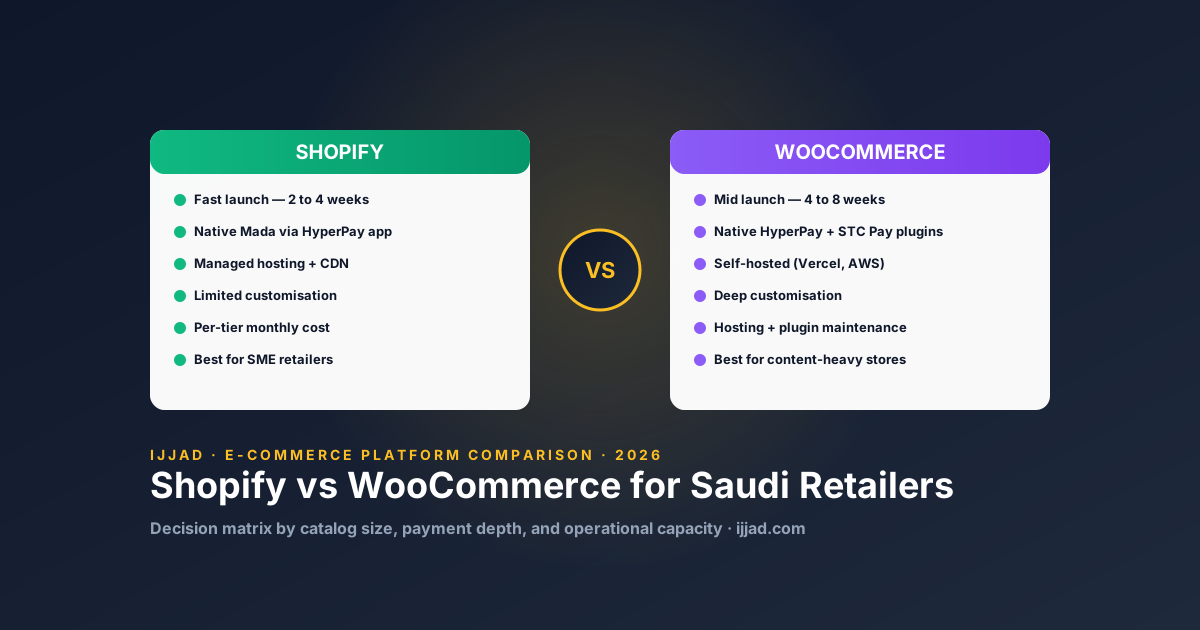
What about WooCommerce as a fourth option?+−
Can I migrate my Zid store to Shopify?+−
Does Ijjad build Salla, Zid, or Shopify stores?+−
When should Ijjad be involved instead of a hosted platform?+−
What scope is needed for a custom e-commerce build in Saudi Arabia?+−
Ready to ship your Saudi e-commerce store?
Free custom-build discovery call. Hosted platforms are comparison points only; Ijjad scopes custom websites and custom e-commerce systems.
Get StartedRelated reading on Ijjad:
Source note
Market context: Saudi Arabia's digital economy reached 16.0% of GDP in 2024, according to the General Authority for Statistics, published December 31, 2025. This is why Ijjad treats modern websites, SEO, e-commerce, AI MVPs, and mobile experiences as business infrastructure across Saudi Arabia, Jordan, Iraq, and the GCC.