Shopify vs WooCommerce for Saudi e-commerce in 2026 — Mada/STC Pay integration depth, Tabby and Tamara native BNPL, ZATCA Phase 2 e-invoicing, scope band by catalog size, and the operational reality of running each in KSA.
Shopify or WooCommerce for a Saudi e-commerce store in 2026?
Shopify and WooCommerce are common Saudi e-commerce choices, but they are not Ijjad build services. Ijjad only builds custom websites and custom e-commerce systems; use this comparison to decide whether a hosted or plugin-based platform is enough or whether custom development is justified.
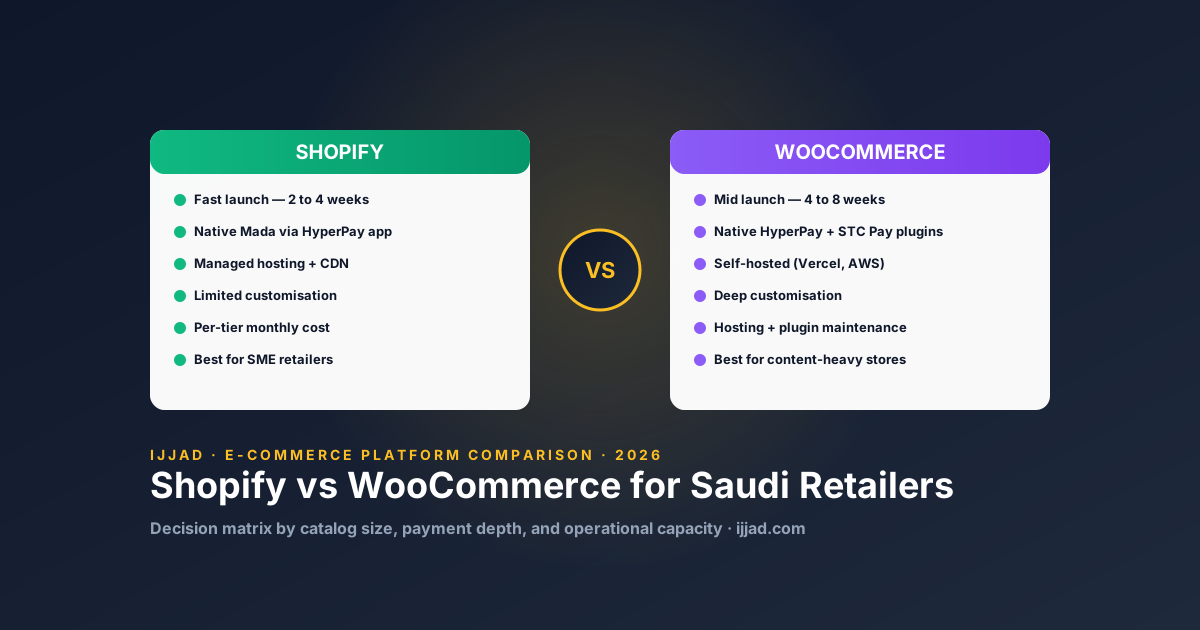
- Shopify: 2-4 weeks launch, managed hosting, native Mada via HyperPay, limited customisation
- WooCommerce: 4-8 weeks launch, self-hosted, native Mada and STC Pay plugins, deep customisation
- Both handle Tabby and Tamara BNPL natively; both handle ZATCA Phase 2 e-invoicing
- Decision factors: launch speed, catalog scale, customisation depth, team capacity, cost trajectory
- Saudi-native alternatives (Salla, Zid) worth considering for pure SME local retail
Last reviewed by Karam Abdalqader
Every Saudi retailer launching e-commerce in 2026 faces the same first decision: Shopify or WooCommerce? The honest answer depends on launch speed need, catalog complexity, customisation depth, team capacity, and growth trajectory. This page walks through the full decision matrix as buyer education; Ijjad only builds custom websites and custom e-commerce systems, including the +340% conversion-rate redesign for a Jeddah store covered in our case study at /case-study-ecommerce-jeddah.
One thing upfront: there is no single right answer. Both platforms can work for Saudi e-commerce; the question is which fits your specific situation. Ijjad does not build or configure either platform, so this is buyer education rather than a claim about our delivery history. The decision matters because changing platforms later costs meaningful migration work.
Why this is the decision every Saudi retailer faces in 2026
Saudi e-commerce has matured to the point where platform choice meaningfully affects business trajectory. Vision 2030 entertainment expansion drove consumer spending into new categories. International brands launched localised Saudi stores (Net-a-Porter, Farfetch, ASOS, Zara, H&M, and dozens more in fashion plus parallel expansions in electronics, beauty, home, F&B). Saudi-native brands scaled aggressively (Solitaire, Boutiqaat, Yasmina, Sivvi, plus dozens of independent designer brands). The competitive baseline rose; templated 2019-era stores feel obsolete.
Platform choice in 2026 affects three things directly. One: launch speed. Saudi retailers competing for seasonal moments (Ramadan, Eid, Saudi National Day, year-end sales) need predictable launch timelines. Two: payment integration depth. Saudi consumers expect Mada, STC Pay, Apple Pay, and BNPL (Tabby/Tamara) as first-class options not redirects. Three: operational overhead. Saudi SME teams running on lean operations cannot afford weekly plugin update emergencies; managed platforms reduce this surface.
The platforms Saudi retailers actually choose between in 2026 are Shopify, WooCommerce, the Saudi-built Salla and Zid, and custom builds. No public dataset splits Saudi stores by platform in a way we can check, so this page does not publish a share it cannot source; the Shopify vs WooCommerce question is simply the one that arrives in our briefs most often. Salla and Zid are legitimate alternatives we cover in section 10.
Shopify for Saudi retailers — strengths and limits
Shopify works well for Saudi SME retailers who want the fastest possible launch (2-4 weeks for a standard store) with managed hosting, native Mada integration via HyperPay or Network International apps, and a smooth admin interface. Shopify Plus extends to Saudi enterprise retailers needing higher catalog scale, multi-currency support, B2B wholesale workflows, or international market expansion alongside Saudi presence.
Where Shopify shines for Saudi: managed hosting (no DevOps overhead, Shopify CDN handles performance globally including Saudi mobile network conditions), native Mada integration via official HyperPay or Network International apps with smooth checkout flow, Apple Pay native via Shopify Pay (very high penetration on Saudi iPhones), Tabby and Tamara official Shopify apps with clean BNPL integration, lower total operational overhead because Shopify handles platform updates and security patches automatically.
Where Shopify limits Saudi work: theme-dependent bilingual Arabic-English support (not all themes handle RTL cleanly, especially in checkout/account/email surfaces), Liquid template language constraints when deep customisation is needed, monthly platform fee plus transaction fees that grow with order volume (becomes meaningful above 10,000 monthly orders), ZATCA Phase 2 e-invoicing flexibility lower than WooCommerce (works via Fatoorah or custom but less control), App Store dependency for some Saudi-specific features that exist as plugins on WooCommerce.
WooCommerce for Saudi retailers — strengths and limits
WooCommerce works well for Saudi content-heavy retailers, businesses with existing WordPress investment, and stores needing deep customisation that Shopify Liquid templates do not support. WooCommerce is also the right call for Saudi merchants who anticipate scaling to high order volumes (10,000+ monthly orders) where Shopify transaction fees become meaningful.
Where WooCommerce shines for Saudi: full PHP and WordPress code access for deep customisation of product flows, checkout, account management, and admin workflows, content depth via underlying WordPress (blogs, brand stories, lookbooks, editorial features integrated with product pages), bilingual Arabic-English RTL via WPML or Polylang plugins with full control across all surfaces including checkout and email templates, ZATCA Phase 2 e-invoicing via flexible plugins (Hyvor ZATCA, Booster modules, custom integrations) with more control than Shopify gives, flat-ish cost trajectory at scale (hosting + plugins) versus growing Shopify transaction fees.
Where WooCommerce limits Saudi work: self-managed hosting requires explicit choice and ongoing management (Vercel, AWS, or specialised WordPress hosting like Kinsta or WP Engine), plugin maintenance and update cycles need attention (occasionally plugin updates break unexpectedly and require fixes), launch timelines longer than Shopify (4-8 weeks for standard store vs 2-4 weeks Shopify), in-house WordPress competence or ongoing developer relationship needed for maintenance beyond launch, performance on Saudi mobile networks depends heavily on hosting choice (Shopify CDN consistently fast; WooCommerce only as fast as your hosting plus configuration).
The full 12-dimension comparison matrix
Side-by-side across the dimensions that matter for Saudi e-commerce:
| Dimension | Shopify | WooCommerce | Verdict for KSA |
|---|---|---|---|
| Launch timeline (5-10 page store, ~500 SKUs) | 2–4 weeks | 4–8 weeks | Shopify for speed |
| Native Mada integration | Via HyperPay or Network International app (easy) | Native Mada plugin available (easy) | Tied |
| Native STC Pay integration | Via STC Pay app (easy) | Native STC Pay plugin (easy) | Tied |
| Apple Pay integration | Native Shopify Pay + Apple Pay | Via Stripe or HyperPay | Shopify smoother |
| Tabby/Tamara BNPL native | Official Shopify apps (clean) | Official plugins (clean) | Tied |
| ZATCA Phase 2 e-invoicing | Via Fatoorah app or custom | Via ZATCA-compliant plugins (Hyvor, Booster) | WooCommerce more flexible |
| Bilingual Arabic-English RTL | Theme-dependent; not all themes solid | WPML or Polylang; full control | WooCommerce more reliable |
| Catalog scale (10,000+ SKUs) | Shopify Plus required; smooth | Hosting must scale; works | Shopify Plus for scale |
| Customisation depth | Liquid template + apps; limited | Full PHP/WP code access | WooCommerce wins |
| Performance on Saudi mobile networks | Shopify CDN; consistently fast | Depends on hosting choice | Shopify safer default |
| Maintenance overhead | Shopify handles platform updates | Self-managed plugin and core updates | Shopify lower lift |
| Total cost trajectory at scale | Monthly fee + transaction fees grow | Hosting + plugins flat-ish | WooCommerce cheaper at scale |
Most rows tie or come close to even. The dimensions where one platform decisively wins are: launch speed (Shopify), customisation depth (WooCommerce), maintenance overhead (Shopify), total cost at scale (WooCommerce), and bilingual reliability (WooCommerce). The right answer depends on which of those dimensions matter most for your specific business.
Payment integration depth — Mada, STC Pay, Tabby, Tamara
Saudi payment integration is the area where most agencies build below the bar. Saudi consumers expect Mada (the Saudi domestic card scheme, near-universal adult adoption), STC Pay (mobile wallet, strong urban penetration), Apple Pay (heavy iPhone usage in KSA), and Tabby and Tamara BNPL as first-class options. WebView-based payment flows damage Saudi consumer trust: a checkout that bounces the buyer into a WebView loses people at the exact step where trust matters most, and Ijjad publishes no drop-off percentage for it because no measured dataset exists.
Shopify payment depth for Saudi: Mada via HyperPay or Network International official Shopify apps (both handle Saudi cards cleanly), STC Pay via official STC Pay app, Apple Pay native through Shopify Pay, Tabby and Tamara via official Shopify apps with clean checkout integration. We typically wire 4-5 payment gateways at launch on Shopify Saudi stores. Drop-off is low because all integrations stay within native checkout.
WooCommerce payment depth for Saudi: Mada via WooCommerce HyperPay plugin or native HyperPay integration, STC Pay via WooCommerce STC Pay plugin, Apple Pay via Stripe or HyperPay integration, Tabby and Tamara via official WooCommerce plugins. Similar depth to Shopify with slightly more flexibility in customising the checkout flow. Plugin maintenance attention needed; an out-of-date payment plugin can break Saudi checkout silently.
ZATCA Phase 2 e-invoicing on both platforms
ZATCA (Zakat, Tax and Customs Authority) Phase 2 e-invoicing applies to Saudi merchants meeting the revenue threshold and requires real-time invoice integration with ZATCA Fatoorah platform. Both Shopify and WooCommerce handle this — but with different approaches.
Shopify ZATCA approach: Fatoorah official Shopify app handles the integration. Configuration straightforward; UI shows ZATCA submission status per order; failures surface clearly. Customisation of invoice format is limited to what the app exposes. For most Saudi Shopify clients this is sufficient.
WooCommerce ZATCA approach: Multiple plugin options (Hyvor ZATCA, Booster for WooCommerce ZATCA module, custom WordPress plugins) with more flexibility in invoice format, branding, and integration with downstream accounting systems. Higher complexity to set up correctly but more powerful for businesses with custom accounting workflows or complex invoice requirements (separate VAT entities, multi-warehouse, marketplace-style multi-seller setups).
Both approaches work. For straightforward retail with single VAT entity, Shopify Fatoorah app is simpler. For complex retail (multi-entity, marketplace, custom accounting integrations), WooCommerce flexibility helps.
Decision flowchart: which platform fits which Saudi retailer
Run yourself through this flowchart based on actual business situation:
Shopify or WooCommerce — which fits your Saudi store?
The pattern that fits most Saudi SME retailers: Shopify for first-store fast launch under 2,000 SKUs with standard product flow. The pattern that fits most Saudi content-heavy or customisation-heavy retailers: WooCommerce. The pattern that fits Saudi enterprise retail with 10,000+ SKUs or unusual workflows: Shopify Plus or custom Next.js + Saleor/Medusa. The pattern that fits Saudi SME local retail wanting fastest launch within template constraints: Salla or Zid.
If choosing between Shopify, WooCommerce, or a custom build feels harder than it should — talk to us when you are considering the custom path. Our Saudi e-commerce development service focuses on custom websites and custom e-commerce systems where performance, SEO, checkout control, and integrations matter.
Migration paths between platforms
Both directions are achievable; neither platform locks you in for life. Shopify-to-WooCommerce migration works via Shopify CSV export of product data, customer data, and order history, importing into WooCommerce, then configuring WooCommerce plugins to match the functionality your Shopify apps provided. Typical migration timeline for a 2,000-SKU Saudi store: 4-8 weeks including content audit, redirect mapping, payment integration migration, and 30 days of post-migration stabilisation.
WooCommerce-to-Shopify migration works similarly in reverse. We use WP All Export to extract products together with customers and orders to CSV in Shopify-compatible format, import into Shopify, configure Shopify apps to replace WordPress plugin functionality, redirect old URLs to new (critical for SEO preservation), and stabilise over 30 days. Migration timeline similar to the other direction.
We handle both migration directions for Saudi clients regularly. Reasons clients migrate vary: outgrowing Shopify customisation limits (move to WooCommerce or custom), tiring of WooCommerce maintenance overhead (move to Shopify), changing team capacity (in-house WordPress hire enables WooCommerce; losing dev capacity drives toward Shopify), or changing growth trajectory (high-scale move toward Shopify Plus or custom Next.js).
What about Salla and Zid — Saudi-native alternatives
Salla and Zid are Saudi-native e-commerce platforms designed specifically for Saudi SME retailers. Both handle Mada, STC Pay, and ZATCA out of the box without plugin configuration; both run Arabic-first admin interfaces; both offer fastest possible launch (often under 2 weeks) for SME retailers willing to work within template constraints. Together they hold ~27% of Saudi e-commerce platform share in 2026.
Salla: larger of the two, Saudi-headquartered, broad SME retailer base, growing internationally to UAE and Egypt. Theme library smaller than Shopify but covers most SME use cases. Strong on Saudi-specific payment and shipping integrations out of the box. Limitation: customisation depth lower than Shopify or WooCommerce; brands needing distinctive design or workflow flexibility outgrow it.
Zid: Riyadh-based, narrower focus on Saudi SME retail. Integrates with Saudi-specific delivery partners (Smsa, Aramex Saudi, Naqel) cleanly. Strong on Mada and STC Pay native support. Same limitation as Salla: customisation depth is lower than Shopify or WooCommerce.
When Salla or Zid are right: Saudi SME launching first store within 2-3 weeks, standard product flow, accepting platform template constraints, comfortable with platform monthly fees. When Shopify or WooCommerce are right instead: distinctive brand requiring custom design, content-heavy strategy, international expansion alongside Saudi presence, anticipated scale beyond SME (10,000+ SKUs or 5,000+ monthly orders).
Common mistakes Saudi retailers make in platform choice
Six mistakes we see most often when Saudi retailers pick the wrong platform — based on consultation calls and migration work from clients who came to us after platform regret. Each one is avoidable with explicit discovery work upfront.
Mistake 1 — Picking the platform before scoping the catalog
Saudi retailers often commit to Shopify or WooCommerce based on a competitor recommendation or a developer preference before mapping their actual catalog size, complexity, and growth trajectory. The right order: scope the catalog and growth plan first (current SKUs, projected SKUs in 12 months, average order volume, projected monthly orders in 12 months, customisation depth needed) then pick the platform that fits. Many Shopify-to-WooCommerce migrations stem from this pattern: Shopify chosen for fast launch, then customisation limits hit in month 6.
Mistake 2 — Underestimating Saudi payment integration complexity
Some Saudi retailers launch on either platform with only Stripe and Apple Pay, assuming Saudi customers will adapt. Saudi consumers expect Mada and STC Pay as primary payment methods; without them, buyers who only hold a mada card cannot pay at all, and no published Saudi benchmark is needed to see the effect in your own checkout analytics. The right pattern: 4-5 payment gateways at launch (Mada via HyperPay or Network International, STC Pay, Apple Pay, Tabby, Tamara for BNPL) with smart fallback logic.
Mistake 3 — Ignoring ZATCA Phase 2 e-invoicing until ZATCA flags the store
ZATCA Phase 2 e-invoicing applies to Saudi merchants above the revenue threshold and requires real-time invoice integration with the ZATCA Fatoorah platform. Some retailers launch Saudi stores without ZATCA integration assuming they will add it later. When ZATCA flags the store for non-compliance the remediation is rushed and creates downstream operational headaches. Build ZATCA compliance into launch from day one for any merchant who might cross the threshold.
Mistake 4 — Treating bilingual Arabic-English as a translation overlay
The most common Saudi UX failure on either platform: bilingual implementation as a translation layer over an English-first design. Result: checkout buttons overflow because Arabic copy is longer than English, RTL breaks in account pages because the theme was designed LTR-first, email templates ship in English only because the merchant did not commission Arabic versions. The right pattern: bilingual designed in parallel from day one with proper RTL testing across every customer-facing surface including checkout, account, emails, and SMS.
Mistake 5 — Underestimating WooCommerce maintenance overhead
Saudi retailers pick WooCommerce for the customisation flexibility, then discover the maintenance overhead (plugin updates, security patches, hosting management, periodic broken plugin updates) requires either in-house WordPress competence or an ongoing developer relationship. Without one of those, the store gradually decays — plugins go out of date, security holes emerge, performance degrades. The right call: pick WooCommerce only if you have a clear maintenance plan (in-house WordPress engineer, retained agency relationship, or specialised WordPress hosting like Kinsta or WP Engine that handles platform-level maintenance).
Mistake 6 — Picking Shopify Plus before scaling needs justify it
Some Saudi enterprise retailers jump to Shopify Plus immediately, assuming larger scale automatically warrants the higher tier. Shopify Plus features (multi-currency native, B2B wholesale, custom checkout, higher API limits) only justify the cost premium for businesses actually using those features. Standard Shopify handles catalogs up to ~5,000 SKUs and monthly orders up to ~30,000 cleanly. Picking Shopify Plus before the scale demands it spends meaningfully on capacity you do not yet use.
Want help choosing the right Saudi e-commerce platform?
Ijjad only ships custom websites and custom e-commerce systems. Shopify, WooCommerce, Salla, and Zid are comparison points, not Ijjad delivery services. Free discovery call to decide whether your store needs a custom build — 60 minutes, written scope direction within 72 hours, no obligation.
Get Started →Frequently asked questions
Is Shopify or WooCommerce better for a Saudi e-commerce store in 2026?+−
Can Shopify integrate Mada and STC Pay for Saudi customers?+−
Can WooCommerce handle ZATCA Phase 2 e-invoicing for Saudi merchants?+−
Which platform handles bilingual Arabic-English better?+−
What about Salla or Zid — should I consider those instead?+−
Which is cheaper at scale — Shopify or WooCommerce?+−
Can I migrate from Shopify to WooCommerce later (or vice versa)?+−
Does Ijjad build Shopify or WooCommerce stores?+−
Does Ijjad work with Salla and Zid for Saudi SME clients?+−
Does Shopify vs WooCommerce determine AI search citations?+−
Ready to ship your Saudi e-commerce store?
Free custom-build discovery call. Hosted platforms are comparison points only; Ijjad scopes custom websites and custom e-commerce systems.
Get StartedRelated reading on Ijjad:
- → E-commerce development services in Saudi Arabia
- → Fashion e-commerce development Saudi Arabia (industry vertical)
- → Best headless commerce platforms for Saudi retailers
- → Best e-commerce development companies in Saudi Arabia
- → Case study: +340% conversion-rate redesign in Jeddah
- → E-commerce development services in Dubai
Source note
Market context: Saudi Arabia's digital economy reached 16.0% of GDP in 2024, according to the General Authority for Statistics, published December 31, 2025. This is why Ijjad treats modern websites, SEO, e-commerce, AI MVPs, and mobile experiences as business infrastructure across Saudi Arabia, Jordan, Iraq, and the GCC.