A concise summary of Ijjad's first-party Riyadh case: qualified leads about 3 to 9, monthly organic sessions about 1,800 to 6,300, PageSpeed 42 to 94, and the underlying evidence limits.
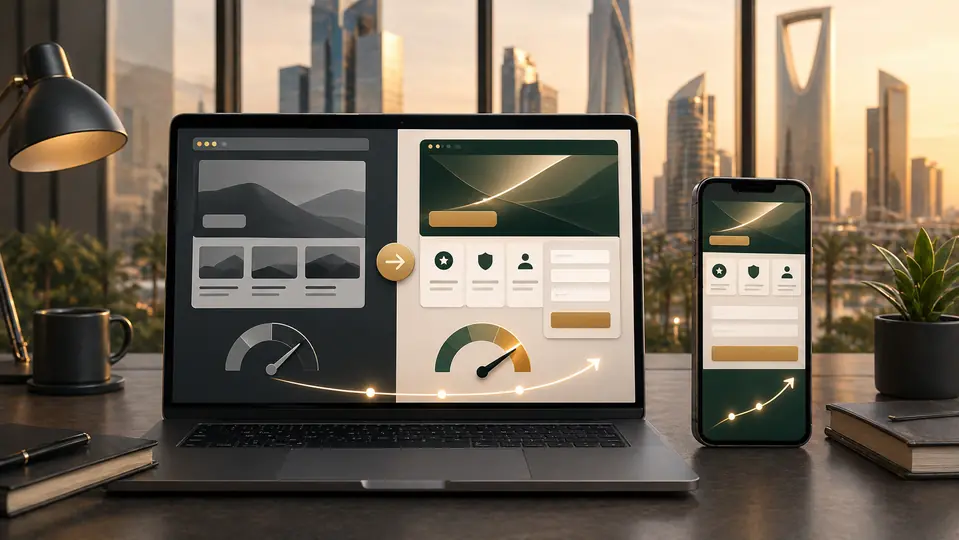
How did a Riyadh business triple its leads in 6 months?
In Ijjad's first-party analysis of an anonymized Riyadh services project, mobile PageSpeed moved from 42 to 94, bounce rate from 71% to 39%, monthly organic sessions from about 1,800 to 6,300, and qualified leads from about 3 to 9 at the six-month checkpoint. The underlying client accounts are private under NDA.
- Outcome: 3× monthly qualified leads at 6 months.
- Experience: PageSpeed 42 → 94; bounce rate 71% → 39%.
- Acquisition: monthly organic sessions ~1,800 → ~6,300.
- Delivery: 9-week rebuild and post-launch iteration on Next.js.
- Investment: scoped to the redesign, confirmed after a discovery call.
Project Snapshot
A Riyadh business services company had a slow WordPress site and an underperforming lead path. Six months after a Next.js rebuild, Ijjad's first-party analysis showed monthly qualified leads rising from about 3 to 9 and monthly organic sessions from about 1,800 to 6,300. The client and source accounts remain private under NDA, so this page explains the method and reported result rather than offering independent verification.
The Challenge: A Slow WordPress Site Bleeding Leads
The original site had been running on the same WordPress theme for over four years. Technical debt had accumulated quietly, and the business owner only noticed something was wrong when competitors with weaker services started winning more inquiries. By the time we audited the site, every fundamental metric was below the bar:
- Google PageSpeed score of 42 — evidence of a slow mobile experience that warranted investigation alongside field Core Web Vitals
- Generic theme design — looked like a thousand other WordPress sites, communicated zero brand differentiation
- Poor mobile experience — cluttered layout, tiny touch targets, slow loads on Saudi mobile networks
- Buried contact form — on a separate page, with seven required fields (a known conversion killer)
- Declining organic traffic — Google's Core Web Vitals update had pushed the site from page 1 to page 3 for its main keywords
Old Site vs Ijjad Rebuild — Side by Side
| Metric | Before (WordPress) | After (Ijjad / Next.js) |
|---|---|---|
| PageSpeed mobile | 42 | 94 |
| Monthly leads | ~3 | ~9 |
| Bounce rate | 71% | 39% |
| Schema markup | None | 5 types (Org · Service · FAQ · Breadcrumb · LocalBusiness) |
| Contact form fields | 7 required | 3 required |
The Solution: Five Connected Workstreams
This was a complete rebuild, not a patch. Performance, content, conversion paths, search foundations, and regional UX changed together; the available data does not assign a fixed share of the reported lead result to any one workstream.
1. Modern Tech Stack on Next.js
We replaced the bloated WordPress theme with a custom Next.js build. Server-side rendering, image optimisation, code splitting, and edge caching moved the reported mobile PageSpeed score from 42 to 94. Google documents Core Web Vitals as part of page experience, but this case changed performance, content, structure, and conversion paths together, so the data does not assign the ranking movement to speed alone. The web performance guidance is at web.dev/articles/vitals.
2. Clearer Messaging and Content Structure
We rewrote the site's core messaging around a single value proposition, restructured service pages into focused landing pages, and added visible FAQ blocks with matching structured data where prospects' sales questions belonged on the page. Query-to-page data was then monitored in Search Console rather than assuming the markup would produce rankings.
3. Conversion-Centred Design
Every page was designed around a single goal: generate an inquiry. Specifically:
- Sticky contact CTAs visible on every page without scrolling
- Contact form simplified from 7 fields to 3 (name, phone, brief description)
- Permissioned first-party project evidence and anonymised testimonials where client identity remained private
- WhatsApp click-to-chat alongside a short form so visitors could choose a contact path
- Service-specific landing pages with CTAs tailored to each service line
4. Full SEO Foundation
We built comprehensive SEO into every page:
- Schema markup:
Organization,Service,FAQPage,BreadcrumbList,LocalBusiness - Internal linking architecture connecting all service and location pages
- Proper heading hierarchy (H1–H4) with target keywords placed naturally
- Owner-provided business-profile details reviewed and linked to the canonical website where applicable
- XML sitemap,
robots.txt, and structured data validated against the Google Rich Results test
5. Saudi-Specific UX Details
Small details, big cumulative effect:
- Phone numbers formatted for Saudi (+966) and Jordanian (+962) markets
- WhatsApp integration as an optional contact channel alongside the form
- Working hours displayed in AST (Arabia Standard Time) — not whatever the host timezone defaulted to
- Clear requirements and engagement-fit guidance without publishing a one-size-fits-all price
Sound familiar? If your site is slow, English-only, or hard to contact, measure the current experience before choosing a rebuild. Request a scoped review of the gaps that can be checked from your site and owner-provided data.
The PageSpeed Story: 42 → 94
PageSpeed is a useful lab diagnostic, while field Core Web Vitals describe real-user experience. The project tracked both alongside engagement and search outcomes; the figures below should not be read as proof that performance alone caused the lead or ranking change.
Use PageSpeed and Lighthouse to reproduce template-level performance issues under stated test conditions.
Review real-user Core Web Vitals when the site has enough eligible traffic; do not infer them from a lab score.
Test important templates on realistic mobile devices, networks, content, third-party integrations.
Protect image, font, JavaScript, layout-shift, and server-response budgets as the site changes.
The Results — Six Months Live
Measurement note: these are Ijjad-reported, first-party figures from an anonymized client engagement. The canonical comparison uses client GA4, Google Search Console, and CRM data across comparable pre-launch and months 4–6 post-launch windows. The underlying accounts are private under NDA; see the full methodology and endpoint table.
Ijjad completely transformed our online presence. Our new website generates more qualified inquiries than the old one, and the team understood our market and delivered what we needed.
Anonymized first-party client testimonial published by Ijjad; not a native platform review. Underlying client records are private.
— Business Owner, Riyadh · anonymized first-party testimonial
The Pattern: Why So Many Saudi Business Sites Look Like This
This case illustrates why an old site should be diagnosed before it is redesigned. Performance, messaging, information architecture, and contact friction can interact, but the material constraint differs by business and must be measured.
In this project, several changes moved together, so the available first-party data cannot isolate one feature as the cause of the reported 3x lead comparison. That is why another site starts with its own baseline rather than this outcome.
From understanding to leads
This first-party case explains the measured baseline, implementation, and reported six-month endpoint. Your site needs its own evidence-led diagnosis because market conditions, traffic, offer, content, and execution differ.
Talk to Ijjad about your websiteFAQ
How did Ijjad triple the client's leads?
Ijjad's first-party analysis shows several changes moved together over six months: mobile PageSpeed increased from 42 to 94, bounce rate moved from 71% to 39%, monthly organic sessions increased from about 1,800 to 6,300, and the contact path became shorter. Qualified leads increased from about 3 to 9 per month. The data does not isolate one change as the sole cause.
How is a website redesign scoped in Saudi Arabia?
A professional Saudi business website redesign is scoped around the work required: page count, Arabic-English content, custom features, integrations, migration risk, and post-launch support. Ijjad provides a detailed proposal after reviewing the current site and project goals; this case study is not a payback forecast for another business.
Will a redesign hurt my existing Google rankings?
A redesign can lose rankings if URLs, content, internal links, or metadata are changed without a migration plan. Ijjad maps redirects, preserves useful content and metadata, validates structured data, and monitors Search Console after launch when the owner supplies access. No agency can guarantee unchanged rankings.
What does Ijjad include in a website audit?
The review can cover PageSpeed and Core Web Vitals, mobile usability, supported schema, internal linking, public search signals, owner-provided Search Console data, and the conversion path. The output is a prioritized scope, not a ranking or lead guarantee.
How long did the Riyadh redesign take?
The published project record covers nine weeks: one week of audit and strategy, four weeks of design and build, one week of testing and launch, and three weeks of post-launch CRO and SEO iteration. The 3x lead comparison uses the six-month checkpoint, not the launch date.
Can Ijjad replicate this Riyadh result for my business?
No specific multiplier can be replicated or promised. The first-party record shows several changes moving together, so it does not isolate one cause. A new engagement starts with its own baseline, scope, market conditions, acceptance criteria, and measurement window.
Does Ijjad work with other Saudi cities besides Riyadh?
Yes. Ijjad is based in Amman and serves Saudi Arabia as a service market, including Riyadh, Jeddah, Dammam. A service-area page does not imply a physical office in that city.
Is your website holding your business back?
If your site is slow, English-only, or not generating leads, Ijjad can review the available evidence, identify the highest-priority constraints, and scope the next step. Saudi-aware rebuilds start after discovery.
Keep exploring: Ijjad Web Design Services · Free Website Analyzer · Mihbaj Ordering Platform Case Study · Jeddah E-Commerce Case Study
Source note
Market context: Saudi Arabia's digital economy reached 16.0% of GDP in 2024, according to the General Authority for Statistics, published December 31, 2025. This is why Ijjad treats modern websites, SEO, e-commerce, AI MVPs, and mobile experiences as business infrastructure across Saudi Arabia, Jordan, Iraq, and the GCC.