React Native vs Flutter for 2026 — talent availability, ecosystem maturity, native module needs, GCC fintech/B2B app fit, App Store and Play Store launch reality. Decision matrix informed by an Ijjad-reported 20+ Saudi enterprise digital products.
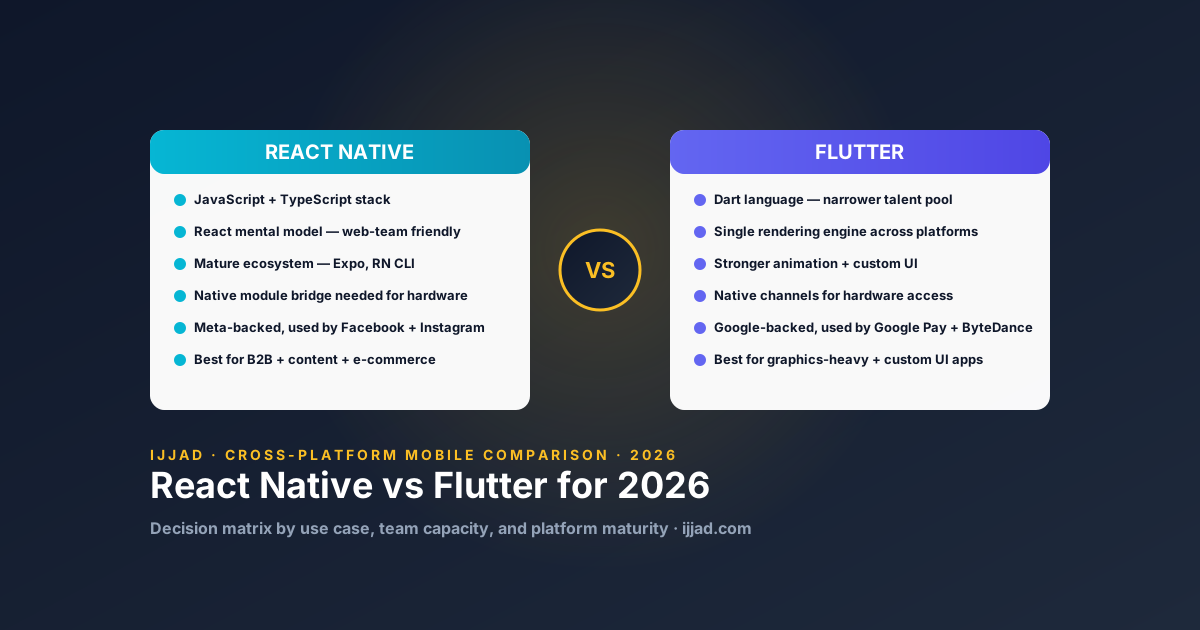
React Native or Flutter for a 2026 mobile app?
React Native and Flutter can both ship production apps successfully. The best fit depends on existing team skills, native-module needs, UI ambition, long-term maintenance, and current payment and device-integration requirements. Ijjad validates those constraints during discovery rather than treating one framework as a universal default.
- React Native: shortlist when an existing React/TypeScript team can own the app and its native modules
- Flutter: shortlist when the team can own Dart and the product benefits from Flutter's rendering model
- Native iOS and Android: consider when profiling, hardware, platform APIs, or vendor SDKs justify direct native work
- Saudi payments: verify every provider's current official SDK, plugin, API, sandbox, and supported versions
Last reviewed by Karam Abdalqader
GCC teams planning a shared mobile codebase often compare React Native and Flutter. Both can ship production apps. The right answer depends on the existing team's skills, the app category, how ambitious the UI is, the provider and device integrations, and who owns the code long term. This page uses those constraints instead of an unsupported delivery-history claim.
This is not a universal winner exercise. A poor fit can create a costly rewrite, but migration scope varies with the architecture, the native modules, the tests and the size of the product. The safer decision comes from a technical spike on the highest-risk UI and integration, followed by a maintenance plan the actual team can own.
Why this decision matters for 2026 GCC mobile teams
GCC teams use React Native, Flutter or native development, depending on the product constraints. The choice affects who can maintain the code, how the interface is rendered, and how much direct platform work the product needs. No reliable MENA project-share dataset was found for this page, so the decision summary below is qualitative rather than a market-share chart.
The source-backed architectural difference is more useful than a popularity claim. React Native documents a component model that maps to native platform views, while Flutter documents its own widget and rendering pipeline. Both expose supported ways to call platform-specific code. Review the current React Native architecture documentation and Flutter architectural overview against the versions your team plans to ship.
Evaluate four things directly: team ownership, the hardest UI behavior, required native or vendor integrations, and long-term release maintenance. Hiring and cost should be tested against current candidates and the existing team rather than a broad GCC talent assumption. For Saudi payment methods, the decisive evidence is the provider's current official SDK or plugin, its API, its sandbox and its support commitment for the exact framework version.
Where each mobile approach fits
Use this as a shortlist, then validate the highest-risk workflow in code before choosing:
Qualitative decision summary
Where each mobile approach fits
React Native
Shortlist when: Teams that already own React and TypeScript code, and products that benefit from React Native's platform-component model.
Verify first: Prototype the hardest screen and confirm every required device or provider integration against current official documentation.
Flutter
Shortlist when: Teams comfortable owning Dart and products that need a tightly controlled visual system across supported platforms.
Verify first: Prototype demanding motion and confirm every required plugin, platform channel, and release target.
Native iOS + Android
Shortlist when: Products whose critical workflows depend on direct platform APIs, specialist hardware, or vendor SDKs that are not suitable through a bridge.
Verify first: Use profiling and vendor requirements to justify separate native implementations; do not assume native is automatically faster or safer.
React Native — strengths and limits
React Native is a practical candidate when the team already owns React and TypeScript, wants to use platform-backed UI components, and can maintain any native modules the product requires. Web React experience helps with component and state concepts, but mobile navigation, device APIs, accessibility, app lifecycle, and store delivery still require mobile-specific knowledge.
Where React Native can fit: an existing React team can reuse language and some engineering practices. React Native documents Fast Refresh and a supported path for native platform code. Treat Expo, third-party libraries, and over-the-air update choices as architecture decisions with current platform-policy and dependency checks, not automatic advantages.
What to verify: prototype the demanding motion, the scrolling, the startup and the native integrations on representative devices. Confirm that required libraries support the planned React Native version and that the team can own any Swift or Kotlin module. Performance and release size must be measured from the proposed app; generic framework ranges are not reliable estimates.
Flutter — strengths and limits
Flutter is a practical candidate when the team can own Dart and wants Flutter's widget and rendering model for a controlled visual system. That model can be useful for custom interfaces, but it does not remove platform-specific behavior, accessibility work, device testing, or store requirements.
Where Flutter can fit: the framework offers a cohesive widget system, animation APIs, documented hot reload, and platform channels. Teams with established Flutter ownership may value that consistency. A prototype should still test the hardest visual states, the Arabic and English layouts, then accessibility and behavior on the target devices.
What to verify: confirm that the delivery and maintenance teams can own Dart, then audit each required plugin and platform channel against the target Flutter version and the target iOS and Android versions. Measure release footprint and critical interactions from a release build. Do not infer Saudi payment support from the framework name.
The full 12-dimension comparison matrix
Side-by-side across the dimensions that matter for GCC mobile project decisions:
| Dimension | React Native | Flutter | Decision check |
|---|---|---|---|
| Language | JavaScript or TypeScript | Dart | Prefer the language the team can maintain and review confidently. |
| Existing team fit | Natural candidate for an established React team | Natural candidate for an established Flutter/Dart team | Existing ownership can outweigh generic framework preferences. |
| Hiring | Assess current React Native candidates in each hiring market | Assess current Flutter candidates in each hiring market | Use live applicants and recruiters; regional talent claims age quickly. |
| UI rendering model | Uses React Native components that map to platform views | Uses Flutter's own widget and rendering pipeline | Choose based on the intended platform feel and visual-control requirement. |
| Animation and custom UI | Capable, with architecture depending on the design | Capable through Flutter's rendering and animation APIs | Prototype the hardest interaction on target devices before deciding. |
| Native integrations | Native modules may be required when a maintained library is unavailable | Platform channels or native plugins may be required | Verify the exact API and plugin maintenance for the target versions. |
| Release footprint | Depends on the assets, the dependencies, the target architectures and the build settings | Depends on the assets, the dependencies, the target architectures and the build settings | Compare release builds from the proposed app, not generic size ranges. |
| Performance | Profile critical interactions and move suitable work to native code when needed | Profile critical interactions and use platform code when needed | Neither framework is a universal performance winner. |
| Developer iteration | Fast Refresh is available | Hot reload is available | Team fluency, test coverage, CI, app complexity: these determine actual velocity. |
| Framework stewardship | Open-source framework led by Meta | Open-source framework led by Google | Review current release notes, support policy, and dependency health. |
| Saudi payment integrations | Support depends on each provider's current SDK, plugin, API, sandbox | Support depends on each provider's current SDK, plugin, API, sandbox | Get provider confirmation for the exact framework and version; plan a native bridge when required. |
| Custom branded UI | Can deliver custom design while retaining platform-component behavior | Offers direct control through Flutter's widget and rendering system | Use a design prototype to choose between platform feel and shared visual control. |
The matrix does not declare a universal winner. An established React team may favour React Native; an established Flutter team may favour Flutter. Custom rendering can strengthen Flutter's case, while platform-component requirements can strengthen React Native's. Release footprint, performance, staffing, integrations: each needs project-specific evidence.
GCC fintech app fit — where ecosystem maturity matters
A Saudi or GCC fintech product should not choose a framework from a package-maturity claim. Build an integration register for every gateway, wallet, BNPL provider, identity service, analytics dependency, and device capability. For each one, record the current official SDK or plugin, supported framework and OS versions, sandbox access, maintenance owner, and production-support route.
SAMA compliance is a question of product design and legal review, of operations and of security architecture rather than a React Native-versus-Flutter feature. Either framework may require Swift or Kotlin work for secure storage, biometrics, certificate handling, or a provider SDK. Confirm the applicable rules with the regulated entity and security advisers, then test the actual implementation.
The framework shortlist should survive a working sandbox test for the hardest regulated flow. If the provider supports only native iOS and Android SDKs, compare the cost and ownership of bridges in both frameworks; if neither bridge is supportable, direct native development may be the safer option. Our Saudi fintech app development guide covers the wider discovery questions.
Decision flowchart by use case + team capacity
Run yourself through this flowchart based on actual app category and team situation:
React Native or Flutter — which fits your 2026 mobile project?
The flowchart creates a shortlist, not a final architecture. Run a technical spike on the hardest screen, one critical native or provider integration, and a release build on representative devices. The result may favour React Native, Flutter, a cross-platform app with targeted native modules, or separate native applications.
When to consider native iOS and Android
Keep native iOS (Swift) and Android (Kotlin) on the shortlist when direct platform ownership solves a documented requirement that a maintained cross-platform bridge cannot satisfy cleanly. Common triggers include:
- Graphics-heavy apps with custom OpenGL, Metal, or Vulkan rendering needs (advanced AR experiences, gaming-adjacent apps, advanced computer vision).
- Deep hardware integration with POS hardware, IoT devices, advanced sensor work, NFC payment terminals, biometric reader integration beyond standard Face ID/Touch ID.
- Measured performance constraints in workflows such as professional audio, low-latency media, or advanced on-device processing.
- Platform-specific features that the product must support before a suitable cross-platform abstraction is available.
These conditions do not make native development automatically necessary. A cross-platform shell with focused native modules may still meet the requirement. Compare the prototypes, the staffing, the release operations, then accessibility and long-term ownership before funding two native codebases.
Common framework choice mistakes
These mistakes all come from choosing by reputation instead of testing the proposed team, the interface, the integrations and the maintenance model.
Mistake 1 — Picking Flutter for the wrong reasons
A single codebase does not guarantee simple delivery. Pick Flutter when the team can maintain Dart and a prototype shows that its rendering model helps the product. Standard B2B and e-commerce apps can work in either framework; integrations and ownership usually matter more than visual consistency alone.
Mistake 2 — Underestimating Dart talent constraint in GCC
Do not assume Dart talent is scarce or React Native talent is abundant across every GCC hiring market. Test the current pipeline with recruiters and real candidates in the locations where the team will hire. Include seniority, mobile experience, compensation, retention, code-review ownership in that check.
Mistake 3 — Picking React Native without measuring animation needs
Existing React experience is useful, but it does not prove the proposed team can deliver demanding mobile motion or platform behavior. Prototype the hardest interaction in React Native and Flutter when visual execution is a core product risk, then compare maintainability and device results.
Mistake 4 — Underestimating native module bridge complexity
Both frameworks can require native work for platform APIs, security controls, hardware, or vendor SDKs. Inventory those dependencies during discovery and identify who will maintain the Swift and Kotlin code. Cross-platform development can reduce duplicate application code, but it does not promise zero native code.
Mistake 5 — Migrating frameworks without strong business justification
A React Native-to-Flutter or Flutter-to-React Native migration can require substantial UI and platform rework. Size it from the actual codebase, test coverage, native modules, backend boundaries, and feature roadmap. Migrate only when a documented business or technical constraint outweighs the rewrite and dual-running risk.
Need help choosing the right framework for your GCC mobile project?
Ijjad evaluates React Native, Flutter or native development during discovery. We map the current team, hardest interface behavior, provider and device integrations, release requirements, and maintenance ownership before recommending an approach.
Get Started →Frequently asked questions
Should I pick React Native or Flutter for a 2026 mobile app?+−
Is React Native or Flutter faster to develop in?+−
Does Flutter support Mada and STC Pay for Saudi fintech apps?+−
Which has a larger talent pool in the GCC?+−
Which has better animation and custom UI?+−
Can I migrate from React Native to Flutter or vice versa?+−
What about native iOS and Android development?+−
Does Ijjad build with both React Native and Flutter?+−
Which framework should a Saudi fintech app use?+−
How long does a React Native or Flutter MVP take?+−
Ready to ship your GCC mobile app?
Free framework-choice discovery call. We pick React Native, Flutter, or native per app fit — not per agency preference.
Get StartedRelated reading on Ijjad:
Source note
Market context: Saudi Arabia's digital economy reached 16.0% of GDP in 2024, according to the General Authority for Statistics, published December 31, 2025. This is why Ijjad treats modern websites, SEO, e-commerce, AI MVPs, and mobile experiences as business infrastructure across Saudi Arabia, Jordan, Iraq, and the GCC.