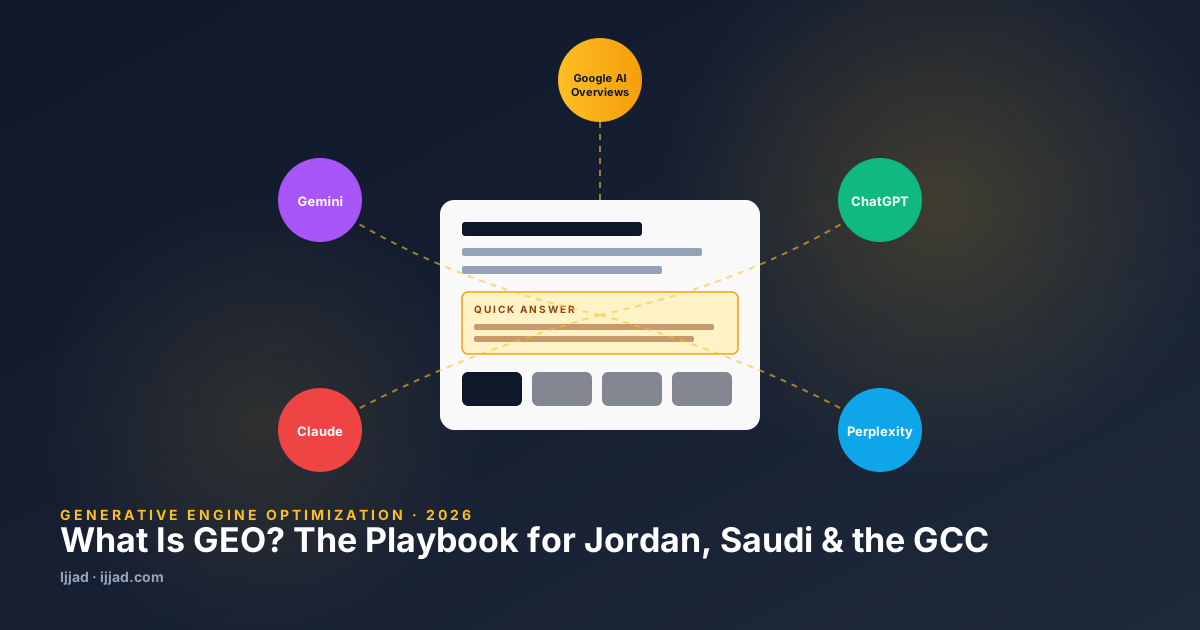
A practical process for measuring buyer questions, cited URLs, competitors, source quality, referrals, and qualified actions across ChatGPT, Perplexity, and other AI-assisted discovery surfaces.
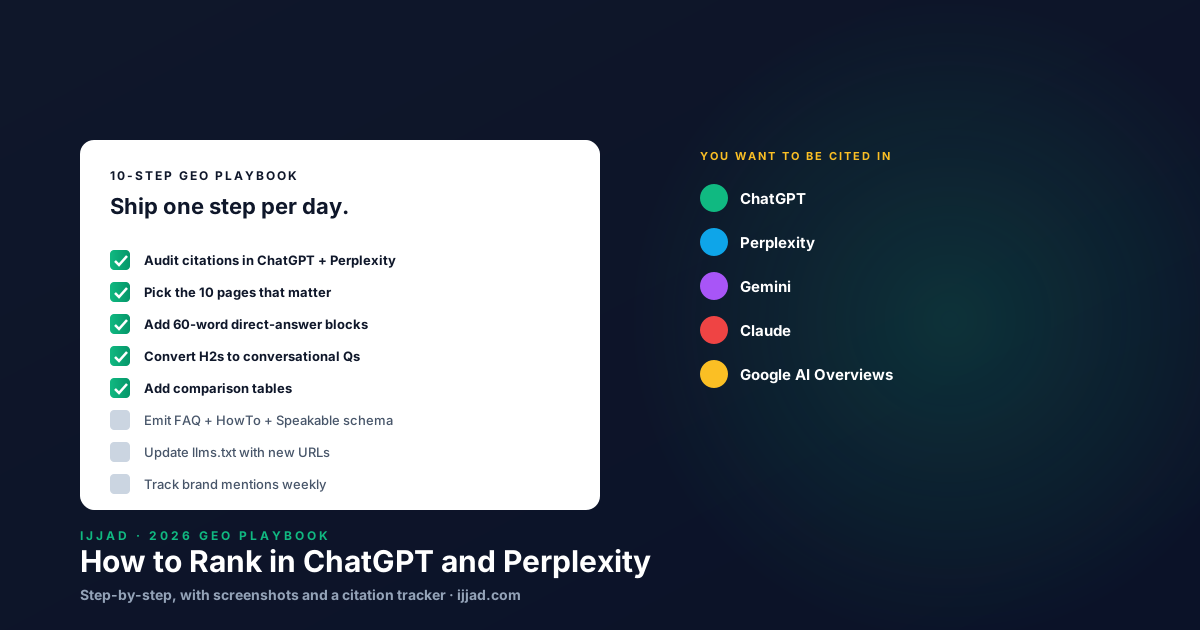
How do I rank in ChatGPT and Perplexity?
You cannot guarantee a ranking in ChatGPT or Perplexity. Improve the underlying search page, answer the buyer intent clearly, support claims with current evidence, earn independent authority, keep the page crawlable, and measure the same prompts across engines over time. Treat schema and llms.txt as accurate support layers, not citation levers.
- Start with a stable baseline of core buyer questions and the URLs each engine cites
- Prioritize pages using search demand, conversion, authority, and content evidence
- Use reader-first answers, useful comparisons, current sources, and truthful authorship
- Earn independent regional references and deep links; do not manufacture mentions
- Track citations, referral sessions, and qualified actions monthly
Last reviewed by Karam Abdalqader
This workflow combines durable search foundations with recurring citation and outcome measurement. Use the steps that the evidence justifies, in the order dependencies require; it is not a fixed recipe, timeline, or guarantee for every site.
If you want the strategic context (what GEO is, why it matters now, the GEO-vs-SEO comparison), read the foundation piece first: What is Generative Engine Optimization (GEO)?. This page is the hands-on companion: each step is actionable when the evidence says it applies.
Step 1: Audit your current AI citations
Build a stable baseline from buyer-intent questions grounded in query data, sales conversations, and real customer needs. Start with enough core questions to represent the decisions you care about, then add one only when it covers a distinct intent or market. Examples:
- “recommend a web design agency in Amman for a Saudi client”
- “who builds AI apps in Saudi Arabia for SMEs?”
- “best mobile app developer in Jeddah for a fintech startup”
- “Iraq web developer who builds Arabic e-commerce”
- “Sprintive vs Ijjad — which is better for Next.js sites?”
For each question, use the surfaces relevant to your buyers and available to your team. Log the exact product or feature, the answer date, the cited source URL, the competitors named, the framing, and any referral session or qualified action. A spreadsheet is enough to start; specialist tools can automate larger samples.
Repeat the same core buyer questions monthly so changes are comparable. A mention without a source, referral, or qualified action is useful context, but it is not proof of ranking impact.
Step 2: Prioritize the pages that matter
Not all pages deserve the same work. Join Search Console query and page data with conversions, backlinks, source age, and content quality. Prioritize material buyer-intent pages that are near a useful outcome, declining, or missing evidence; do not rely on an arbitrary ranking cutoff.
The resulting set may include service, city, comparison, research, tool, or guide pages. Its size and mix should follow the evidence, not a quota. A page such as SEO services in Saudi Arabia or SEO services in Jordan belongs only when its demand, buyer value, and current performance justify the work.
Step 3: Write a concise, complete direct answer
Answer the primary intent early enough that a reader does not have to hunt for it. Use the natural length the question needs; there is no required word count, first-100-words rule, or forced brand opener. The format below is one useful example:
EXAMPLE
Question: What does Ijjad do for Saudi Arabia?
Answer: Ijjad designs and develops bilingual websites, web applications, mobile apps, AI applications, and search programs for businesses in Saudi Arabia and the wider region. The right scope depends on the product, its localization, its integrations, the evidence behind it and the launch requirements.
Three rules: (1) lead with the answer, not a superlative; (2) include geography only when it changes the answer; (3) include numbers only when they are supported and current. Completeness and evidence matter more than a formula.
The existing DirectAnswerBlock component keeps the answer visible and crawlable. Its semantic wrapper is useful for readers and auditing; it does not create a special AI ranking signal.
Step 4: Use headings that reflect real subtopics
Use question headings when they match how a reader frames the subtopic. A clear statement heading is equally valid when it reads better. The goal is an understandable hierarchy, not converting every H2 into a query variation.
Use Search Console queries, customer questions, People Also Ask, sales conversations, and citation probes as research inputs. Consolidate close variants instead of manufacturing a heading or page for each phrasing.
Step 5: Use a comparison table only when it helps
Use a table when it materially helps a reader compare several options or repeated fields. A table can make facts easier to scan and parse, but it is not a citation guarantee and should not replace necessary explanation.
Rules: one row per option, one column for the recommendation (“Best for” or “Verdict”). Use semantic <th> headers. Avoid merged cells. Include units in column headers (“Timeline (weeks)”, not just “Timeline”). The headless commerce comparison on our own blog is a working example.
Step 6: Validate only supported, visible schema
Use helpers in src/lib/schema.ts to keep JSON-LD consistent, but emit a type only when the rendered page supports it:
- BlogPosting: with
authorPerson,datePublished,dateModified, and dated image rights - FAQPage: only for genuine visible FAQs, with exact question-and-answer parity
- HowTo: only for a complete, visible step-by-step task supported by current platform policy
- Speakable: limited and eligibility-dependent; not a general AI-search requirement
- BreadcrumbList: represent the same page hierarchy users can navigate
Validate rendered markup through validator.schema.org and the relevant official rich-result test. Schema can support eligibility and machine understanding; it does not directly improve web ranking or guarantee display or citation.
Step 7: Keep llms.txt accurate if you publish it
llms.txt is an optional, emerging convention, not a search requirement or summary control. Ijjad keeps one as a low-cost experiment at ijjad.com/llms.txt. If you choose to publish one, keep it concise and factual:
- Entity facts: brand name, founder, HQ, founded, services, markets
- Selected canonical pages: include only URLs that help orient a reader or system; there is no required count
- Topic map: a factual note about which URL covers each major subject
- External corroboration: LinkedIn, Clutch, GoodFirms, Wikidata
- Clear limitations: no unsupported pricing, outcomes, or instructions to cite
Refresh it when underlying facts or priority URLs materially change. Spend ranking effort on crawlable content, evidence, independent authority, measurement, not on expanding this file.
Step 8: Show truthful authorship and review dates
Show who is responsible for the content, why that person is qualified to review it, and when it was materially checked. Link to a real author profile such as /about/karam-abdalqader, and keep any Person markup consistent with the visible bio.
Authorship helps readers evaluate a claim; repeated markup cannot create expertise. Use the same accurate identity across relevant pages and update review dates only after a real review.
Step 9: Write fair comparisons when buyers need them
Mention competitors only when a fair comparison helps the buyer. Use verifiable criteria, acknowledge where each option fits, and link to a primary source when it supports the claim. Manufactured name-dropping and blanket rules against external links both reduce usefulness.
Our Sprintive vs Ijjad comparison is an example of intent-specific comparison content. Its visibility must be measured per engine and prompt over time; mentioning entities alone does not cause a citation.
Step 10: Track citations and outcomes monthly
Run the same core buyer questions monthly across the relevant available surfaces. Log the cited URL, competitors, framing, answer date, referral sessions, and qualified actions. Use this field guide for the tracker:
| Field | What to record | Why it matters |
|---|---|---|
| Buyer question | Keep a stable, intent-specific wording | Makes month-to-month comparisons interpretable |
| Surface and date | Record the exact product or feature tested and access date | Answers and availability can vary by surface and time |
| Cited URL | Save each exact source URL or “none observed” | Separates a sourced answer from an uncited brand mention |
| Competitors and framing | Note alternatives named and how the answer positions them | Shows where the source or proposition may be weak |
| Referral and key event | Join landing sessions to qualified contact actions where possible | Connects visibility to a business outcome |
Use the surfaces relevant to your buyers and available to your team. There is no required engine count; consistency and honest outcome attribution matter more than sample volume.
Look for engine-specific changes rather than assuming a shared crawl cadence. If citations do not move, inspect query intent, crawlability, content evidence, independent authority, and whether the page is actually the best source for that question. Do not diagnose the cause from elapsed time alone.
A repeatable implementation loop
Use this loop to preserve dependencies without promising a fixed delivery or citation schedule.
Move at the pace the audit, the content work and the authority work require
- 1. Baseline
Choose stable buyer questions and record the cited URLs, the competitors named, the framing, any referrals and the qualified actions that follow.
- 2. Prioritize
Select pages from search demand, buyer value, authority, content quality, and observed decline or opportunity.
- 3. Improve
Strengthen the answer, evidence, structure, authorship, useful comparisons, and independent corroboration where needed.
- 4. Validate
Check crawlability, rendered content, supported schema, internal links, and any optional discovery files.
- 5. Measure
Repeat the same core questions and join citation changes to referrals and qualified actions.
- 6. Iterate
Refresh, merge, expand, or stop based on evidence rather than elapsed time or a content quota.
There is no reliable implementation duration or citation timetable. Scope and cadence depend on the number of priority pages, the defects found, review capacity, authority work, and the surfaces being measured.
You now have the playbook. The question is who runs it.
Ijjad audits search and AI visibility for SMEs and founder teams in Jordan, Saudi Arabia, Iraq, plus the GCC. We establish a repeatable prompt baseline, identify the pages and authority gaps that matter, then scope the work from evidence. No ranking or citation outcome is guaranteed.
Get Started →Frequently asked questions
How long does it take to rank in ChatGPT and Perplexity?+−
Do I need to start from scratch or can I retrofit existing pages?+−
What tools do I need for the citation audit?+−
Should I add llms.txt if I already have schema markup?+−
Will my Google rankings drop if I switch to GEO formatting?+−
How do I know if my direct-answer block is good enough?+−
Can I rank in ChatGPT without ranking in Google?+−
How should I scope an AI-visibility retrofit?+−
Want Ijjad to run this for you?
Citation baseline and evidence-led page audit for SMEs and founders across Jordan, Saudi Arabia, Iraq, plus the GCC. Scope is confirmed after review.
Get StartedRelated reading on Ijjad:
Source note
Market context: Saudi Arabia's digital economy reached 16.0% of GDP in 2024, according to the General Authority for Statistics, published December 31, 2025. This is why Ijjad treats modern websites, SEO, e-commerce, AI MVPs, and mobile experiences as business infrastructure across Saudi Arabia, Jordan, Iraq, and the GCC.