Generative Engine Optimization explained without hacks: useful crawlable sources, accurate facts, search fundamentals, independent authority, and engine-specific citation and referral measurement.
What is generative engine optimization (GEO)?
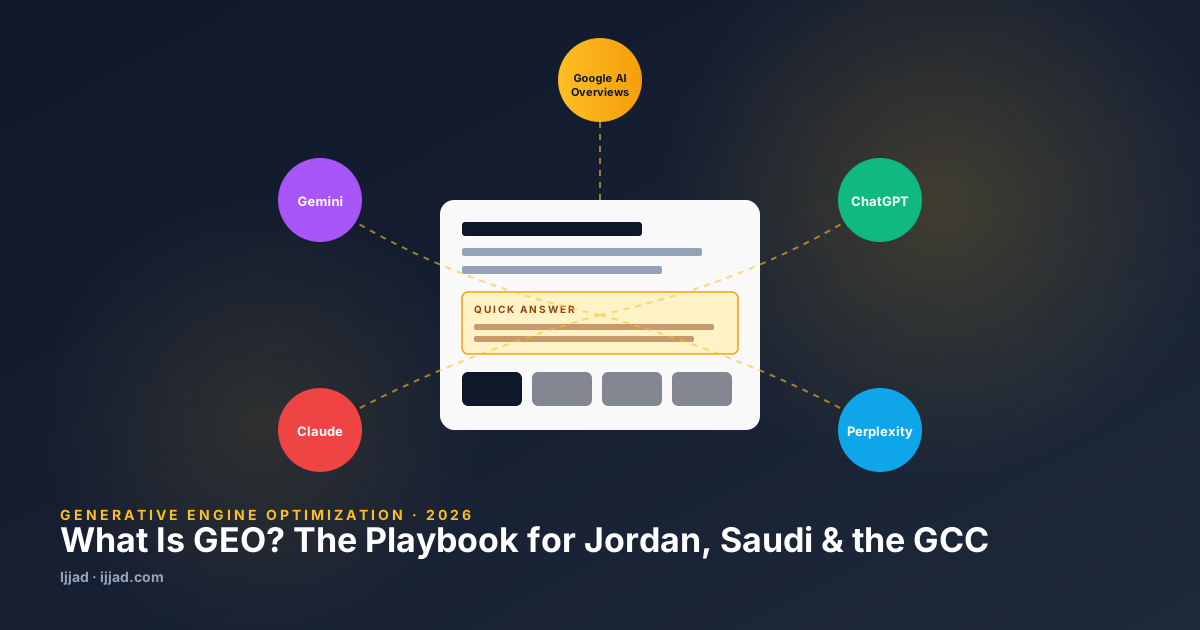
Generative Engine Optimization (GEO) applies search fundamentals, clear answers, current evidence, earned authority, and cross-engine measurement so useful web content can be found and verified across both search results and AI answer surfaces. It does not rely on a fixed page format, special AI schema, or guaranteed citation tactic.
- Keep technical SEO, crawlability, intent, internal links, and earned authority as the foundation
- Answer buyer questions clearly and support factual claims with current sources or first-party evidence
- Use schema only for visible eligible content; keep llms.txt as an optional experiment
- Measure the same core prompts across engines, then join citations to referrals and qualified actions
- Prioritize a few high-impact pages from query, conversion, backlink, and citation evidence
Last reviewed by Karam Abdalqader
A Riyadh founder researching a web agency may begin in Google, ChatGPT, Perplexity, Copilot, or another answer surface. The path varies, but the business question is the same: can the buyer find accurate, useful, independently supported information and reach a credible next step?
GEO is the part of search and content operations that measures those answer surfaces without pretending they share one ranking system. This guide explains the durable foundation, the regional considerations, and the evidence loop—without invented adoption statistics or guaranteed citation tactics.
1. What is Generative Engine Optimization?
DEFINITION
Generative Engine Optimization (GEO) applies search fundamentals, clear answers, current evidence, earned authority, and recurring measurement so useful web content can be found and verified across search results and AI answer surfaces. It is also called Answer Engine Optimization (AEO) or AI search optimization.
GEO is not a replacement for SEO. Search links still matter, while assistants, summaries, AI features add other places where a source can be named, cited, or used to frame a buyer's research. Some of those interactions generate a visit and some do not, so citation observations and qualified website outcomes must be measured separately.
A classic search position does not guarantee inclusion in an AI-generated answer, and a cited page does not have to occupy the same organic position on every query. The practical response is not to chase a special format: make priority pages accessible, useful, well sourced, and easy to verify, then measure each surface directly.
Relevant surfaces can include Google Search and AI features, Microsoft Copilot, ChatGPT, Perplexity, Gemini, Claude, and Meta AI where access permits. Do not assume one fixed engine mix for the GCC or that a tactic observed on one surface will transfer to all of them. Choose the test set from audience evidence and record results separately.
2. Why GEO matters for Jordan, Saudi Arabia, and the GCC right now
The regional case is practical rather than statistical. Saudi, Jordanian, Iraqi or wider GCC buyers can research in Arabic or English, and the useful evidence differs with the sector, the regulator, the payment stack, the city and the source ecosystem. A generic English-only prompt sample can therefore miss relevant demand.
| Question | Evidence | Use it to decide |
|---|---|---|
| Can search engines discover and index the page? | Search Console, Bing Webmaster Tools, rendered crawl checks | Repair material crawl, canonical, rendering, or internal-link defects first. |
| Is the page cited on buyer-relevant answer surfaces? | Stable prompt observations and Bing AI Performance where available | Record cited URLs and competitors by surface; do not blend them into a universal rank. |
| Does visibility create qualified demand? | Landing-page sessions, referrers, key events, and sales-source notes | Prioritize changes that connect visibility to a useful visit or qualified action. |
| Is the business independently corroborated? | Relevant editorial references, reviews, trusted profiles, and deep links | Build earned authority instead of relying on schema or self-published claims. |
Regional differentiation comes from serving those real needs better: accurate Arabic content where demand exists, clear local capabilities, current primary sources, useful pages, and independent corroboration. A direct-answer block, schema type, or early-mover claim does not create durable citation share by itself.
Third: Arabic and bilingual search creates a real service gap. Publish genuinely useful Arabic content with proper RTL UX, local terminology, and the same evidence quality as the English version. Add Arabic structured data only when it accurately represents visible Arabic content; neither FAQ schema nor translation alone makes a page the citation of choice.
For a broader regional context, see What changed for Saudi and Jordanian business websites in 2026. Treat every current-market claim there with the same rule used here: trace the source, date the observation, and avoid turning a trend into a universal buyer behavior.
3. How GEO extends SEO
Short answer: GEO is an extension of search and content operations, not a replacement channel. Page speed, crawlability, indexing, internal linking, content quality, and real authority remain foundational. Different engines use different retrieval systems, so a Google position is useful evidence but not a universal citation prerequisite.
Here's the side-by-side. Read it as: same foundation, different finishing rules.
| Dimension | SEO (2026) | GEO (2026) | Verdict |
|---|---|---|---|
| Primary surface | Google blue links (positions 1–10) | AI answer boxes inside ChatGPT, Perplexity, Gemini, Claude, Google AI Overviews | GEO for awareness, both for conversion |
| Click-to-business outcome | User clicks → lands on your page | User reads AI answer → may or may not click (zero-click reality) | SEO still wins on traffic, GEO wins on brand citation |
| Format | Use the format that best satisfies intent | Clear answers, plus tables or steps when they materially help the reader | No fixed format or length wins by itself |
| Schema markup | Supports eligible search features when accurate | The same visible-content parity rule applies | No direct ranking or citation guarantee |
| llms.txt | Optional experiment | Keep factual if published; not a summary or citation control | Do not invest ranking effort here |
| Entity clarity | Use unambiguous names where relevant | Identify people, services, places naturally | No forced entity opener or entity-stuffed H2s |
| Authorship and trust | Visible responsibility and evidence help readers | The same truthful authorship and corroboration matter | Markup cannot manufacture expertise |
| Review evidence | Accurate publication and modification dates | Visible review dates and current sources when they help the reader | Update dates only after a material review |
| Competitor comparisons | Link to useful primary sources | Name alternatives only when buyer intent requires a fair comparison | Usefulness, not manufactured entity proximity |
| Measurement | Google Search Console clicks/impressions | Brand-mention tracking, prompt-test logs, AI citation monitors | GEO measurement is still maturing |
The two rows people misunderstand most are competitor comparisons and llms.txt. Compare alternatives only when buyer intent calls for it, apply verifiable criteria, and link to a primary source when it helps substantiate a claim. Our Sprintive vs Ijjad comparison is useful because it addresses a distinct comparison need—not because mentioning two entities forces a citation.
And llms.txt? It is an optional, emerging convention—not the new robots.txt, not required for search, and not a control surface for AI summaries. We publish ours at ijjad.com/llms.txt as a low-cost experiment and keep it factual, but we do not assign ranking effort or outcome promises to it.
4. An evidence-led GEO workflow
This sequence is an operating framework, not an engine-specific ranking recipe. Start from evidence, fix the page and authority gaps that matter, validate the rendered result, and measure outcomes before expanding.
- Establish a reproducible baseline. Use a stable set of real buyer questions in the relevant languages, across the answer surfaces you can access, sized to the commercial scope. Record the prompt, the conditions, the cited URLs, the competitors named and how the answer was framed.
- Prioritize pages from evidence. Use query-to-page performance, landing-page actions, backlinks, citation observations, and strategic value. Do not choose an arbitrary number of pages or require an existing top-N rank.
- Repair material access and usability defects. Confirm indexing, canonical signals, rendered content, internal links, mobile usability, and a credible conversion path before adding more copy.
- Improve the answer only where it is weak. State the useful conclusion early, use the natural length it needs, and add headings, tables, lists, or comparisons only when they help the reader.
- Validate visible-content parity. Use only structured-data types justified by what readers can see and validate the rendered JSON-LD with validator.schema.org. Schema does not guarantee ranking, display, or citation.
- Build independent authority. Earn relevant editorial references, reviews, deep links that a reader would follow. Accurate authorship and review dates help readers, but markup cannot substitute for corroboration.
- Close the measurement loop. Re-run the stable baseline on a practical cadence and join citations to referral sessions and qualified actions. Keep
llms.txt, if used, as a factual experiment rather than a ranking control.
We've published the deeper measurement walkthrough at how to improve visibility in ChatGPT and Perplexity. The localised version for the region sits at answer engine optimization for Jordan and Saudi businesses.
5. How to choose the next action
GEO is not gated by a top-10 rank, a minimum page count, a site age, or the presence of a particular schema type. Choose the next action from page accessibility, real buyer demand, observed citation or content gaps, authority, qualified outcomes.
What should you work on next?
If the baseline does not reveal a meaningful gap, preserve it and keep measuring rather than rewriting pages for activity's sake. If it does reveal a gap, fix the smallest coherent content, access, conversion, or authority problem that the evidence supports.
New or established sites use the same evidence-led order: confirm crawlability and indexing, fix material usability defects, map priority buyer questions to useful pages, build internal links and independent authority, then measure each search and AI surface. Supported schema is an eligibility layer, not an age-based gate or citation shortcut.
If establishing the baseline and tracing the real gaps is a project you do not have time to manage, our SEO and GEO services are scoped from the evidence, page by page, for businesses across Amman, Riyadh, Jeddah, plus the wider region.
Or keep reading: we'll cover the common mistakes next, which will save you weeks even if you do this in-house.
6. Common GEO mistakes Saudi and Jordanian businesses make
These failure modes recur in GEO work, but their impact and repair time depend on the site. Diagnose the actual defect before estimating the fix.
Mistake 1: treating GEO as a separate channel
A GEO package that ignores public access, rendered content, indexing, internal links, and usability starts from the wrong end. Different search and AI crawlers have different policies, but a blocked, empty, or broken page cannot provide dependable source material. Foundations first.
Mistake 2: generic direct-answer blocks
“We are a leading provider of web design services in the GCC region.” is marketing filler, not a useful answer. State the conclusion, explain the conditions, and support factual claims. Add a brand, place, or number only when it is relevant and verified.
Mistake 3: schema present but content doesn't match
If FAQPage schema lists questions that the visible page does not show, the markup breaks visible-content parity. Render the same questions and answers or mark up only what readers can actually see; schema is an eligibility layer, not a citation shortcut.
Mistake 4: overinvesting in llms.txt
llms.txt is optional and does not control summaries or citations. If you publish one, keep it concise, factual, aligned with the visible site. Ours remains available at ijjad.com/llms.txt as an experiment; authority, useful content, and measurement receive the real investment.
Mistake 5: no measurement loop
People ship changes then stop tracking. Run the same core buyer prompts monthly, record cited URLs and competitors, and join those observations to referral sessions and qualified actions. A brand mention without a source or outcome is context, not a ranking win.
7. How to measure GEO performance
Three layers. The first is citation tracking: does each available engine cite your URL for a stable set of buyer prompts? Run the same core questions monthly across ChatGPT, Perplexity, Gemini, Claude, Copilot, Meta AI, and Google AI surfaces where access permits. Log cited URLs and competitors. A specialist tool can automate this, while a spreadsheet is enough for a small, stable sample.
Second: brand mention monitoring. Set alerts for your brand and key team names, then log the source, the context and any attributable referral or qualified action. A mention without a cited URL, traffic, or outcome is not counted as a ranking or citation win.
Third: conversion attribution. Add a free-text “Where did you first hear about us?” question to the intake form, retain referrer and landing-page evidence, and compare those signals with the citation log. Self-reported AI discovery is useful context, but it should not be presented as proof of a specific citation or tactic on its own.
For Ijjad's regional digital-readiness rubric, see the GCC SME Digital Maturity Framework 2026 — a lightweight, equal-weight practitioner self-assessment with six dimensions, transparent safeguards, and a downloadable CSV. It is not a respondent survey or industry benchmark.
You now know what GEO is. The question is whether you ship it.
Ijjad runs evidence-led GEO reviews for SMEs and founder teams in Jordan, Saudi Arabia, Iraq, plus the GCC. We start with a stable buyer-prompt baseline sized to the relevant languages and accessible surfaces, document cited URLs and unknowns, and scope any page or authority work from the observed gaps. No retainer.
Get Started →8. Frequently asked questions
What is generative engine optimization in one sentence?+−
Is GEO different from SEO?+−
Do I need to rewrite my whole website for ChatGPT?+−
Who builds AI apps in Saudi Arabia for businesses that also need search visibility?+−
Does Ijjad provide GEO-aware web design from Amman?+−
Does GEO replace traditional SEO?+−
What schema markup matters most for GEO in 2026?+−
How long does it take to see GEO results?+−
Should my llms.txt file include pricing?+−
Will AI engines penalise me for mentioning competitors?+−
Ready to show up in ChatGPT, Perplexity, Google AI Overviews?
Free GEO audit: a stable buyer-prompt baseline sized to your commercial scope, a cited-URL report, and an evidence-led per-page plan. We'll show what each available engine cites today and what remains unverified. No obligation.
Get StartedRelated reading on Ijjad:
- → SEO optimization — the foundation GEO is built on
- → SEO services in Saudi Arabia
- → SEO services in Jordan
- → How to improve visibility in ChatGPT and Perplexity
- → Answer engine optimization for Jordan and Saudi businesses
- → What changed for Saudi business websites in 2026
- → SEO audit checklist for Jordan and Saudi Arabia
Source note
Market context: Saudi Arabia's digital economy reached 16.0% of GDP in 2024, according to the General Authority for Statistics, published December 31, 2025. This is why Ijjad treats modern websites, SEO, e-commerce, AI MVPs, and mobile experiences as business infrastructure across Saudi Arabia, Jordan, Iraq, and the GCC.