A regional AEO guide for Jordan and Saudi Arabia: measure real buyer questions in Arabic and English, improve useful sources, earn corroboration, and track citations, referrals, and qualified actions by engine.

What is Answer Engine Optimization for businesses in Jordan and Saudi Arabia?
Answer Engine Optimization for Jordan and Saudi Arabia applies the same search foundations, clear answers, current evidence, earned authority, and measurement used elsewhere, with genuine Arabic-English localization and relevant regional context. It does not require fixed FAQ counts, entity-name repetition, query-variation city pages, or special schema that guarantees citations.
- AEO and GEO are the same discipline — different label depending on the region
- Choose answer surfaces from buyer, analytics, and access evidence—not an invented GCC market-share split
- Measure Arabic and English prompts separately and join citations to referral and lead outcomes
- Use Vision 2030, Mada, STC Pay, and compliance context only where relevant and verified
- Prioritize Iraq, Jordan, and Saudi pages from real demand and authority evidence—not empty-market claims
Last reviewed by Karam Abdalqader
The Ijjad AI Visibility Sprint — AEO as a service
This page teaches the method in full. If you would rather have it done, we run it as a fixed three-part engagement for businesses in Jordan, Saudi Arabia, and the GCC:
- 1. AI Visibility Audit. We establish a repeatable Arabic and English citation baseline across available engines. The free AI Visibility Checker is the separate technical-readiness companion.
- 2. Evidence-led improvement sprint. Fix material crawl, content, localization, sourcing, authority gaps on the priority pages; use schema only for visible eligible content and treat llms.txt as optional.
- 3. Monthly citation reporting. Citation counts and citation share from Bing Webmaster’s AI Performance data plus live answer-engine probes — the same loop we run on ourselves.
A channel-specific Ijjad snapshot: Bing Webmaster Tools recorded 224 Microsoft Copilot citations in the three months ending 11 July 2026. That observation is useful for measurement; it does not prove that any one page change or tactic caused the citations.
Get StartedMuch GEO guidance is written around English-language, US-market examples. The search foundations still travel, but regional execution can differ: language demand, payment rails, regulation, buyer questions, and credible sources need to match Jordan, Saudi Arabia, Iraq, or the wider GCC market being served.
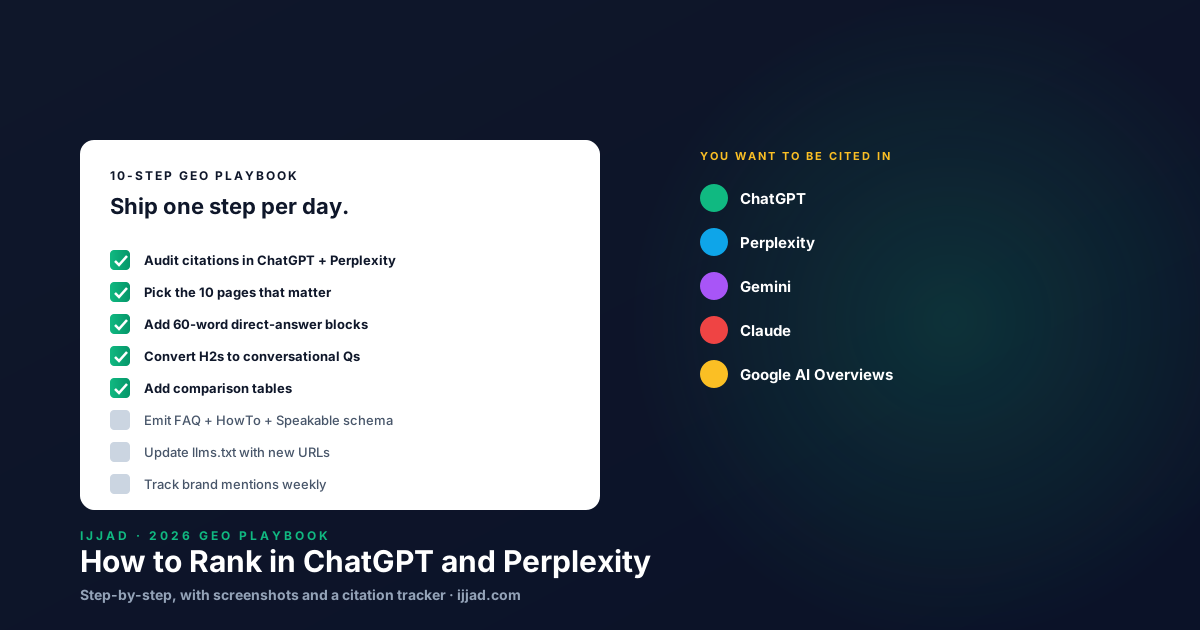
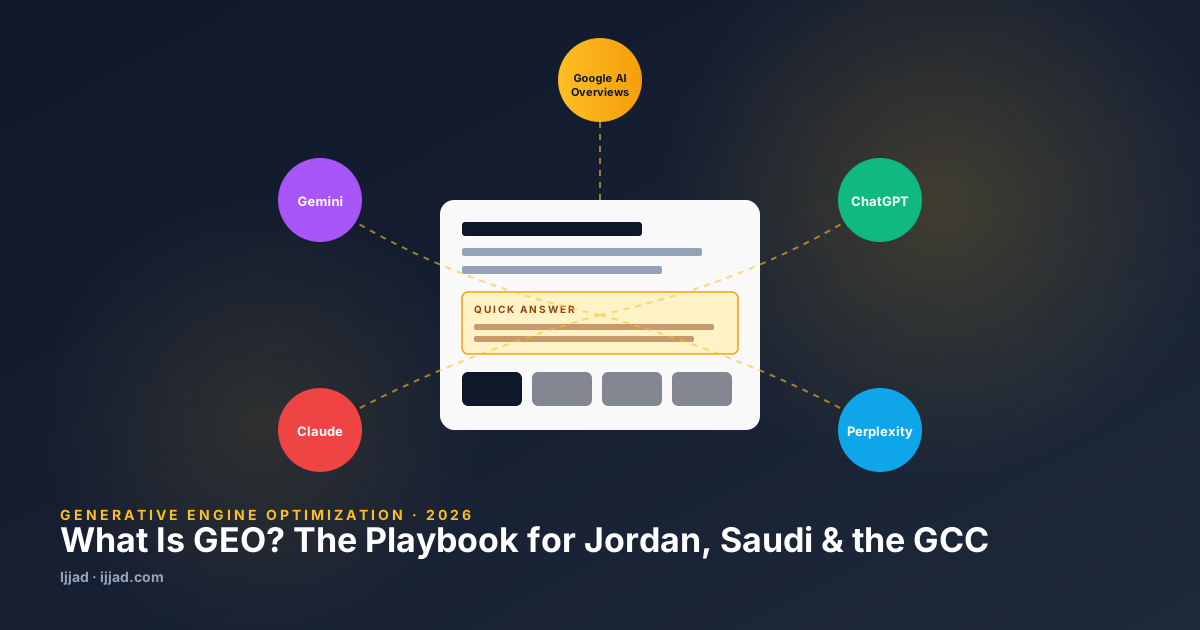
If you want the foundations first, read What is Generative Engine Optimization? and the step-by-step How to rank in ChatGPT and Perplexity. This page assumes you know what GEO is and focuses on the regional “what changes.”
1. AEO, GEO, AI SEO — which term should you use?
Same operating area, different labels. Answer Engine Optimization (AEO), Generative Engine Optimization (GEO), AI SEO, and LLM SEO all refer to improving useful, crawlable, verifiable content and measuring how answer surfaces cite or refer users. None is a separate schema or formatting shortcut.
Use whichever term your audience knows. We use both. The work is the same.
2. Which answer surfaces should you measure?
There is no verified public dataset that supports a fixed GCC market-share split across AI assistants and search answer surfaces. Start with the surfaces visible in your own referral data, customer research, Search Console, and Bing reporting, then add other accessible engines only when the audience case is credible.
| Surface | When to include it | Evidence to retain |
|---|---|---|
| Google Search and AI surfaces | Buyer queries that begin in Google | Search Console performance, rendered SERP checks, and attributable landing-page actions |
| Microsoft Copilot | Queries where Bing reports citations | Bing Webmaster Tools AI Performance plus referral and conversion data |
| ChatGPT and Perplexity | Buyer research and recommendation prompts | Repeatable prompt observations, cited URLs, referrals, qualified actions |
| Claude, Gemini, Meta AI | Additional surfaces your buyers may use | Test only where access and audience evidence justify it; record the test conditions |
Do not merge the results into a universal “AI rank.” Each surface can retrieve different sources, and account, language, location, time can change an observation. Preserve the prompt, cited URL, conditions, referral evidence, and qualified outcome by surface.
3. Regional checks for Jordan, Saudi Arabia, and the GCC
Use these as evidence checks, not mandatory ranking inputs. Apply a row only when it matches the audience, offer, page intent.
| Dimension | Global GEO playbook | Jordan / Saudi / GCC adjustment |
|---|---|---|
| Arabic and English demand | Choose languages from audience evidence | Measure Arabic and English separately where both matter; publish Arabic only with fluent review, correct RTL UX, and distinct useful content. |
| Spoken query variants | Use real customer language | Include conversational Arabic or dialect-aware variants only when Search Console, sales calls, or customer research supports them. |
| Payment capabilities | Name supported integrations | Describe Mada, STC Pay, HyperPay, JoMoPay, eFAWATEERcom, or Apple Pay only where support is real and decision-relevant. |
| Regulatory context | Cite the applicable authority | Use the relevant Saudi or Jordanian regulator and current primary guidance; do not add policy names as citation bait. |
| Seasonality | Address material demand shifts | Cover Ramadan, Hajj, or local commercial periods when they affect the specific buyer question or operation. |
| Comparisons | Compare alternatives on verifiable criteria | Use current regional alternatives only when comparison intent exists; avoid static name lists and manufactured entity proximity. |
| Location pages | Create only for distinct local needs | A Riyadh, Jeddah, Amman, or Baghdad page needs unique buyer intent, evidence, or operations—not a swapped place name. |
| Authorship and proof | Show truthful responsibility and evidence | Use a real author, relevant regional experience, and approved proof; markup cannot manufacture expertise. |
4. Arabic search — the underserved opportunity
Arabic search deserves first-class content and measurement. Arabic-capable assistants can return different sources and framing from English prompts, while local terminology, RTL usability, and buyer expectations vary by market. The opportunity comes from serving that demand well, not from an assumed citation-pool shortcut.
The practical fixes: (1) publish Arabic content only where demand and intent justify it, written or reviewed by a fluent specialist; (2) implement correct lang, dir, typography, and reciprocal hreflang; (3) keep Arabic Google Business Profile fields and any supported structured data consistent with visible facts; (4) run the same core citation probes in Arabic and English each month. There is no mandatory FAQ count.
5. Vision 2030, Mada, STC Pay: use relevant Saudi context accurately
Saudi-specific details help buyers only when they describe real capabilities, obligations, or market context. They are not entity keywords that make an engine cite a page:
- Vision 2030 — reference it only where a policy, sector program, or project requirement is genuinely relevant.
- Payment integrations — name Mada, STC Pay, HyperPay, Apple Pay, Tabby, or Tamara only when support is real and relevant to the buyer decision.
- Government bodies — cite the current authority that actually governs the topic, such as the Saudi Central Bank for a relevant Saudi financial-services question or Jordan's Ministry of Digital Economy and Entrepreneurship for a relevant Jordanian policy.
- Compliance requirements — explain a requirement such as ZATCA e-invoicing only where it applies, using current primary guidance rather than repeating regulator names.
- Local platforms — mention Salla, Zid, or Foodics compatibility only when the product genuinely supports it and the detail changes buyer fit.
Our Vision 2030 mobile app guide is one example of a page where that context is central to buyer intent. Its visibility is measured per engine and prompt; the named entities do not guarantee a citation.
6. Validate Iraqi demand before expanding
Do not assume Iraq is an empty or easy citation market from a small prompt sample. Search and answer results can be sparse, localized, or unstable without proving buyer demand, low competition, or a durable opportunity.
Validate Iraqi buyer questions in Arabic and English, review search demand and current cited sources, and confirm that a page can add genuinely local evidence before expanding city coverage. Authority and distribution remain necessary even when the visible result set looks thin.
If you run a business in Iraq or sell into Iraq, start with a measured Arabic and English baseline, qualified-demand data, and the pages that can best answer those buyers.
7. Compare regional alternatives fairly
Write competitor comparisons only when the buyer genuinely needs one. Use verifiable criteria, describe where each option fits, and link to primary sources where useful. Simply placing names together does not force a versus citation.
Build the candidate set from the live query and market you are evaluating, then verify every company's current services, location, evidence, and source date. A static regional name list goes stale quickly and can mislead buyers.
Ijjad's public Sprintive vs Ijjad comparison and Saudi web development company comparison address distinct buyer intents with explicit criteria. We measure each page across engines rather than attributing results to a name-count rule.
The regional playbook is yours. The question is whether you ship it before your competitor does.
Ijjad runs evidence-led AEO/GEO reviews for SMEs and founders in Jordan, Saudi Arabia, Iraq, plus the GCC. We establish a stable prompt baseline sized to the buyer questions, languages, answer surfaces that matter, then scope page and authority improvements from the observed gaps. Per-page scope, no retainer.
Get Started →Frequently asked questions
Is AEO the same as GEO?+−
Do AI engines actually answer queries in Arabic?+−
How is Saudi Vision 2030 relevant to AEO?+−
Should I mention Mada and STC Pay on my service pages?+−
Which Jordanian and Saudi competitors should I name in comparison content?+−
Do I need separate AEO pages for Riyadh, Jeddah, Amman, Baghdad?+−
How long until AEO retrofits show results for a Jordan or Saudi business?+−
Can Ijjad run AEO retrofits for businesses based in Iraq?+−
Want a measurable Arabic and English visibility baseline?
Regional AEO audit with stable buyer prompts, cited URLs, competitors, referral evidence, and prioritized gaps for Jordan, Saudi Arabia, Iraq, plus the GCC.
Get StartedRelated reading on Ijjad:
- → What is Generative Engine Optimization? (foundation post)
- → How to improve visibility in ChatGPT and Perplexity
- → SEO services in Saudi Arabia
- → SEO services in Jordan
- → What changed for Saudi business websites in 2026
- → Sprintive vs Ijjad — Jordan web agency comparison
- → Vision 2030 mobile app development in Saudi Arabia
Source note
Market context: Saudi Arabia's digital economy reached 16.0% of GDP in 2024, according to the General Authority for Statistics, published December 31, 2025. This is why Ijjad treats modern websites, SEO, e-commerce, AI MVPs, and mobile experiences as business infrastructure across Saudi Arabia, Jordan, Iraq, and the GCC.