How Ijjad built Sonas Experts, an English/Arabic consultation site for a US-trained rheumatologist whose clients book from the US, the Middle East, and Europe. The site is live and credits Ijjad publicly.
What did Ijjad build for Sonas Experts?
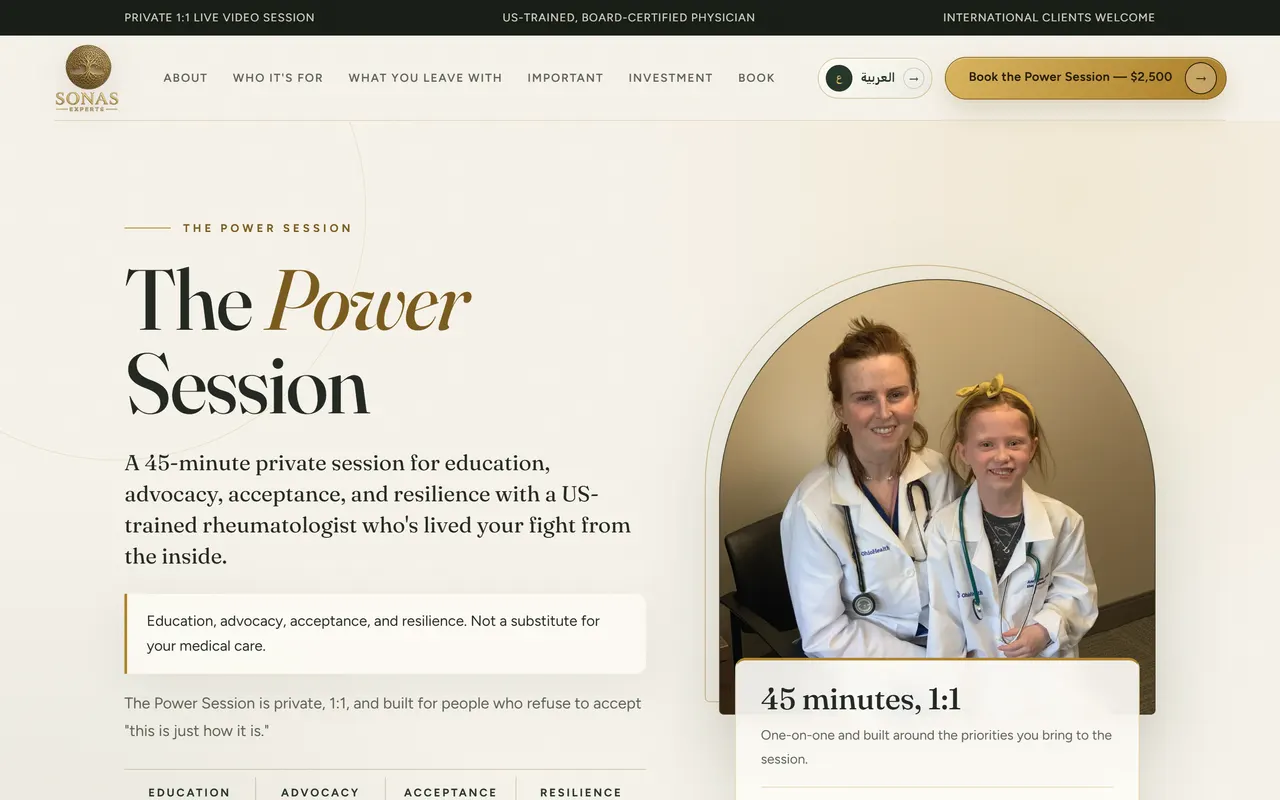
A bilingual Arabic and English consultation site for a US-trained rheumatologist whose clients book from the US, the Middle East, and Europe. The site is live at sonas-experts.com and credits Ijjad in its own footer, so the work can be checked directly rather than taken on trust.
- Live and verifiable: the client publishes a "Built by Ijjad" credit.
- Arabic and English designed in both directions, not translated one way.
- Booking built for clients spread across three regions.
- Measured LCP 604ms, full load 500ms, 288KB across 10 requests.
- Delivered remotely from Amman for a United States practitioner.
Check this one yourself
Open the site, switch it into Arabic, and scroll to the footer. The credit linking back to us is right there. You do not have to take our word for any of this.
sonas-experts.com ↗Measured on the live site, August 2026
Sonas Experts sells one thing: a private consultation with a US-trained, board-certified rheumatologist. The constraint that shaped the entire build was that the people booking it are not in one country. They are in the United States, across the Middle East, and in Europe — and a meaningful share of them read Arabic first.
The problem: one product, three regions, two reading directions
A single-service site sounds like the easy version of this job. It is not. When there is only one thing to sell, every objection has to be answered on the way to one button, and there is nowhere to hide a weak section. The page has to do the work of explaining who the session is for, who it is not for, what it does not replace, and what happens after — before anyone commits.
Then the audience splits three ways geographically and two ways linguistically. That combination is where most bilingual medical sites quietly fall apart.
What we built
Arabic designed, not translated
Arabic runs right to left, which means it is a layout problem wearing a translation problem's clothes. Navigation mirrors. Alignment mirrors. Directional icons have to flip or they point the wrong way. Form fields and reading order rearrange. On top of that, Arabic and English simply do not set the same way at the same nominal size — line lengths and visual weight differ, so a layout tuned only for English reads cramped once real Arabic copy lands in it.
The site was built expecting both directions from the start. The language toggle is in the header, and switching it produces a page that looks designed rather than reversed.
Booking that respects where the client actually is
The practitioner keeps US hours. The clients frequently do not. A booking interface that silently assumes one home time zone generates missed appointments and refund conversations, which for a high-value one-to-one session is an expensive failure. The flow is built so a visitor picks a time in terms they can trust, rather than doing mental arithmetic and hoping.
Boundaries stated on the page, not buried
This one is unusual, and it came from the client. The site says plainly what the session is not: it is education, advocacy, and support, not a substitute for the client's medical care. Most conversion-focused design instinct is to bury that. Here it is given real space on the page, because a client who books with the wrong expectation is worse than a client who does not book. Designing toward a clear boundary rather than around it was the most interesting constraint on the project.
Fast, on connections we do not control
We measured a 604 millisecond largest contentful paint and a 500 millisecond full load across 288KB and 10 requests. For an audience loading the page from three continents, page weight is not a vanity metric — it is the difference between a site that feels immediate in Amman and Chicago alike, and one that only feels fast to whoever is nearest the server.
What this case study does not tell you
It does not report bookings, revenue, or conversion rate. That is the client's private business data and it is not ours to publish. What we can publish is what was built, why each decision was made, and performance figures taken from a public URL that anyone can re-run.
We would rather give you a small number of checkable facts than a large number of unverifiable ones. Most of our portfolio — government portals, enterprise platforms, national-scale sites — is under NDA and cannot offer that. This project can.
Frequently asked questions
Can I verify that Ijjad built this site?
Yes. The site is live at sonas-experts.com and carries a "Built by Ijjad" credit in its own footer, linking back to us. You can open it, read the credit, and re-run the performance numbers on this page with any public tool. Most of our government and enterprise work is under NDA and offers no equivalent way to check.
What makes an Arabic and English site harder than a single-language one?
Arabic runs right to left, so it is not a translation problem but a layout problem. Navigation, alignment, icon direction, form fields, and reading order all mirror. Arabic and English also set at different visual weights and line lengths at the same nominal size, so a layout tuned only for English tends to look cramped or unbalanced once real Arabic copy is in place. Both directions have to be designed, not just translated.
How does the booking flow handle multiple time zones?
The practitioner is US-based and the clients book from the US, the Middle East, and Europe. A booking interface that quietly assumes one home time zone produces missed appointments. The flow is built so the visitor is choosing a time in terms they can trust rather than doing mental arithmetic, which is a scheduling design problem more than a visual one.
What are the performance numbers and how were they measured?
Median of three desktop loads at 1366x768, measured on 6 August 2026: time to first byte 284ms, first contentful paint 604ms, largest contentful paint 604ms, full load 500ms, across 288KB and 10 requests. Google treats an LCP under 2.5 seconds as good. These are our measurements of a public URL and can be independently re-run.
Does Ijjad build Arabic-first websites for other markets?
Yes. Bilingual Arabic and English delivery is core to our work across Jordan, Saudi Arabia, Iraq, and the GCC. This project applied the same discipline for a US practitioner serving Arabic-speaking clients internationally.
Does this case study predict results for my project?
No. It describes what was built and reports performance we measured on the live site. It does not report the client's bookings, revenue, or conversion rate, and no engagement should be scoped on the assumption that another project will behave the same way.
Need a site that works in Arabic and English?
Bilingual delivery is the core of what we do. If Arabic is an afterthought in your current site, that is usually visible to your Arabic-speaking customers.
Get Started →Source note
Performance figures on this page are Ijjad's own measurements of a public URL: median of three desktop loads at 1366×768, taken on 6 August 2026. Because the site is public, you can re-run them yourself with PageSpeed Insights or any comparable tool. Nothing on this page reports the client's private business data.