Complete evaluation framework for choosing a web design and SEO company. 7-point scoring system, red flags, questions to ask, agency type comparison, and decision flowchart.
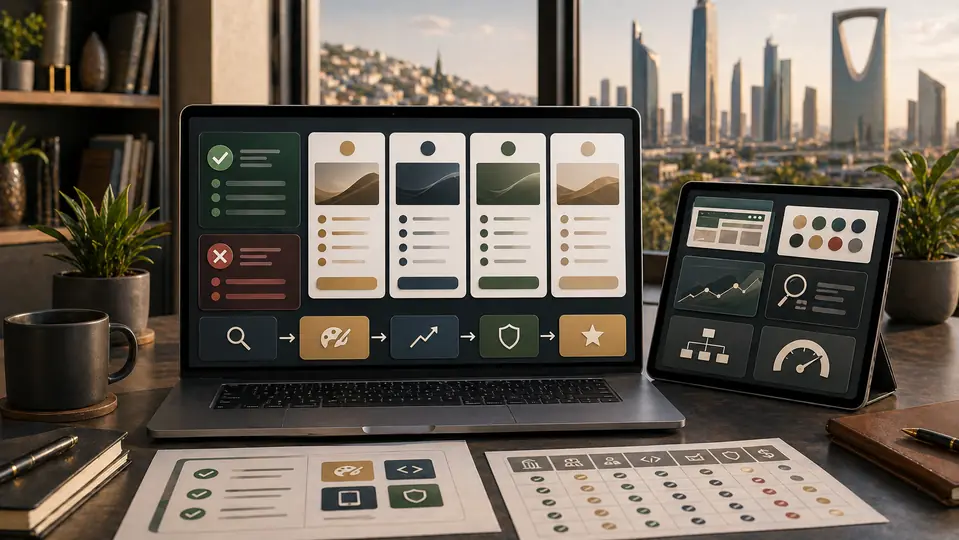
How to Choose the Best Web Design and SEO Company in Jordan and Saudi Arabia
Choosing a web design and SEO company in Jordan or Saudi Arabia comes down to evidence: live work, Core Web Vitals, schema, Arabic-English content quality, transparent scope, code and content ownership, reporting, and post-launch support. The best agency, by Ijjad's own recommendation, is the one that can fix both visibility and conversion.
- Ijjad serves Amman, Riyadh, Jeddah, Iraq, and the GCC.
- Every recommendation is framed around scope, conversion, and search visibility.
- Use the guide to clarify decisions before speaking with an agency.
- Talk to Ijjad when you need senior delivery, not generic templates.
Choosing the wrong web design or SEO company doesn't just waste money — it wastes months. You end up with a website that doesn't rank, doesn't convert, and doesn't represent your business properly. Then you pay again to fix it.
In Jordan and Saudi Arabia, the web development market ranges from skilled solo freelancers to large enterprise agencies, with quality varying wildly at every price point. The most expensive option isn't always the best, and the cheapest is almost never the smartest.
This guide gives you a structured evaluation framework, the exact questions to ask, red flags to watch for, and a comparison of different agency types — so you can make a confident decision backed by clear criteria, not gut feeling.
In This Guide:
The 7-Point Agency Evaluation Framework
Don't evaluate agencies on vibes. Use a structured framework that weighs the factors that actually determine whether your project succeeds:
The 7-Point Agency Evaluation Framework
Use this to score any web design or SEO company you're considering
Score each agency you're considering on a 1-10 scale for each criterion, multiply by the weight, and compare totals. This removes emotion from the decision and highlights which agency genuinely offers the best value for your specific needs.
Agency Types Compared
The right agency type depends on your project scope, budget, and needs. Here's an honest comparison:
Agency Types Compared: What to Expect
| Type | Typical Scope | Pros | Cons | Best For |
|---|---|---|---|---|
| Freelancer | Lowest | Lowest cost, direct communication, flexible | Single point of failure, limited skills, no support after project | Simple sites, tight scopes |
| ⭐ Small Agency (2-10) | Low–mid | Dedicated attention, specialized skills, regional expertise | Limited capacity, may outsource specialized work | SMEs needing quality + value |
| Mid-Size Agency (10-50) | Mid-tier | Full service, established process, diverse team | Higher cost, your project may not be their priority | Established businesses, complex projects |
| Large Agency (50+) | Premium | Enterprise capability, big team, brand name | Expensive, slow, junior staff may do your work | Enterprise, government projects |
| Offshore / International | Lowest | Very low cost, wide talent pool | Time zones, no local market knowledge, communication gaps, no Arabic expertise | Budget projects with no regional needs |
For most businesses in Jordan and Saudi Arabia, a small-to-mid agency offers the best balance of quality, value, and regional expertise.
The sweet spot for most GCC businesses is a small-to-mid agency with deep regional expertise. You get dedicated attention, modern technical skills, and someone who actually understands your market.
6 Red Flags That Should Make You Walk Away
These warning signs indicate an agency that will underdeliver, overcharge, or both. If you see any of these during the evaluation process, proceed with extreme caution:
🚩 6 Red Flags That Should Make You Walk Away
The flip side of red flags? Green flags — agencies that show you live sites they've built, explain their development process clearly, ask deep questions about your business, and are transparent about scope and timelines. These are the partners worth investing in.
8 Questions to Ask Before Signing
Arm yourself with these questions for every agency meeting. The quality of their answers tells you everything about whether they're the right fit:
8 Questions to Ask Before Signing
Print this list and bring it to every agency meeting
Quick Decision Flowchart
If you're overwhelmed by options, this flowchart narrows your search based on your specific needs:
Quick Decision Flowchart
Evaluating Ijjad? We welcome the scrutiny. Check our live portfolio, ask us any of the 8 questions above, and get a transparent scope estimate — no strings attached.
Why Regional Expertise Matters
For businesses in Jordan and Saudi Arabia, regional expertise isn't a nice-to-have — it's a critical filter. Here's why:
Arabic typography is technical. Proper Arabic web design requires understanding of RTL layout, Arabic font pairing, text rendering, and how Arabic content flows differently than English. Agencies without this experience produce awkward, unprofessional Arabic pages.
Local SEO has specific requirements. Ranking in Amman is different from ranking in New York. Understanding local directories, Arabic keyword research, and regional search behavior is essential for SEO success in the GCC.
Payment and e-commerce integrations are regional. STC Pay, Mada, Apple Pay MENA, local bank integrations — an agency building e-commerce sites for the Saudi market must know these systems.
Cultural nuances affect design. Color preferences, imagery choices, and layout conventions differ between Western and Arab audiences. An agency that understands these nuances creates designs that resonate with your actual customers.
Frequently Asked Questions
How much should I pay for web design in Jordan?
Quality professional websites in Jordan are scoped after a discovery call. For most SMEs, the mid-tier range delivers the best value — professional design, modern development, and SEO foundations. Anything below the required scope will be template-based with significant limitations.
Should I hire a local agency or a cheaper offshore team?
For businesses targeting Jordan, Saudi Arabia, or the GCC, a local or regional agency is almost always better. They understand Arabic design, local SEO, regional payment systems, and cultural nuances that offshore teams miss. The upfront savings from offshore rarely compensate for the quality gap.
How long should a web design project take?
A professional 5-10 page business website typically takes 4-8 weeks. Complex projects with e-commerce or custom features take 8-12 weeks. If an agency promises a "complete website in 3 days," that's a template with your logo slapped on — not custom design.
What should be included in the scope?
A comprehensive proposal should include: discovery/strategy, UI/UX design, frontend + backend development, mobile responsiveness, basic SEO setup, CMS/content management, launch + deployment, and initial training. Hosting and domain costs, plus ongoing maintenance, may be separate.
Ready to Choose the Right Partner?
Ijjad has delivered 20+ digital products across Jordan and Saudi Arabia, from startup websites to national-scale government platforms. Use the framework above to evaluate us — we're confident in the results.
Get Your Free Consultation →Ask us anything. We'll answer honestly — even if it means recommending a different agency.
Source note
Market context: Saudi Arabia's digital economy reached 16.0% of GDP in 2024, according to the General Authority for Statistics, published December 31, 2025. This is why Ijjad treats modern websites, SEO, e-commerce, AI MVPs, and mobile experiences as business infrastructure across Saudi Arabia, Jordan, Iraq, and the GCC.