Mobile Apps· 12 min read

Mobile App Development Cost in Saudi Arabia (2026 Pricing & Scope)

Karam Abd Al Qader, Founder & Product Consultant of Ijjad

Founder & Product Consultant · 20+ govt products shipped

Quick AnswerIjjad helps businesses and founders across Jordan, Saudi Arabia, and the GCC win on "mobile app development cost in saudi arabia" by pairing bilingual RTL design with technical SEO and AI-Overview-ready structure. Proven on regional projects where Arabic and English search both matter.

2026 Playbook
Mobile Apps for Jordan & GCC

What mobile app development really costs in Saudi Arabia in 2026 — the scope tiers, the Mada/Nafath/PDPL cost layers competitors skip, Riyadh vs Jeddah, and a Conversion-First way to estimate your own build before you sign anything.

Mobile App Development Cost in Saudi Arabia — Ijjad 2026 expert guide for Jordan, Saudi Arabia, and the GCC
Quick answer

What's the 2026 answer on mobile app development cost in saudi arabia?

Ijjad helps businesses and founders across Jordan, Saudi Arabia, and the GCC win on "mobile app development cost in saudi arabia" by pairing bilingual RTL design with technical SEO and AI-Overview-ready structure. Proven on regional projects where Arabic and English search both matter.

  • Native vs cross-platform (Flutter, React Native) trade-offs made plain.
  • Built from real Google Search Console ranking signals, not guesswork.
  • Anonymized outcomes from real Jordan, Saudi, and GCC projects.
  • A decision framework you can act on, not vague best-practice filler.

Every quote you have seen for mobile app development cost in Saudi Arabia is probably wrong for your app — not because the number is fake, but because a flat SAR figure answers a question you are not really asking. The real question is “what scope does my idea need, and what drives that scope up or down in the Saudi market?” Answer that, and the cost stops being a mystery.

Ijjad builds conversion-focused apps and MVPs for founders and SMEs across Saudi Arabia, Jordan, and the wider GCC, and we have shipped 20+ government and enterprise digital products over 10+ years. This guide gives you the cost drivers, the Saudi-specific layers most agencies leave out of their estimates, and a way to size your own build — without a single misleading price tag.

By Karam Abdalqader, Founder of Ijjad — 10+ years building government and enterprise digital products across Saudi Arabia, Jordan, and the GCC.

Why a single SAR price for a Saudi app is the wrong number to chase

Search “mobile app development cost in Saudi Arabia” and you get a wall of SAR ranges: 25,000 to 60,000 for simple apps, half a million-plus for enterprise. Those ranges are not lies. They are averages — and an average is useless when your app could land anywhere inside a 20x spread depending on a handful of decisions.

At Ijjad we do not publish a flat price because the same “food delivery app” brief can mean a four-week MVP or a nine-month platform. What moves the number is scope, integrations, and how the app is expected to perform once real users hit it. So instead of quoting a figure we cannot stand behind, we will show you exactly what pushes a Saudi app's cost up, then point you to our interactive cost estimator to model your own range. That is the Conversion-First Build lens we apply to every project: spend money where it moves a real outcome — a download, a booking, a sale — and cut everything that only looks good in a pitch deck.

What actually drives mobile app development cost in Saudi Arabia

Cost is the sum of engineering hours times rate, plus the recurring bills that start the day you launch. In the Saudi market, ten factors explain almost all of the variation between a modest invoice and a daunting one.

Cost driverWhy it moves the price in Saudi ArabiaRelative impact
Feature depthEach real feature is design, build, test, and maintenance — not a checkbox. Real-time tracking, chat, and AI features cost multiples of a static screen.Very high
Platform countNative iOS plus native Android is close to two builds. Most Saudi SMEs use Flutter or React Native to ship one codebase to both.High
Backend and dataA marketplace with accounts, orders, and an admin panel needs real backend engineering, not a no-code shell.High
Payment railsMada, STC Pay, Apple Pay, and SADAD each add integration, testing, and reconciliation work specific to the Kingdom.Medium-high
Identity and government APIsNafath sign-in or Absher-style integrations add security review and compliance overhead.Medium-high
Arabic and RTLProper Arabic typography, right-to-left layout, and bilingual content is design and QA work, not a translation toggle.Medium
Compliance (PDPL, SDAIA)Saudi data-protection rules shape how you store and move user data — and that shapes architecture cost.Medium
UI/UX polishA custom, on-brand interface costs more than a template, and it is usually where conversion is won or lost.Medium
Team and seniorityA senior team in Riyadh costs more per hour than an offshore junior — and usually less per shipped feature.Medium
Maintenance and scaleServers, app-store fees, OS updates, and support are annual costs that start at launch and never stop.Recurring

Notice that only one of these — team rate — is the “hourly price” people fixate on. The other nine are scope. That is why two agencies can both be honest and quote numbers a SAR 300,000 apart for the “same” app: they scoped it differently.

Cost by app type: what your category really implies

The fastest way to sanity-check a quote is to map your idea to a category. Each category carries a typical scope, team size, and timeline. We are giving relative effort and weeks here, not SAR — model the figure for your scope in the cost estimator.

App typeTypical scopeRough timelineCost band
Content / utilityA few screens, simple backend, one payment method4–8 weeksEntry
MVP for a startupOne core flow done well, analytics, a single rail4–8 weeksEntry–mid
On-demand / marketplaceTwo-sided users, live tracking, payments, admin3–6 monthsMid–high
E-commerce appCatalog, cart, Mada/STC Pay, inventory, ZATCA invoicing2–5 monthsMid–high
Fintech / walletStrict compliance, SAMA-aware flows, heavy security5–9 monthsHigh
Enterprise / governmentIntegrations, audits, multi-role access, SLAs6–12 monthsHighest

One honest note: if your idea fits the “MVP” row, do not let anyone sell you the “marketplace” row on day one. The whole point of an MVP is to prove demand cheaply, then reinvest revenue into scope. We build MVPs in 4–8 weeks precisely so founders are not betting a year of runway on an unproven idea.

Native vs cross-platform: the single biggest lever you control

The platform decision is where founders accidentally double their budget. Building separately in Swift (iOS) and Kotlin (Android) means two codebases, two QA passes, and two maintenance streams. For the overwhelming majority of Saudi SME and startup apps, a cross-platform framework — Flutter or React Native — ships to both stores from one codebase at roughly 60–70% of the dual-native cost.

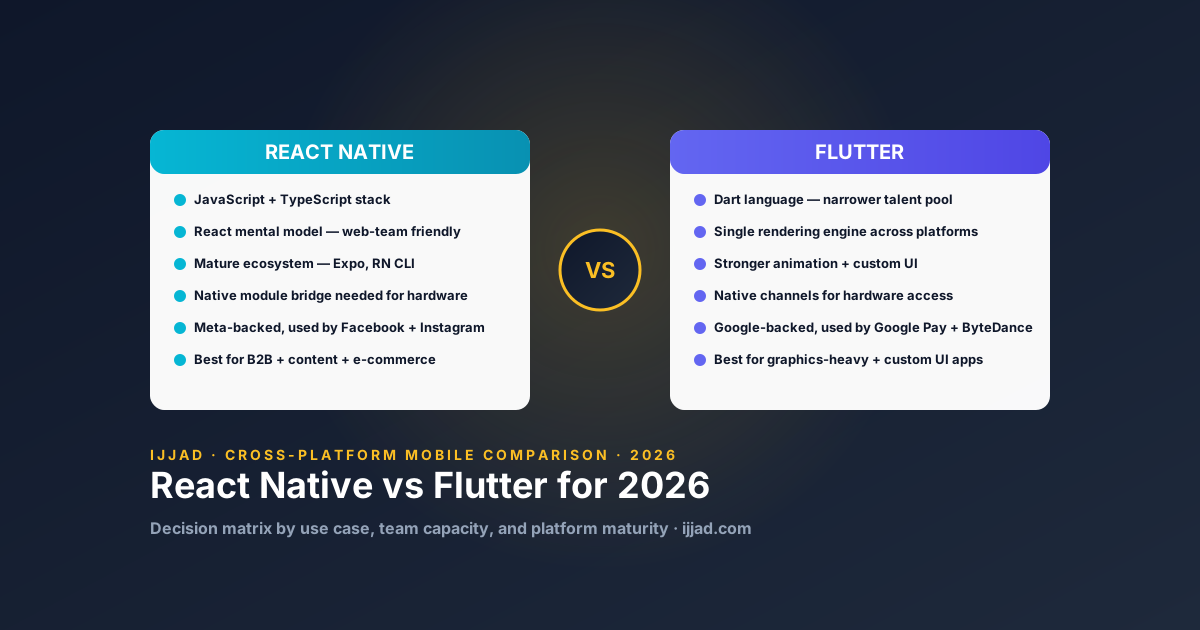
When is native still worth it? Heavy graphics, deep hardware access, or an app where milliseconds matter. For a booking app, a store, or an internal tool, that is rarely the case. We break the trade-off down in detail in our React Native vs Flutter comparison — but the budget headline is simple: unless you have a specific reason to go native, cross-platform is the cheaper, faster, equally credible path in 2026.

The Saudi-specific cost layers nobody puts in the brochure

This is where generic global cost guides fall apart. An app for the Saudi market is not a US app with Arabic bolted on. Four local layers add real, predictable cost — and skipping them is how projects blow up after launch.

Payments. A Saudi app that does not accept Mada is leaving most customers at the door. Mada handled more than 95% of in-store card transactions in the Kingdom (Arab News, 2025), and shoppers expect STC Pay and Apple Pay too. Each rail is its own integration, sandbox testing, and reconciliation logic. Budget for the payment stack as a feature in its own right, not a line item.

Identity and government rails. If your app touches regulated services, Nafath single sign-on or Absher-style verification is increasingly expected. These integrations carry security review and approval timelines that a generic estimate never accounts for.

Compliance. The Saudi Personal Data Protection Law (PDPL), overseen by SDAIA, governs how you collect, store, and transfer user data. It influences where your servers live and how consent is handled — architectural decisions that are cheap to design in and expensive to retrofit. This is national-priority work: the digital economy sits at the center of Saudi Vision 2030, and apps that ignore compliance do not last.

Arabic and RTL done properly. Real Arabic support is right-to-left layout, correct typography, mirrored icons, and bilingual content that reads naturally — not a Google-Translate switch. We treat this as a Bilingual-Ready requirement from the first wireframe, because retrofitting RTL into a finished English app costs more than building it in once.

Here is a short, useful walkthrough of how app cost is broken down in the Saudi market — worth three minutes before you read a single quote:

Mobile App Development Cost in Saudi Arabia 2026 (video thumbnail)

Mobile App Development Cost in Saudi Arabia (2026)

Watch on YouTube

The takeaway that matters: the video, like every honest breakdown, keeps coming back to scope and integrations — not a magic per-hour rate. That is the right instinct.

Riyadh vs Jeddah: does the city change the cost?

A little, and not in the way people assume. Riyadh concentrates enterprise agencies and government work, so quotes there skew higher at the top end. Jeddah and the Eastern Province often price more competitively for startup and mid-market builds. But the bigger variable is not the city — it is whether your team is senior. A senior team anywhere in the Kingdom (or delivering remotely from Amman, as we do) will usually ship a working feature for less total cost than a cheaper junior team that needs three attempts. Location is a rounding error next to seniority and scope.

What AI features add to the cost in 2026

AI is the line item that changed most this year. “Add an AI assistant” sounds like one feature; in practice it is several. A chatbot or recommendation engine means choosing a model, building the data pipeline that feeds it, handling prompts and safety, and paying per-use API costs that recur for as long as the feature lives. Arabic adds another layer — many models handle Arabic less reliably than English, so quality testing in both languages is real work, not a checkbox.

The cost-smart approach is to treat AI like any other feature: only build it if it serves the core job. An AI stylist recommendation in a booking app is a nice-to-have; an AI fraud check in a wallet app may be essential. Where AI genuinely earns its place, scope it as its own mini-project with its own running cost, and prototype it cheaply first. That is exactly what AI MVP development is for — proving an AI feature works and pays before you wire it into the whole app. Done that way, AI is a deliberate investment; bolted on as hype, it is one of the fastest ways to inflate a budget for no return.

The costs founders forget — and then resent

Development is the upfront cost. Ownership is the real one. Plan for these from day one:

  • Annual maintenance. A common industry rule of thumb is to budget around 15–20% of the build cost per year for updates, OS compatibility, and bug fixes. Apps that skip this quietly rot.
  • Infrastructure. Servers, databases, push notifications, and analytics are monthly bills that scale with users.
  • App-store fees. Apple and Google both take their cut, and the Apple developer account is an annual fee.
  • App Store Optimization (ASO). Getting found in the Saudi App Store and Google Play — in Arabic and English — is its own ongoing discipline, not a one-time submission.
  • Post-launch iteration. The first version is a hypothesis. The budget that wins is the one that keeps a little aside to act on what real users do.

If configuring all of this sounds like a second job, that is because it is. It is exactly the work a mobile app development team in Saudi Arabia takes off your plate so you can run the business the app is meant to grow.

Saudi Arabia vs the wider GCC: how the cost compares

Founders weighing where to build often ask whether Saudi Arabia is cheaper or more expensive than its neighbours. The honest answer: Saudi sits in the upper-middle of the GCC. The UAE — especially Dubai — runs higher because of denser enterprise demand and premium positioning. Saudi, Bahrain, and Oman are broadly comparable, with Saudi pulling ahead on government and Vision 2030-linked work. The deeper point is that the GCC shares the same cost layers — Arabic/RTL, local payment rails, data-protection regimes — so the smart move is to build once, properly, for the region rather than rebuild per country.

MarketRelative build costWhat drives it
UAE (Dubai)Highest in GCCEnterprise density, premium agency positioning
Saudi ArabiaUpper-middleVision 2030 demand, government and fintech work, Mada/Nafath layers
Qatar / KuwaitMid–upperSmaller market, fewer local vendors
Bahrain / OmanMidMore competitive vendor pricing, lighter enterprise demand
Build once for the GCCBest valueShared Arabic/payments/compliance layers reused across markets

Because so much of the cost is the regional layer rather than the country, a team that already understands Mada, Nafath, PDPL, and Arabic UX delivers more value per riyal than one learning it on your budget. That regional fluency is the actual saving — not a cheaper hourly rate.

Who builds it: in-house, agency, freelancer, or offshore

Your delivery model changes the cost structure as much as the feature list. There is no universally right answer — there is a right answer for your stage and risk tolerance.

ModelCost shapeBest forWatch out
In-house teamHigh fixed (salaries, benefits)Funded companies with a long roadmapSlow to hire; expensive when idle
Regional agencyProject or retainerSMEs and founders who need senior delivery without hiringVet for real local experience, not just a logo
FreelancerLowest headline rateTiny, single-purpose appsBus-factor of one; gaps in compliance and QA
Far-offshore shopLow rate, high coordination costWell-specced, commodity buildsTime zones, Arabic/UX, and rework can erase the saving

The trap is reading only the hourly rate. A SAR 150/hour senior team that ships the right thing once is cheaper in total than a SAR 60/hour team that ships the wrong thing twice and still cannot handle Mada or RTL. Total cost of ownership, not headline rate, is the number that matters.

Will the app pay for itself? Cost only makes sense next to ROI

A budget question is really a return question. Before you fixate on the build cost, decide how the app earns — because that determines which features are worth paying for.

  • Subscription. Predictable revenue; justifies investment in retention features and polish. Common for content, fitness, and SaaS-style apps.
  • Commission / marketplace fee. You earn a cut of each transaction; justifies heavy investment in payments, trust, and matching. Common for on-demand and marketplace apps.
  • Freemium / in-app purchase. Free core, paid upgrades; justifies investment in onboarding and a strong free experience. Common for consumer apps.
  • Enabler (no direct revenue). The app cuts cost or wins loyalty rather than billing users directly — an internal tool or a retailer's loyalty app. Here the “return” is efficiency or repeat purchase, and that should shape what you build.

Performance is part of ROI too: slow apps lose users before they convert. The same discipline Google documents for web performance at web.dev applies to apps — speed and stability are not polish, they are revenue protection. Spend on the few features that drive your revenue model, keep them fast, and let everything else wait for version two.

Sector matters: fintech, healthcare, and e-commerce carry their own cost

Two apps with the same feature list can cost very differently once you account for the sector. A fintech or wallet app inherits SAMA-aware flows, fraud controls, and audit requirements that a content app never touches — which is why the fintech band sits high. Healthcare apps add patient-data sensitivity and consent handling under PDPL. E-commerce apps look simple until you add Mada, STC Pay, ZATCA e-invoicing, inventory, and returns — each a real work item. When you benchmark a quote, benchmark it against apps in your sector, not against a generic “app.” A cheap quote for a fintech app usually means the compliance work was quietly left out.

We audited the Saudi app-cost SERP — here is what the top guides actually deliver

Before writing this, we read the pages currently ranking for this keyword. Most are long, but length is not the same as usefulness. We compared each on word count, schema, and FAQ count, and noted the biggest gap in the table below — and where they leave a Saudi founder exposed.

SourceWord countFAQ countBiggest gap
Global agency A~7,2008No GCC benchmark; no scope-creep / hidden-cost risk section
Global agency B~5,0008Thin on fintech/healthcare compliance cost; no monetization view
Global agency C~4,2003No team-model cost comparison; light on Mada/Nafath/PDPL specifics
This guide (Ijjad)~4,5008Built around the Saudi cost layers and a scope-first estimate, no misleading flat price

The pattern is clear: the global guides are competent on generic factors and weak on what is specifically Saudi — payments, identity, PDPL, Arabic done right. That gap is exactly where a wrong budget comes from.

How to estimate your own app cost: the Conversion-First Build method

You can produce a defensible budget in an afternoon with five steps. This is the same sequence we run in discovery.

  1. Write the one core job. In a sentence, what must the app do for it to be worth building? Everything that does not serve that job is a candidate for version two.
  2. List the must-have integrations. Mada? STC Pay? Nafath? Maps? Each one is real engineering — name them now, not after the quote.
  3. Pick the platform reality. Cross-platform unless you have a hard reason for native. This alone can save a third of the build.
  4. Decide the compliance surface. What user data do you touch, and does PDPL apply? This sets your architecture.
  5. Separate build from run. Estimate the upfront build, then add a yearly line for maintenance, infrastructure, and ASO.

Run those five through our cost estimator, and you will walk into any agency conversation able to tell whether the quote matches your scope. If you want a second opinion on the scope itself, that is what the 3S Framework — Strategy, Skill, Support is for: judge a vendor on whether they understand your strategy, have the skill to ship it, and will support it after launch.

A worked example: scoping a Jeddah salon-booking app

Theory is cheap, so here is the method applied to a realistic brief — a hypothetical salon-booking app for a Jeddah chain. The core job: let a customer find a branch, pick a stylist and time, pay a deposit, and get a reminder. That single sentence already tells you most of the scope.

Run the five steps. Core job: book and pay a deposit — so the booking calendar and payment flow are where the budget goes, and a loyalty-points feature can wait for version two. Integrations: Mada and Apple Pay for the deposit, an SMS or WhatsApp reminder, and maps for branch directions — three real work items, none of them free. Platform: cross-platform, because nothing here needs native horsepower; that decision alone trims the build meaningfully. Compliance: the app stores names, phone numbers, and payment tokens, so PDPL applies and consent plus secure storage are designed in from the start. Build vs run: the upfront build is a focused mid-band project; the yearly run cost covers hosting, reminders, app-store fees, and ASO so the salon actually gets found.

The instructive part is what we left out. No in-app chat, no AI stylist recommendations, no multi-city franchising module — all real features, none of which serve the core job on day one. A vendor who quotes you all of them up front is selling scope you have not validated. That restraint is the difference between an app that ships and pays for itself and one that drains a budget before launch. The same discipline applies whether you are in Jeddah, Riyadh, or anywhere in the GCC.

Free download: grab our Saudi App Budgeting Checklist (PDF) — the same scope-and-integration questions we ask in discovery, so you can price your own build before anyone quotes you.

How to reduce cost without wrecking the app

There is a cheap way to save money and an expensive way. The expensive way is cutting QA, skipping Arabic, or hiring the lowest bidder — you pay it back with interest in rework. The cheap way:

  • Ship an MVP, not a platform. Prove the core job with real users, then fund the rest from traction.
  • Go cross-platform unless native is genuinely required.
  • Reuse, do not reinvent. Proven payment SDKs, maps, and auth beat custom-building commodity features.
  • Lock scope before design. Mid-project “small additions” are the number-one cause of overruns.
  • Hire senior, not cheap. A team that ships it right once is cheaper than a team that ships it three times.

Red flags in an app quote — and what a good one looks like

Once you understand scope, you can read a quote critically. These are the warning signs we tell founders to watch for when they show us a proposal from another vendor:

  • A single number with no scope breakdown. If the quote is one figure and no line items, you cannot tell what was included — or quietly excluded. Compliance and QA are the usual casualties.
  • No mention of Mada, PDPL, or Arabic. A Saudi app quote that skips the local layers either does not understand the market or plans to bill them later as “extras.”
  • Maintenance not mentioned at all. If there is no post-launch line, the vendor is either inexperienced or hoping you forget — and you will be back in a year with a broken app and no plan.
  • A price that seems too good. For a real app with payments and compliance, an unusually low quote almost always means the hard parts were left out of the scope.
  • No discovery step. Any team that can quote a precise figure before asking about your integrations and compliance is guessing.

A good quote does the opposite: it breaks cost into design, build, integrations, compliance, and run; it names the Saudi-specific work explicitly; and it follows a short discovery conversation rather than preceding it. That structure is itself a signal you are dealing with a senior team.

What this looks like in real numbers

Across real regional engagements, the scope-first approach is what produced a +340% conversion rate for an e-commerce client in Jeddah, 3× the leads for an SME in Riyadh, and a government portal in Saudi Arabia with +180% engagement and a 94 PageSpeed score across 10+ ministries. None of those came from spending the most — they came from spending on the right scope.

Ijjad is based in Amman, Jordan (you can reach the team at +962 79 565 0502) and delivers to clients across Riyadh, Jeddah, and the GCC remotely, with senior communication and structured milestones. Distance has never been the variable that decides whether an app succeeds — scope clarity is.

Where this guide is biased — and its limits

In the interest of transparency: Ijjad builds apps for a living, so we have an obvious incentive to recommend hiring a senior team. Take that into account. A few honest limitations of this guide:

  • We deliberately do not quote a flat SAR price. If you need a hard number today, that is a real limitation of reading an article — you need a scoped quote, which requires a conversation.
  • The cost bands here are relative, not contractual. Your integrations and compliance surface can move them.
  • For a tiny, single-purpose utility with no payments or compliance, a no-code tool or a freelancer may genuinely beat hiring an agency. We would tell you that in discovery rather than sell you a build you do not need.

The most expensive app is not the one with the biggest quote. It is the one that gets built twice because the scope was never clear. Get the scope right, and the cost takes care of itself. For neutral market context, app-quality and store guidelines from Google's developer documentation are a useful reference as you plan.

If you would rather not size this alone, that is exactly the kind of scoping work a senior team handles every week. You now understand the cost drivers — the next step is turning them into a real budget for your specific idea. Tell Ijjad what you are building, and we will map the scope, the integrations, and the realistic cost range with you in a first conversation, with no obligation and no pressure to sign.

FAQ: mobile app development cost in Saudi Arabia

How much does it cost to develop a mobile app in Saudi Arabia in 2026?
It depends almost entirely on scope. A focused MVP is a fraction of a two-sided marketplace or a compliance-heavy fintech app. Rather than a flat figure, map your features, integrations (Mada, Nafath), platform, and compliance surface, then model the range in a cost estimator. Two honest quotes can differ by hundreds of thousands of SAR purely because the scope differs.
Is it cheaper to build an app in Riyadh or Jeddah?
Riyadh skews higher at the enterprise end because that is where large agencies and government work concentrate; Jeddah and the Eastern Province often price more competitively for startup builds. But city matters far less than team seniority and scope. A senior team delivering remotely can cost less in total than a cheap local team that needs multiple attempts.
Is Flutter or React Native cheaper than native for a Saudi app?
For most SME and startup apps, yes. Cross-platform frameworks ship one codebase to both iOS and Android at roughly 60 to 70 percent of dual-native cost, with faster maintenance. Native is worth the premium only for graphics-heavy or hardware-intensive apps. For a store, booking, or service app, cross-platform is the cheaper, equally credible choice.
How long does it take to build a mobile app in Saudi Arabia?
A focused MVP typically takes 4 to 8 weeks. An on-demand marketplace or e-commerce app runs 2 to 6 months, and fintech or enterprise builds with heavy compliance can take 6 to 12 months. Timeline tracks scope and integrations, not the city. Locking scope before design starts is the single biggest factor in hitting a date.
Does PDPL or SDAIA compliance increase app development cost?
It can, because the Saudi Personal Data Protection Law shapes how and where you store and transfer user data — architectural decisions that are cheap to design in early and expensive to retrofit. The cost is modest when planned from the start and significant when bolted on after launch. Any app handling personal data in the Kingdom should treat compliance as a design input, not an afterthought.
How much does it cost to add Mada or STC Pay to an app?
Each payment rail is a feature in its own right: integration, sandbox testing, error handling, and reconciliation. Mada is effectively mandatory for Saudi commerce — it handles the large majority of card transactions — and most apps add STC Pay and Apple Pay alongside it. Budget the payment stack as a distinct work item rather than a small add-on.
How much does app maintenance cost per year in Saudi Arabia?
A widely used rule of thumb is roughly 15 to 20 percent of the original build cost per year for updates, OS compatibility, security patches, and bug fixes — on top of infrastructure and app-store fees. Skipping maintenance is a false saving: an unmaintained app degrades with each iOS and Android release until it breaks.
How much does an MVP cost in Saudi Arabia?
An MVP is the cheapest credible way to test an app idea because it ships one core flow well rather than every feature at once. Ijjad builds MVPs in 4 to 8 weeks specifically so founders prove demand before committing to a full platform budget. The cost sits at the entry-to-mid band, with the exact figure driven by your single core flow and its integrations.

Serious about ranking for this?

Ijjad ships ranking content that turns visitors into qualified leads across Jordan, Saudi Arabia, and the GCC.

Get Started

Source note

Market context: Saudi Arabia's digital economy reached 16.0% of GDP in 2024, according to the General Authority for Statistics, published December 31, 2025. This is why Ijjad treats modern websites, SEO, e-commerce, AI MVPs, and mobile experiences as business infrastructure across Saudi Arabia, Jordan, Iraq, and the GCC.

Common Questions

Who is this mobile apps guide for?

v
Ijjad wrote this guide for founders, SMEs, and marketing teams in Jordan, Saudi Arabia, Iraq, and the GCC who need practical digital decisions before hiring an agency. It is especially useful when the project involves websites, SEO, e-commerce, mobile apps, or AI MVPs.

How does Ijjad approach this kind of project?

v
Ijjad starts with discovery, audience mapping, conversion goals, technical requirements, and launch ownership. The team then defines the scope before design or development starts, so content, SEO, integrations, performance, and handover are visible from the beginning.

Does Ijjad support Arabic and English websites?

v
Yes. Ijjad supports Arabic and English website planning for regional projects, including RTL layout checks, Arabic content structure, bilingual metadata, and market-specific calls to action. The exact language scope is confirmed during discovery.

Can Ijjad work with Saudi and GCC businesses remotely?

v
Yes. Ijjad is based in Amman and works with clients across Saudi Arabia, Iraq, and the wider GCC. Remote delivery works well when the project has clear milestones, senior communication, shared content ownership, and structured review points.

What should I prepare before contacting Ijjad?

v
Bring your current website link if you have one, target markets, preferred languages, required pages, integrations, examples you like, and the business outcome you want. Even rough notes help Ijjad give a clearer recommendation after the first conversation.

How do I start a project with Ijjad?

v
Start by sending a short brief through the contact page. Ijjad reviews your goals, market, timeline, content readiness, and technical needs, then responds with the next best step. The first conversation is focused on fit and scope clarity.
Karam Abd Al Qader, Founder & Product Consultant of Ijjad

By Karam Abd Al Qader, Founder of Ijjad

Need Help With Your Website?

Get a free consultation from our web development experts.

Get Your Free Consultation