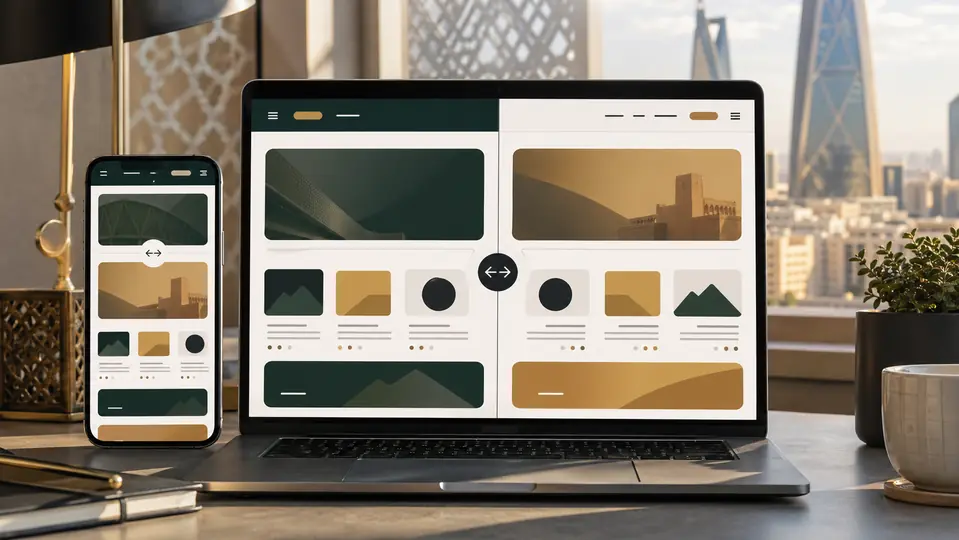
A practical 2026 guide to web development in Saudi Arabia covering Arabic-English UX, payments, ZATCA-aware handoffs, performance, ownership, integrations, and support. Ijjad reports 20+ government and enterprise digital products; supporting project records are private. The named client work on this site is live and independently checkable; the government and enterprise projects stay anonymized under NDA.
What does web development in Saudi Arabia involve in 2026?
Modern web development in Saudi Arabia can require bilingual Arabic-English UX, relevant payment integrations, security, performance budgets, and requirements such as ZATCA or PDPL where they apply. Ijjad reports 20+ government and enterprise digital products; supporting client records are private. Exact scope is confirmed after discovery.
- Fast, secure builds that stay quick as they grow.
- Arabic-first bilingual UX with proper RTL.
- Mada, STC Pay, and ZATCA context where your project needs it.
- Structured for Google, Bing, and AI answers alike.
Web development in Saudi Arabia can involve bilingual UX, payment integrations, performance, security, search foundations, and sector-specific requirements. This guide explains the regional decisions to scope in 2026 and how to compare providers without treating rankings, AI citations, or compliance as guaranteed outcomes.
TL;DR: web development in Saudi Arabia, 2026
- Saudi builds live or die on five things: bilingual Arabic/English (RTL), Mada and STC Pay, PDPL and ZATCA compliance, Core Web Vitals (INP), and AI-search readiness.
- In the sample reviewed for this guide, many ranking pages emphasized price or general agency claims while giving limited detail on compliance and engineering.
- Choose a partner with the 3S Framework: Strategy, Skill, Support. Not the cheapest quote.
- Ijjad is an Amman-based team serving Riyadh, Jeddah, plus the wider GCC. Ijjad reports 20+ government and enterprise digital products; client records are private.
What “web development in Saudi Arabia” actually means in 2026
Web development is the engineering layer of a website: the code, content management, integrations, performance work, and security that turn a design into a usable product. In Saudi Arabia, digital service delivery is central to Vision 2030, while internet-use data from GASTAT supports planning for a highly connected market. The exact expectations on language, on devices, on payment and on service still need to be validated for the product's target users.
That means a build in Riyadh or Jeddah is not the same project as a build in London or Dubai. The same brochure site needs a right-to-left Arabic layout that reads natively, a checkout that accepts Mada, and structured data that earns a place in Google’s AI Overviews and in answers from ChatGPT, from Perplexity and from Gemini. Skip any of those and the site looks fine in a demo but underperforms in the market.
Below is a short, plain-English explainer of how web development works end to end, useful background before you scope a Saudi project.

Web Development Explained In Under 4 minutes
Watch on YouTube · CodeHead
The takeaway for a Saudi project: the frontend (what users see) and the backend (data, payments, integrations) are separate problems, and the regional requirements below mostly live in the backend and the build process, which is exactly where cheap templates fall short.
What Saudi web development costs
This guide promises cost in its title, so here is the published market before the detail. Three Saudi agency guides put a number on the same two tiers. None of these are Ijjad prices.
| Published guide | Business site, 5 to 8 pages | E-commerce store |
|---|---|---|
| Safwa Web | SAR 1,500 to 3,000 | SAR 3,500 to 10,000 |
| Digital Gravity | SAR 3,500 to 12,000 | SAR 25,000 to 115,000 |
| Digital Wasfa | SAR 8,000 to 20,000 | SAR 25,000 to 60,000 |
Sources read 1 August 2026, Digital Wasfa re-checked 2 September 2026 (its page is marked last updated June 2026): Safwa Web, Digital Gravity, Digital Wasfa. Each figure is one agency’s published positioning rather than an independent market survey, and not an Ijjad quote.
The disagreement is the finding. On e-commerce the lowest published floor and the highest published ceiling differ by a factor of more than thirty, which tells you these are positioning statements rather than a market rate. Use them to judge whether a quote you receive sits inside the published spread. Do not use them to predict your own number. The dedicated Saudi cost guide breaks the tiers down and shows where each source disagrees.
The five things that make Saudi web development different
Strip away the generic advice and the Saudi market comes down to five engineering decisions. A guide that skips these is writing about web development in general, not web development in Saudi Arabia.
- Bilingual Arabic and English, done at the layout level. Real Arabic support is not a translation plugin. It is a right-to-left layout with logical CSS properties, mirrored components, and Arabic typography that does not break line height. Build it in from day one or you rebuild later.
- Mada and STC Pay are required at checkout. Mada is the domestic card rail behind the overwhelming majority of Saudi card transactions. A checkout that only takes Visa and Mastercard quietly loses local buyers. Plan for Mada, STC Pay, and buy-now-pay-later (Tabby, Tamara) from the start.
- PDPL and ZATCA compliance. The Personal Data Protection Law (PDPL) governs how you store and move user data, and ZATCA Phase 2 e-invoicing applies the moment you sell. These are build-time decisions about data residency and invoicing, not afterthoughts.
- Core Web Vitals, especially INP. Google now measures Interaction to Next Paint. A heavy template that lags on a mid-range Android phone, the typical Saudi device, loses both rankings and conversions. See the web.dev INP guide for what “fast enough” means in 2026.
- AI-search and GEO readiness. A growing share of Saudi research starts in an AI assistant or an AI Overview. Structured data, clear entity signals, and direct-answer content decide whether your business gets cited. Google documents the supported types in Search Central, and the vocabulary lives at schema.org.
None of these five are exotic. They are the baseline a Saudi business should expect in 2026, and the reason a generic international agency often underdelivers here: they design for a single language, a single card network, and a single regulatory regime, then treat Arabic, Mada, ZATCA as change requests. Building them in from the first sprint is cheaper than retrofitting them after launch, and far cheaper than rebuilding a site that never converted because the Arabic layout felt like an afterthought.
What a Saudi web development project actually looks like
A well-run build is not a black box. Whether the partner is in Riyadh, Jeddah, or Amman, the shape of the work is similar, and knowing the stages helps you spot a team that is winging it.
- Discovery and scope. The team learns your market, your customers, your competitors, and how Saudi users actually search — in Arabic and English. This is where compliance needs (PDPL, ZATCA), payment requirements, and bilingual scope get pinned down, before a line of code is written.
- Design and content. Wireframes and a visual system that work right-to-left and left-to-right, with Arabic typography treated as a first-class citizen rather than a mirrored afterthought. Real content beats lorem ipsum here: copy is part of conversion and part of how AI engines understand the page.
- Build. Frontend and backend engineering, payment and integration work, plus the structured data that makes the site legible to Google and to AI assistants. A good team ships in increments you can review, not one big reveal at the end.
- QA and performance. Test on representative devices and network conditions for the target audience, then tune against documented Core Web Vitals budgets. Good performance supports usability and search readiness but does not guarantee rankings or conversions.
- Launch and support. A clean deployment, analytics and Search Console wired up, and an ongoing plan for the changes that keep coming: browser updates, ZATCA rule changes, the moving target of AI search.
If a prospective partner cannot describe these stages and where the Saudi-specific decisions sit inside them, that is a signal. The market rewards teams that have done this before, in this region, in both languages.
Custom build vs template vs platform: an honest comparison
There is no single right answer. The honest version: a template is fine for a simple brochure, a platform (Salla, Shopify) is fine for a standard store, and a custom build earns its keep when bilingual control matters as much as performance and compliance, all at once. Here is how the three options trade off on the dimensions that actually decide a Saudi project.
| Dimension | Template / page builder | Platform (Salla, Shopify) | Custom (Next.js / Laravel) |
|---|---|---|---|
| Time to launch | Usually the shortest path; verify setup and content | Depends on the catalog, the theme and the integrations | Confirmed after discovery and dependency review |
| Bilingual / RTL control | Limited | Good for stores | Full control |
| Mada / STC Pay | Add-on dependent | Native | Native, any gateway |
| ZATCA e-invoicing | Manual / plugin | Built in | Built to spec |
| Core Web Vitals / INP | Often poor | Decent | Best achievable |
| AI-search / schema control | Limited | Partial | Full control |
| Custom features / integrations | Minimal | App-store limited | Unlimited |
| Scalability | Low | Medium-high | High |
| Ongoing cost profile | Low | Subscription + apps | Build + maintenance |
| Best for | Simple brochure | Standard store | Brand sites, portals, apps |
If you are weighing a store platform specifically, our web development in Saudi Arabia service page and the deeper 2026 review of Saudi web development companies go further on the trade-offs.
We audited the pages ranking for “web development in Saudi Arabia”
Before writing this, we pulled the pages currently ranking for the term across Google and Bing and measured them. The pattern is clear: the SERP is split between price-led cost guides and thin agency landing pages, and almost none cover compliance, bilingual engineering, or AI-search as development requirements. That is the gap.
For each ranking page we recorded the word count, the schema types present, the FAQ count, whether it addresses Saudi compliance, and whether it brings any original data. Here is the picture:
| Page type | Word count | Schema | Covers compliance? | Original data? |
|---|---|---|---|---|
| Agency guide (EON) | ~1,800 | Minimal | No | No |
| Cost guide (Naveck) | ~4,500 | None detected | No | Price tables only |
| Agency landing (BSMART) | ~1,500 | Unknown | No | No |
| Directory (Clutch) | ~800 | ItemList, Review | No | Review counts |
| Riyadh-only agency (WASFA) | ~900 | Unknown | No | No |
The lesson is not “write more words.” It is that a page which treats Mada, ZATCA, PDPL, bilingual RTL, and INP as core engineering requirements, with real data behind it, is more useful than a longer price table. That is what we set out to build here.
How to choose a web development partner: the 3S Framework
The cheapest quote is rarely the cheapest project. We score every vendor decision through the 3S Framework (Strategy, Skill, Support):
- Strategy. Do they ask about your market, your customers, and how Saudi users search before talking tech? A partner who leads with strategy builds the right thing, not just a thing.
- Skill. Can they show real engineering (bilingual builds, payment integrations, fast Core Web Vitals), not just screenshots? Ask for a live site and run it through PageSpeed Insights yourself.
- Support. What happens after launch? ZATCA rules change, browsers update, and AI-search keeps moving. A one-time build with no support plan ages fast.
Proof, not promises
In an anonymized first-party Riyadh case, a nine-week rebuild took an SME website from a PageSpeed score of 42 to 94 and, over the six months that followed, Ijjad reports qualified leads moving from about 3 to 9 a month. The full anonymized breakdown is in our Riyadh website redesign case study.
For context on who is doing this work: Ijjad is based in Amman, Jordan (+962 79 565 0502), and serves clients across Riyadh, Jeddah, plus the GCC. Ijjad reports 20+ government and enterprise digital products; client deployment records are not public. You can read more about founder Karam Abd Al Qader on the founder profile.
Riyadh vs Jeddah: does location change the build?
For the engineering itself, not much: the Saudi requirements are national. What changes is market context: Riyadh skews toward enterprise and government-adjacent B2B buyers, while Jeddah leans commercial: retail and trade. That shifts content strategy and conversion design more than the codebase. We keep dedicated pages for web development in Riyadh and web development in Jeddah for that reason. Wherever you are, the build standard (bilingual, compliant, fast) stays the same.
Where this guide might be biased
In the interest of transparency: Ijjad builds websites for a living, so this guide naturally argues for doing things the way we do them. That is a conflict of interest, even where the reasoning holds up. A few honest caveats: if you need a simple one-page brochure on a tight timeline, a good template will beat any custom build on cost and speed. If you are running a standard catalog store, Salla or Shopify may serve you better than a custom platform. And we did not benchmark every agency in the Kingdom; this is a framework for evaluating partners, not a ranked directory. Use the 3S Framework to judge us by the same standard.
Free: the Saudi web build readiness checklist
Free Download
The Saudi Web Development Checklist (PDF)
The five requirements on one page you can take to any vendor — bilingual, Mada/STC Pay, PDPL/ZATCA, Core Web Vitals, and AI-search readiness, with the exact questions to ask so you can score quotes side by side.
Frequently asked questions
How much does web development cost in Saudi Arabia?
It depends entirely on scope: a brochure site, a bilingual store and a custom portal are three different projects. Rather than quote a number that misleads, we scope after a short discovery call so the estimate reflects your actual features, your integrations and your compliance needs.
Which technologies are used for web development in Saudi Arabia?
For custom builds, React and Next.js on the frontend and Node.js or Laravel/PHP on the backend are common. Stores often run on Salla, Zid, Shopify, or WooCommerce. The right stack depends on performance needs, bilingual requirements, and integrations.
How long does it take to build a website in Saudi Arabia?
There is no reliable fixed timeline before discovery. A template brochure may have fewer delivery dependencies than a platform store or custom bilingual build, but content readiness, integrations, approvals, testing, whichever requirements apply: these determine the committed schedule.
Do websites in Saudi Arabia need to be bilingual?
Use Arabic, English, or both according to the target users and operating requirements. When Arabic is in scope, it should use a true right-to-left layout and be tested as a complete user journey rather than added as a surface translation.
What compliance rules apply to Saudi websites?
The PDPL governs personal data, and ZATCA Phase 2 e-invoicing applies once you sell. Both are build-time decisions about data handling and invoicing, so raise them before development starts.
What payment gateways should a Saudi website support?
Mada is essential, alongside STC Pay and major cards. Buy-now-pay-later options like Tabby and Tamara are increasingly expected in retail. HyperPay, Moyasar, Tap: three common aggregators.
Should I hire a freelancer or a web development company?
A freelancer can suit a small, well-defined job. For bilingual, compliant, performance-critical builds that need ongoing support, a team with proven Saudi delivery reduces risk; judge either through the 3S Framework.
Let's turn this into leads.
We build fast, bilingual, conversion-focused sites for SMEs and founders across the region.
Get StartedSource note
Market context: Saudi Arabia's digital economy reached 16.0% of GDP in 2024, according to the General Authority for Statistics, published December 31, 2025. This is why Ijjad treats modern websites, SEO, e-commerce, AI MVPs, and mobile experiences as business infrastructure across Saudi Arabia, Jordan, Iraq, and the GCC.