Industry-by-industry breakdown of why every business in Jordan and the GCC needs a professional website. Country comparisons, maturity scale, and common excuses debunked with data. Updated for 2026.
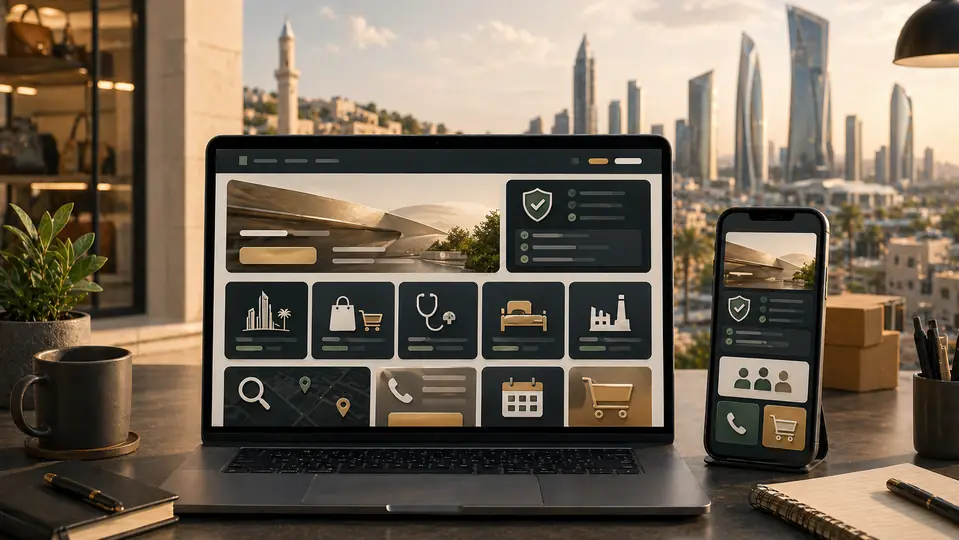
Why does every business in Jordan and the GCC need a website?
Every serious business in Jordan and the GCC needs a website because buyers search online first, social platforms are rented space, and a fast Arabic-English website turns trust, search visibility, and leads into owned business value. That is the premise Ijjad builds from.
- A website is owned digital real estate.
- Search visibility can be measured over time.
- Arabic-English UX builds regional trust.
- Social media should feed the website, not replace it.
Across Jordan and the GCC, a website can connect regional search, referrals, map listings, social traffic, and campaigns to one owned destination. Its value depends on whether the experience matches the market and produces qualified actions.
Before commissioning a build, inspect the current buyer path. Can people find the right service, language, location, proof, contact option? Which searches and referrals lead to qualified enquiries today?
This guide maps common industry jobs to market-specific website requirements and measurable outcomes. Use it to define a baseline and a scope, not as a promise that every business receives the same result.
The GCC Website Value Chain
Baseline each target market separately and connect analytics events to qualified CRM outcomes.
In This Guide:
The GCC Digital Snapshot: Country by Country
The GCC is not a single market. Language, payment, regulation, procurement, logistics, buyer expectations: all change by country and sector. Plan each market against those requirements:
GCC Website Planning by Market
| Country | Buyer context | Build priority | Measure |
|---|---|---|---|
| 🇸🇦 Saudi Arabia | Arabic-English buyers and local commerce requirements | Local payments, regulatory context, and city/service pages | Qualified KSA queries and contact or checkout events |
| 🇦🇪 UAE | Multilingual regional and international audiences | Clear market positioning, language, service coverage | Qualified enquiries by market and language |
| 🇯🇴 Jordan | Local discovery plus regional service exports | Google Business Profile, Arabic-English pages, proof | Map, branded-search, service-page enquiries |
| 🇰🇼 Kuwait | Market-specific buyer and payment expectations | Localized offer, payment, delivery, support details | Kuwait landing-page and conversion events |
| 🇧🇭 Bahrain | Compact market with regional buying journeys | Specific service fit, trust, contact ownership | Qualified enquiries and assisted conversions |
| 🇶🇦 Qatar | B2B, services, hospitality, local procurement needs | Sector pages, credentials, clear response path | Qualified sector and procurement enquiries |
The consistent thread is operational: each target market needs a clear offer, appropriate localization, trustworthy proof, and a contact or checkout path that can be measured.
For businesses serving multiple markets, a bilingual website can provide one controllable foundation while keeping country-specific pages, requirements, reporting separate. Service-area copy must not imply a physical office where none exists.
Website Impact by Industry
The useful question is what job the website must do in your industry and how that job will be measured:
Website Impact by Industry
How a professional website affects different business sectors in the GCC
Connect menus, locations, reservations, ordering, map visibility.
Measure: Menu views, booking starts, orders, calls
Explain services, practitioners, locations, appointment options clearly.
Measure: Qualified appointment requests by service page
Give buyers searchable products, local payment choices, delivery details, and support.
Measure: Product-to-checkout and completed-order funnel
Publish current listings, location context, licensing details, and useful filters.
Measure: Listing enquiries and qualified buyer intent
Show expertise, relevant work, process, ownership, a clear contact path.
Measure: Qualified enquiries by service and market
Connect course information, schedules, eligibility, enrollment, learner support.
Measure: Course-detail to enrollment completion
Present rooms, experiences, policies, availability, direct booking options.
Measure: Booking starts, completions, assisted enquiries
Organize capabilities, project evidence, certifications, tender documents.
Measure: Qualified project and procurement enquiries
For a physical business, connect the website and Google Business Profile to directions, calls, bookings, menus, inventory, or appointment actions—and measure each path.
Not every industry needs the same website. A clinic appointment flow, restaurant menu, property listing, professional-services proof page, and B2B procurement library solve different buyer tasks.
If the current buyer path has a verified gap, scope professional web design around that gap, the required integrations, and the events that will prove whether the change helped. Timing and payback depend on the actual project and demand.
Website Maturity Scale: Where Is Your Business?
Not all websites are created equal. A poorly built website can sometimes be worse than no website at all: if it loads slowly, looks unprofessional, or doesn't work on mobile, it actively damages your credibility.
Use this scale to assess where your business currently stands:
Website Maturity Scale: Where Is Your Business?
Use this as a planning rubric, not a statistic about the GCC market.
No owned landing-page or contact baseline to measure.
Audit content, mobile UX, performance, ownership.
Add market-specific pages and qualified-event tracking.
Report queries, landing pages, and qualified enquiries.
Attribute qualified outcomes and improve from evidence.
Value increases when the website moves from mere presence to a measured buyer journey: useful pages, credible proof, qualified contact events, and reporting connected to business outcomes.
For more details on what each level requires, read our guide on web development services and our breakdown of why professional web development delivers the best ROI.
Common Excuses, and Why They Don't Hold Up
We've heard every reason for not having a website. Here is an evidence-led way to test each one:
Common Excuses, and Why They Don't Hold Up
Still unsure about the investment? Share the market, buyer task, integrations, current baseline through Ijjad's contact form for a scoped recommendation.
What Your Business Website Actually Needs
The good news: you don't need a complex 50-page website to start seeing results. For most businesses in the GCC, here are the essentials:
Mobile-first design. Test the priority buyer journeys on real phone sizes, input methods, languages, connection conditions. Google uses the mobile version of a site for indexing, but device quality still needs rendered testing.
Bilingual Arabic + English. If you serve Arabic-speaking customers (and in the GCC, you do), proper bilingual support with correct RTL layout is essential. Badly formatted Arabic damages your credibility. Properly designed Arabic content opens up a massive, underserved SEO opportunity.
Measured performance. Set a page-specific performance budget, test the rendered site, and monitor field data where available. A framework alone does not guarantee a load time, Core Web Vitals result, ranking, or conversion outcome.
SEO foundations. Title tags, meta descriptions, heading structure, clean URLs, schema markup: these technical SEO elements need to be built into the code from day one. Bolting them on later is more expensive and less effective.
Lead capture. Contact forms, WhatsApp integration, click-to-call buttons, and booking systems. Your website should make it effortless for interested visitors to take the next step.
Google Business Profile connection. Your website and your GBP listing should work together, driving local search visibility and building review-based credibility.
Frequently Asked Questions
How should I compare GCC e-commerce markets?
Compare market-specific search demand, payment methods, delivery operations, language, regulation, competition, qualified conversion data. A regional headline does not show whether a market fits your catalog and operating model.
I have a physical store; do I really need a website?
A website and Google Business Profile can help local buyers verify the business and take a measurable action such as directions, a call, a booking, a menu view, or an inventory enquiry. Confirm the need from the store's actual discovery and customer journey.
What type of website does my industry need?
It depends on the business model and buyer task. A restaurant may need menus or reservations, healthcare may need appointment requests, retail may need e-commerce, and professional services may need portfolios and lead capture. Validate responsive behavior, in-scope languages, crawlability, measurement without imposing every feature on every business.
How is a website scoped in the GCC?
Professional websites start lean for basic business sites in both Jordan and Saudi Arabia. Complex e-commerce or web application projects are scoped after a discovery call. Try our contact form for a scoped recommendation.
Can social media replace a business website?
Social media can be enough for an early or social-first business, but the platform controls audience access and page format. A website becomes useful when the business needs owned search pages, stable content, lead measurement, integrations, or a durable destination for campaign and map traffic.
What should a 2026 business website include?
Include only what the buyer journey and operating model require: responsive design, relevant languages, useful service or product information, measurable contact paths, crawlability, privacy and security controls, plus maintainable ownership. Add structured data, local-profile links, payments, or checkout only when the visible content and business genuinely support them.
Build a Website You Can Measure
Ijjad serves businesses across Jordan, Saudi Arabia, and the GCC. Ijjad reports 20+ government and enterprise digital products; supporting project records are private.
Get StartedShare your target market, buyer task, and current baseline.
Source note
Market context: Saudi Arabia's digital economy reached 16.0% of GDP in 2024, according to the General Authority for Statistics, published December 31, 2025. This is why Ijjad treats modern websites, SEO, e-commerce, AI MVPs, and mobile experiences as business infrastructure across Saudi Arabia, Jordan, Iraq, and the GCC.