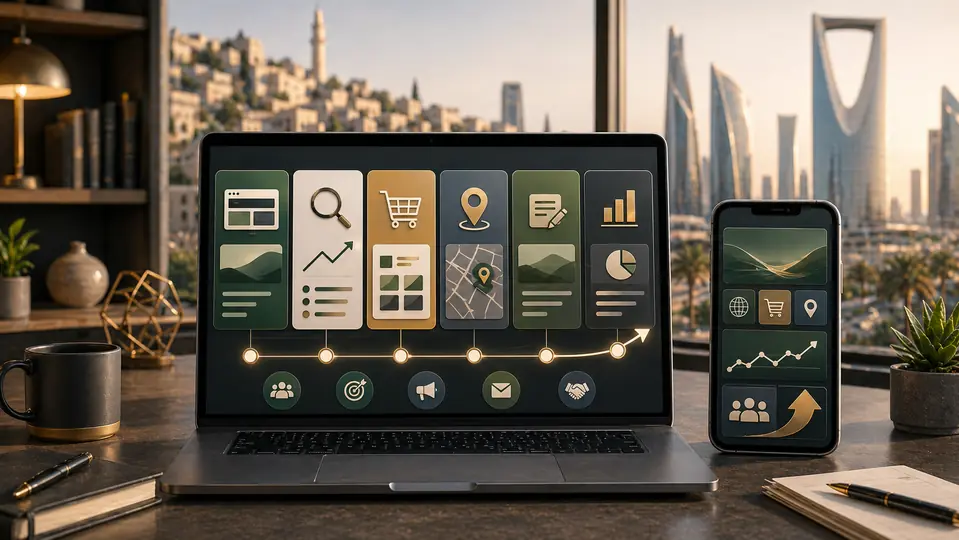
How an owned website supports buyer trust, search visibility, and measurable enquiries across Jordan, Iraq, Saudi Arabia, and the GCC.
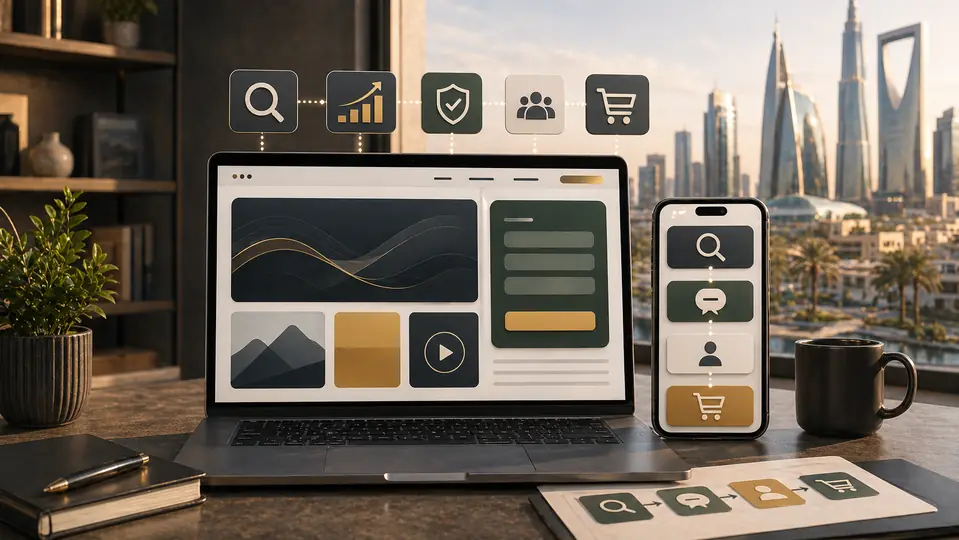
Why Website Is Important for Business: The Straight Answer
An owned website can give buyers one place to verify an offer, proof, location, and contact options. It can connect search and referral demand to measurable forms, calls, bookings, or WhatsApp actions while giving the business control over content and analytics.
- Ijjad serves Amman, Riyadh, Jeddah, Iraq, and the GCC.
- Every recommendation is framed around scope, conversion, and search visibility.
- Use the guide to clarify decisions before speaking with an agency.
- Talk to Ijjad when you need senior delivery, not generic templates.
A website gives buyers one place to verify what your business does, where it operates, what evidence supports it, and how to take the next step. It also gives you an owned path from search or referral to a measurable enquiry.
If you operate without a website, or with one that no longer reflects the business, audit the buyer journey before assuming a redesign will fix it. Check whether people can find the right page, understand the offer, inspect credible proof, and contact you without friction.
This guide explains why a website is important for business through buyer tasks and metrics you can verify. The same framework works for a restaurant in Amman, a consulting firm in Riyadh, or a startup serving several GCC markets.
Buyer Value You Can Measure
Record the baseline before launch, then compare qualified outcomes by landing page and market.
In This Guide:
- 1. What Your Customers Actually Do Before Buying
- 2. How to Measure Regional Online Demand
- 3. 7 Concrete Reasons a Website Drives Business Growth
- 4. Business With a Website vs. Without (Comparison)
- 5. The Real ROI of a Business Website
- 6. "But I Have Social Media" — Why It's Not Enough
- 7. Getting Started: What Your Website Needs
- 8. FAQ
What Your Customers Actually Do Before Buying
Buyers can encounter your business through a recommendation, search result, map listing, directory, social post, or advertisement. A website gives each source a stable destination with enough context to evaluate the offer.
Think about your own behavior. When someone recommends a restaurant, a contractor, or a service provider — what's the first thing you do? You Google them. You look for a website. You check reviews. If you find nothing — or find a website that looks unprofessional — you move on.
Your customers do exactly the same thing.
How Customers Actually Find & Choose a Business
A website creates an owned path you can inspect from landing page to qualified enquiry.
Measure the verification step instead of assigning it an industry-average loss. Use tagged referral links, branded-search queries, profile insights, calls, form submissions, and CRM qualification to see whether referred buyers reach a useful page and contact the business.
How to Measure Regional Online Demand
National internet-use figures do not tell you how much qualified demand exists for your service. Start with the exact markets, services, languages, buyer actions your business needs.
For Jordan, Saudi Arabia, Iraq, or another GCC market, record the search baseline, landing pages, contact events, and qualified outcomes separately. This makes the business case specific to your audience rather than a generic regional statistic.
Measure Regional Demand Against Your Own Baseline
Use the same funnel definition for Jordan, Saudi Arabia, Iraq, each GCC market.
Agree attribution and qualification rules before comparing performance.
The useful question is not whether people in the country use the internet. It is whether qualified buyers can find the right page, understand the offer, and complete a trackable next step.
In Saudi Arabia, add the requirements that apply to the project: Arabic-English UX, local payment methods, regulatory context, or procurement evidence. In Jordan and Iraq, validate the equivalent local search, language, payment, trust requirements rather than copying one market's assumptions.
7 Concrete Reasons a Website Drives Business Growth
Let's move beyond vague claims. Here are seven specific, measurable ways a website impacts your bottom line:
1. Credibility That Converts
Credibility comes from clear ownership, current contact details, specific service information, relevant work, truthful testimonials, and an understandable process. Track whether visitors move from those proof points to a qualified contact action.
2. Your 24/7 Sales Team
Your website doesn't take breaks, holidays, or sick days. It generates leads, answers questions, and showcases your work at 3 AM on a Friday just as effectively as it does at noon on a Tuesday. For businesses in Jordan serving Saudi clients (or vice versa), a website bridges the time zone gap effortlessly.
3. Market Reach Beyond Your City
A physical store serves customers within driving distance. A website serves customers across Amman, Riyadh, Jeddah, Dubai — and anywhere in the world. For service businesses especially, a professional website opens doors to clients you'd never reach otherwise.
4. Lead Generation on Autopilot
Contact forms, WhatsApp links, booking systems, and click-to-call actions create trackable paths for interested buyers. Mark the qualified actions as analytics events and reconcile them with the CRM before claiming a revenue effect.
A website earns commercial value when a buyer can find the right page, understand the offer, and complete a contact action that the business can qualify.
5. SEO: Getting Found When It Matters
Service and location pages can earn visibility for relevant searches and give buyers a better destination than a short profile. Measure query impressions, clicks, landing-page engagement, and qualified enquiries; no page or ranking is guaranteed.
6. Data-Driven Decisions
With Google Analytics on your website, you know exactly how visitors find you, what pages they visit, how long they stay, and where they drop off. This data tells you what's working and what isn't, so you can make smarter business decisions instead of guessing.
7. Competitive Advantage
A competitive website is specific rather than merely present. Publish distinct service pages, explain regional requirements, show verifiable proof, and make the contact path easy to test. Compare those elements against the actual alternatives buyers see in search.
If you're starting to realize your website isn't pulling its weight — or if you don't have one at all — that's exactly the kind of challenge that professional web design teams solve every day. Sometimes the smartest move is getting expert help from the start.
Business With a Website vs. Without: The Full Picture
Let's lay it out side by side. This comparison shows how having a professional website impacts every aspect of how customers find, evaluate, choose your business:
Business With a Website vs. Without
| Factor | With Website ✅ | Without Website ❌ |
|---|---|---|
| 🔍Customer Discovery | Found via Google, Maps, social links | Only word-of-mouth & foot traffic |
| ✨First Impression | Professional, credible, trustworthy | Invisible or looks outdated |
| 🕐Available Hours | 24/7 — even while you sleep | Only during business hours |
| 🤝Customer Trust | Proof, process, ownership, contact details in one place | Harder for buyers to verify the business |
| 📈Lead Generation | Contact forms, chat, booking systems | Phone calls only |
| 🌍Market Reach | Amman, Riyadh, entire GCC — and beyond | Limited to your physical area |
| 💰Commercial Measurement | Attribute landing pages to qualified enquiries | No owned conversion path to measure |
| 🏆Competitive Position | Publish distinct service, market, proof pages | Rely on platforms and directories for context |
The practical difference is control: a website lets you publish complete context, connect acquisition sources to landing pages, and measure contact outcomes in one owned system.
The Real ROI of a Business Website
Business owners in Jordan and Saudi Arabia often ask: "Is a website worth the investment?" Answer that with the business's own acquisition, qualification, close-rate, value data:
Website ROI: Use Your Own Inputs
Build a baseline from your analytics and CRM instead of using an industry-average promise:
Do not assume a default conversion rate or payback period. Record the inputs, attribution rules, and comparison window.
Use search data, analytics events, and CRM outcomes from a defined comparison window. Report qualified regional demand separately from irrelevant traffic.
Professional websites are scoped after discovery because content, integrations, languages, compliance, ownership needs vary. Calculate payback only after the real implementation cost and attributable business value are known.
Not sure what your website should scope? Ijjad offers a free contact form that gives you a realistic scope based on your specific needs. No guesswork, no surprises.
"But I Have Social Media" — Why It's Not Enough
This is the most common pushback we hear from business owners in the region. "I have 10,000 followers on Instagram — why do I need a website?"
Here's why social media alone is a risky strategy:
You don't own the platform. Instagram, Facebook, TikTok control their algorithms, page formats, and audience access. Your website gives you direct control over content, analytics, conversion paths.
You can't rank on Google with a social profile. When someone searches "accounting firm Amman" or "interior designer Riyadh," Google shows websites in the results — not Instagram pages. If your only presence is social, you're invisible in search.
Social media has limited functionality. You can't add a booking system, a detailed portfolio, a scope calculator, or a comprehensive FAQ section to an Instagram bio. A website gives you unlimited space to educate, convince, convert visitors.
Professional perception matters. When a potential B2B client evaluates your business, a polished website signals professionalism in a way that a social media page simply cannot. This is especially true in the Saudi and Jordanian markets, where business relationships are built on trust and credibility.
The smart approach? Use both. Social media drives awareness and engagement. Your website converts that attention into leads and sales. They work together — but the website is the foundation.
Getting Started: What Your Business Website Needs
You don't need a 50-page website to start seeing results. For most businesses in Jordan and Saudi Arabia, a well-built 5-7 page website covers everything. Here's the essential checklist:
Business Website Essentials Checklist
Does your current website check all these boxes?
If a gap affects discovery, credibility, conversion, or measurement, add it to the launch plan. Request a scoped website review from Ijjad →
The key is quality over quantity. A fast, professional, mobile-optimized 5-page website will outperform a slow, cluttered 30-page site every time. Focus on making those few pages excellent.
This is where working with a team that understands modern web development and the regional market pays off — from strategy to design, development, SEO that compounds long after launch.
Frequently Asked Questions
How is a business website scoped in Jordan?
Professional websites in Jordan are typically scoped after discovery. A basic informational website takes 2-4 weeks, while complex e-commerce platforms may take 6-12 weeks. The planning depends on features like payment integration and custom functionality. Use Ijjad's contact form for a scoped recommendation.
Can a website really help a small business in Saudi Arabia?
A website can help a Saudi small business publish Arabic-English service information, connect Google Business Profile and search demand to owned landing pages, and measure form, call, booking, or WhatsApp actions. The result depends on the offer, market, visibility, follow-up process, so establish a baseline before launch.
Do I need a website if I already have social media?
Yes. Social media is rented space — you don't control the algorithm, reach, or rules. A website is digital property you own. It ranks on Google, captures leads directly through forms, and provides a professional first impression that social profiles alone can't match. The best strategy is using both together.
How long does it take to build a business website?
A basic informational website can be live in 2-4 weeks. More complex sites with custom features, e-commerce, or mobile app integration typically take 6-12 weeks. The timeline depends on content readiness, design complexity, and required integrations.
Will a website help me get more customers from Google?
Absolutely. A properly optimized website with strong SEO and an active Google Business Profile can dramatically increase your visibility in local search results. When someone searches for your type of business in your city, you want to be the one they find.
Ready to Build an Owned Customer Path?
Ijjad reports 20+ government and enterprise digital products; supporting project records are private. Let's scope a website around your target markets and qualified contact actions.
Get Your Free Consultation →No commitment. Just a conversation about what's possible.
Source note
Market context: Saudi Arabia's digital economy reached 16.0% of GDP in 2024, according to the General Authority for Statistics, published December 31, 2025. This is why Ijjad treats modern websites, SEO, e-commerce, AI MVPs, and mobile experiences as business infrastructure across Saudi Arabia, Jordan, Iraq, and the GCC.