A builder's guide to fintech app development in Saudi Arabia for 2026 — how SAMA licensing, the regulatory sandbox, Nafath KYC, Mada rails, Arabic-English UX, and security controls affect engineering decisions.
How do you build a fintech app in Saudi Arabia in 2026?
A Saudi fintech app needs SAMA-rulebook-aware architecture, native Mada and STC Pay, NAFATH KYC, and the trust patterns Saudi users expect. Ijjad builds to that spec, coordinating with the client's compliance partner and drawing on 20+ government and enterprise products shipped across the Kingdom and the GCC.
- SAMA-rulebook-aware architecture from day one.
- Native Mada and STC Pay — not WebView payment flows.
- NAFATH KYC that can verify in under 90 seconds.
- Native vs cross-platform trade-offs explained plainly.
Fintech app development in Saudi Arabia is a regulatory project as much as an engineering one. The hard part is not writing the code; it is mapping SAMA licensing, the regulatory sandbox, Nafath identity, Mada payment rails, and the SAMA Cybersecurity Framework onto a product you can actually ship. This guide walks through how the regulation translates into build decisions, what the SERP gets wrong, and how to choose a partner who has done it before.
TL;DR: building a fintech app in Saudi Arabia, 2026
- Decide your regulatory path first: SAMA (payments, lending, wallets) or CMA (capital markets), and whether you enter through the regulatory sandbox.
- Five build decisions are unique to Saudi: licensing and sandbox, Nafath KYC plus AML/CFT, Mada and STC Pay rails, the SAMA Cybersecurity Framework plus data residency, then Arabic-first (with an optional Sharia-compliant model).
- Most pages ranking for this term are either pure legal explainers or USD cost guides; few map regulation to engineering.
- Ijjad is an Amman-based team serving Riyadh, Jeddah, plus the wider GCC, with 20+ shipped products.
What “fintech app development in Saudi Arabia” involves in 2026
Fintech app development is the work of turning a regulated financial idea (a wallet, a lending product, a payments app, a robo-advisor) into a licensed, secure, production-grade mobile product. In Saudi Arabia, that work sits inside one of the most deliberately built fintech ecosystems in the region. Growing the sector is an explicit Vision 2030 goal, pursued through the Financial Sector Development Program (Vision 2030, 2024), and the market is overwhelmingly mobile: internet penetration sits near 99% as of 2024 (GASTAT), with a young, digitally native population that already lives in apps like STC Pay.
That context changes what “building an app” means. A fintech product in Riyadh or Jeddah is not a startup MVP you can ship in a weekend and patch later. Before a single screen ships, you have to answer regulatory questions: who licenses you, how you verify identity, how you move money, where data lives, and how you prove the whole thing is secure. The teams that succeed treat those answers as engineering requirements from day one, not as legal paperwork bolted on at the end.
Here is a short look at how open banking and APIs are reshaping Saudi fintech, useful market and regulatory context before you scope a build.

APIs and Open Banking in Saudi Arabia
Watch on YouTube · The Financial
The takeaway: open banking and a maturing payments stack mean the rails you build on are richer than they were a few years ago, but they also come with regulators who expect you to use them correctly.
The regulatory map: SAMA, CMA, the sandbox
Two regulators matter. The Saudi Central Bank (SAMA) governs banking, payments, digital wallets, lending, most of what people mean by “fintech.” The Capital Market Authority (CMA) governs anything touching securities: equity crowdfunding, robo-advisory, debt instruments, fund distribution. Your product idea decides which door you walk through, and some products touch both.
You usually do not start with a full license. SAMA runs a regulatory sandbox that lets you test a real product with real customers in a controlled environment, and the CMA runs an equivalent FinTech Lab for capital-markets ideas. The sandbox is the pragmatic on-ramp: it lets you prove the model and refine compliance before committing to a full-scale launch. For a new fintech starting with minimal controls, reaching mature compliance commonly takes nine to eighteen months of active work, so the build and the licensing run in parallel, not in sequence.
One hard line worth knowing early: SAMA takes a cautious stance on crypto. Banks cannot engage in cryptocurrency transactions without explicit SAMA approval, so if your idea touches digital assets, treat that as a gating question before you design anything.
The ecosystem around you is deliberately supportive. Fintech Saudi, the sector body set up jointly by SAMA and the CMA, coordinates regulatory guidance, acceleration programmes, and industry connections, and the move toward open banking means the APIs you can build on are richer every year. That is the upside of building here: the rails, the sandbox, and the support are maturing fast. The cost of that maturity is that regulators expect you to use them properly, which is exactly why the build decisions below are not optional extras but the core of the project.
The five build decisions unique to Saudi fintech
Strip away the generic “how to build an app” advice and Saudi fintech comes down to five decisions where the regulation directly shapes the engineering. A guide that skips these is describing fintech in general, not fintech in Saudi Arabia.
| Requirement | What it means in the build | Why it matters |
|---|---|---|
| SAMA / CMA licensing | Pick the regulator; design for the sandbox first | No legal path means no launch, however good the app |
| Nafath identity / KYC | National digital identity verification at onboarding | Delaying KYC blocks onboarding approval and compliance |
| AML / CFT | Transaction monitoring, sanctions screening, reporting | SAMA scrutinizes this area the hardest |
| Mada + STC Pay rails | Native domestic payment integration, not just cards | Local users expect Mada and STC Pay by default |
| SAMA Cybersecurity Framework | Security architecture, pen testing, PCI DSS | A licensing prerequisite, not a nice-to-have |
| Data residency (PDPL) | In-Kingdom data handling and storage choices | Personal financial data carries strict rules |
| Arabic-first UX | Right-to-left layout designed from wireframes | Trust in a finance app depends on native feel |
| Sharia compliance (optional) | Different transaction logic and disclosures | Changes financial flows, not just UI wording |
Licensing and the sandbox decide your architecture timeline. Nafath KYC is the gate every Saudi financial app passes through: strong identity verification has to be wired into onboarding, and delaying it usually blocks approval. AML and CFT are where SAMA looks hardest: you need customer due diligence, transaction monitoring tuned to catch suspicious activity, sanctions screening at onboarding and in-flight, and reporting that submits suspicious-transaction reports on time. Mada and STC Pay are the rails locals actually use, so a Saudi fintech app ships with both or it does not ship. And the SAMA Cybersecurity Framework turns security from a checklist into a licensing prerequisite: your infrastructure has to be demonstrably secure, scalable and, at your projected volume, proven to cope.
The fifth decision is product strategy: whether you build a conventional model or a Sharia-compliant one. Sharia compliance is not a translation layer; it changes transaction structures, accounting, disclosures, even UI wording. Decide it early, because retrofitting it is a rebuild.
How to build a Saudi fintech app, step by step
A serious build follows a recognizable shape. Knowing the stages helps you tell a team that has shipped a regulated product from one that is improvising.
- Regulatory scoping. Before design, you map the product to SAMA or CMA, decide whether to enter the sandbox, and list the licensing, KYC, AML, cybersecurity obligations. This is where a build either gets a clear path or sets itself up to stall.
- Architecture and security design. You design the data model, the residency strategy, and the security architecture to the SAMA Cybersecurity Framework and PCI DSS, before writing feature code. Security baked in at this stage is cheap; bolted on later, it is a rebuild.
- Arabic-first product design. Wireframes and flows built right-to-left from the start, with Arabic as a first-class language rather than a mirrored afterthought. In a finance app, a clumsy Arabic experience reads as untrustworthy.
- Core engineering. Identity (Nafath), payments (Mada, STC Pay, and cards), the ledger, and the AML monitoring layer. This is the heart of the build, and the integrations are where Saudi-specific experience pays off.
- QA, penetration testing, and audit. Cross-device testing on the mid-range Android phones most Saudis carry, plus independent penetration testing and the evidence trail SAMA expects.
- Sandbox testing and launch. Validate the model with real customers in the regulatory sandbox, refine, then move toward full launch and licensing, with a support plan for the rule changes that keep coming.
If a prospective partner cannot describe these stages and show you where the Saudi-specific decisions sit inside them, that is a signal. Regulated fintech is unforgiving of teams learning on your project.
Native or cross-platform for a Saudi fintech app?
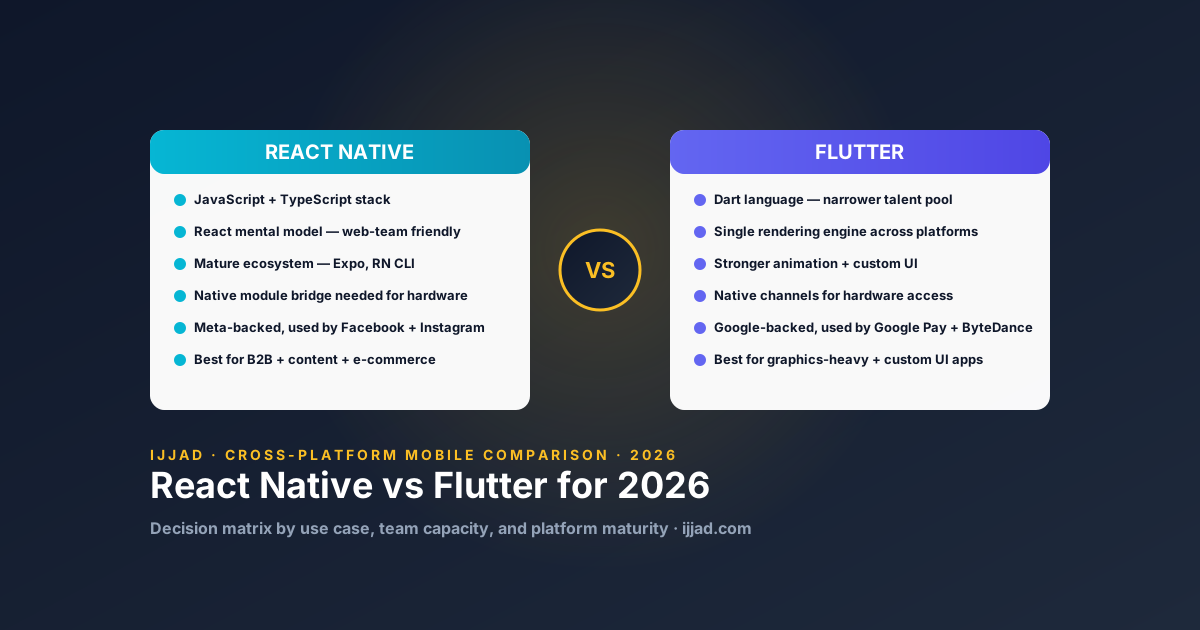
For most Saudi fintech apps, a cross-platform framework is the pragmatic default: it ships iOS and Android from one codebase and the payment SDKs you need (Mada, STC Pay, Tabby, Tamara) tend to have mature support. Go fully native when you need deep hardware integration, the most demanding security posture, or platform-specific biometric flows that justify two codebases. We walk through that trade-off in detail in our React Native vs Flutter comparison, and the broader build options on our mobile app development page. The honest answer is that the framework matters less than the team’s experience with Saudi payment and identity rails.
Do not forget the web surface
A fintech app is never only an app. There is a marketing site that has to rank, an onboarding web flow that some users will start on a browser, and a help centre that should be discoverable. These web surfaces are where a lot of Saudi fintechs quietly lose trust and traffic, because the team pours everything into the native app and treats the website as an afterthought.
Three things keep that surface competitive in 2026. First, performance: the marketing and onboarding pages must pass Core Web Vitals, including Interaction to Next Paint, on the mid-range Android phones most Saudis use; Google’s web.dev guidance is the baseline. Second, structured data: clear, valid schema so the product shows up well in search and in AI answers, following Google Search Central and the vocabulary at schema.org. Third, bilingual Arabic and English done at the layout level, so the brand reads as native to a Saudi audience. A regulated app with a slow, English-only website undersells itself before a user ever downloads it.
We audited the pages ranking for “fintech app development in Saudi Arabia”
Before writing this, we pulled the pages currently ranking for the term across Google and Bing and measured them. The pattern is clear: the SERP splits into pure legal explainers and USD cost guides, with almost nothing that connects the regulation to the code. That is the gap.
For each ranking page we recorded the word count, the schema types present, whether it maps regulation to real build decisions, and whether it brings any engineering depth. Here is the picture:
| Page type | Word count | Schema | Regulation to build? | Engineering depth? |
|---|---|---|---|---|
| Islamic fintech guide (LogioLegion) | ~2,600 | Unknown | Partial (Sharia only) | Thin |
| Agency guide (DashDevs) | ~2,200 | Unknown | Light | Vendor-led |
| Cost guide (Itexus) | ~3,000 | Unknown | No | Price-led |
| Legal report (ICLG) | ~5,000 | Article | No (pure law) | None |
| Market listicle (sdk.finance) | ~1,800 | Unknown | No | Overview only |
The lesson is not “write more words”; the legal report already runs to 5,000. It is that a founder who wants to build needs the regulation translated into engineering decisions: which license, which identity provider, which payment rails, which security framework, and in what order. That translation is what this guide is for.
Five mistakes that stall a Saudi fintech build
Most failed or delayed fintech builds we have seen in the region share the same root causes. They are not exotic; they are the predictable result of treating a regulated product like an ordinary app. Avoid these and you remove most of the risk.
- Treating compliance as the last step. Teams design the product, build it, then ask how to make it compliant. By then the data model, the identity flow, and the security architecture are already wrong for SAMA, and fixing them means reworking the foundation. Compliance is a design input, not a final inspection.
- Delaying identity and KYC. Nafath-based verification feels like plumbing, so teams push it to “later.” But onboarding is the first thing a regulator and a user touch, and a weak KYC flow blocks approval. Build it early and build it well.
- Shipping card-only checkout. An international team wires up Visa and Mastercard, demos it, and plans to add Mada and STC Pay “in phase two.” In Saudi Arabia that is backwards: the domestic rails are the default, and bolting them on later means re-testing the entire payment path.
- Under-investing in security until the audit. The SAMA Cybersecurity Framework and penetration testing are not a formality at the end. Security designed in from the architecture stage is cheap insurance; security retrofitted after a failed audit is an expensive, deadline-wrecking scramble.
- Choosing a partner on price alone. The lowest quote often comes from a team that has never shipped a regulated Saudi product. What looks like a saving becomes months of delay at the licensing stage, when the gaps surface. Track record in regulated fintech is the cheapest risk reduction you can buy.
None of these are hard to avoid once you know to look for them. The thread running through all five is the same: in Saudi fintech, the regulation and the engineering are the same conversation, and any plan that separates them pays for it later.
How to choose a fintech build partner: the 3S Framework
The cheapest quote is rarely the cheapest project, and in regulated fintech a weak partner is expensive in ways that show up at the licensing stage. We score every vendor decision through the 3S Framework (Strategy, Skill, Support):
- Strategy. Do they start with your regulatory path, your customers and how Saudi users behave, before talking tech stacks? A partner who leads with strategy maps the build to SAMA or CMA correctly the first time.
- Skill. Can they show real engineering (Nafath identity, Mada and STC Pay integration, security to the SAMA framework), not just polished mockups? Ask to see a shipped, regulated product and how they handled compliance.
- Support. Fintech rules move. SAMA updates frameworks, payment rails evolve, and identity requirements tighten. A one-time build with no support plan ages into a liability fast.
Proof, not promises
In an anonymized first-party Riyadh case, a nine-week rebuild took an SME website from a PageSpeed score of 42 to 94 and, over the six months that followed, Ijjad reports qualified leads moving from about 3 to 9 a month: the same performance and security discipline a fintech build demands. The anonymized breakdown is in our Riyadh redesign case study.
For context on the publisher: Ijjad is based in Amman, Jordan (+962 79 565 0502) and serves clients across Riyadh, Jeddah, plus the GCC. Ijjad reports 20+ government and enterprise digital products; client deployment records are not public, and that experience does not itself prove fintech security or regulatory readiness. Our dedicated pages cover fintech app development in Saudi Arabia, fintech app development across the GCC, and Vision 2030 app planning.
Where this guide might be biased
In the interest of transparency: Ijjad builds digital products for a living, so this guide naturally argues for doing things the way we do them. That is a conflict of interest, even where the reasoning holds up. A few honest caveats. We are a product and engineering team, not a law firm or a licensed financial advisor; the regulatory points here are orientation, and you should confirm your specific licensing path with SAMA, the CMA, or qualified counsel. If your product is purely a capital-markets play, a CMA-specialist advisor will know that lane better than any generalist. And we did not benchmark every fintech builder in the Kingdom; this is a framework for evaluating partners, not a ranked directory. Use the 3S Framework to judge us by the same standard.
Free: the Saudi fintech build readiness checklist
Free Download
The Saudi Fintech Build Readiness Checklist (PDF)
The five build decisions on one page you can take to any vendor or use to brief your own team: licensing path, Nafath KYC, AML/CFT, Mada and STC Pay rails, the SAMA Cybersecurity Framework, and data residency, with the exact questions to ask at each stage.
The bottom line
Building a fintech app in Saudi Arabia in 2026 is a strong bet: the market is mobile, the rails are maturing, and Vision 2030 is actively pulling the sector forward. But the win goes to teams that respect the order of operations: settle the regulatory path first, design identity, payments, security in from the start, and choose a partner by their track record with regulated Saudi products rather than by their quote. Get that sequence right and the engineering is the straightforward part. Get it wrong and you discover the cost at the licensing stage, when it is most expensive to fix.
Frequently asked questions
How much does it cost to build a fintech app in Saudi Arabia?
It depends entirely on scope: a sandbox MVP and a fully licensed, multi-rail platform are different projects. Regulatory work, identity and payment integrations, security to the SAMA framework: these drive cost more than the UI. We scope after a discovery call so the estimate reflects your actual obligations.
Do you need a SAMA license to launch a fintech app in Saudi Arabia?
Most payment, wallet or lending products need SAMA authorization; capital-markets products fall under the CMA. Many teams enter through the SAMA regulatory sandbox first to test with real customers before securing a full license.
What is the SAMA regulatory sandbox?
It is a controlled environment where fintechs can test innovative products with real customers under SAMA supervision, aligning with regulations and refining the model before a full-scale launch. The CMA runs an equivalent FinTech Lab for capital-markets ideas.
How do you handle KYC and identity verification in a Saudi fintech app?
Through strong identity verification wired into onboarding, using national digital identity (Nafath). KYC has to be built in early; delaying it usually blocks onboarding approval and compliance readiness.
Which payment rails does a Saudi fintech app need?
Mada is the domestic card network behind most Saudi card transactions, alongside STC Pay and major cards. Buy-now-pay-later options like Tabby and Tamara are common in consumer products, typically via aggregators such as HyperPay, Moyasar, or Tap.
Does a Saudi fintech app need to be Sharia-compliant?
Not always, but it is a major strategic choice. Sharia compliance changes transaction structures, accounting, disclosures, UI wording, not just labels, so decide it before design, because retrofitting it is effectively a rebuild.
How long does it take to build a fintech app in Saudi Arabia?
The build and the compliance run in parallel. A sandbox-ready MVP can take a few months; reaching mature compliance from a standing start commonly takes nine to eighteen months of active work, depending on the product and licensing path.
Should a Saudi fintech app be native or cross-platform?
Cross-platform is the pragmatic default for most products, since the Saudi payment and identity SDKs have good support. Go native when you need the deepest hardware, security, or biometric integration. The team’s experience with Saudi rails matters more than the framework.
Let's turn this into leads.
We build fast, bilingual, conversion-focused sites for SMEs and founders across the region.
Get StartedSource note
Market context: Saudi Arabia's digital economy reached 16.0% of GDP in 2024, according to the General Authority for Statistics, published December 31, 2025. This is why Ijjad treats modern websites, SEO, e-commerce, AI MVPs, and mobile experiences as business infrastructure across Saudi Arabia, Jordan, Iraq, and the GCC.