A builder's guide to healthcare app development in Saudi Arabia for 2026 — how MOH telehealth licensing, NHIC standards, NPHIES interoperability, Sehhaty, Arabic-English UX, and in-Kingdom data residency affect engineering decisions.
How do you build a healthcare app in Saudi Arabia in 2026?
A Saudi healthcare app scopes around patient-data handling, eligible identity integrations, bilingual Arabic-English UX, accessibility, and the trust requirements of regulated health products. Ijjad builds to that scope and reports 20+ government and enterprise digital products; supporting project records are private, and legal, security, and clinical requirements must be validated for each engagement.
- Secure patient data and NAFATH identity handled properly.
- Native vs Flutter/React Native trade-offs explained plainly.
- Bilingual Arabic-English UX with proper RTL.
- Compliance-aware architecture, not a generic template.
Healthcare app development in Saudi Arabia is a compliance and interoperability project before it is a UI project. The hard part is not the appointment screen; it is mapping MOH telehealth rules, NHIC data standards, NPHIES interoperability, Sehhaty integration, and in-Kingdom data residency onto an app you can actually license and launch. This guide walks through how that regulation translates into build decisions, what the SERP gets wrong, and how to choose a partner who has shipped a regulated product.
TL;DR: building a healthcare app in Saudi Arabia, 2026
- Five decisions shape the build: NPHIES interoperability, MOH telehealth licensing, in-Kingdom data residency plus NHIC security standards, identity and Sehhaty integration, and Arabic-first clinical UX with accessibility.
- Patient data must be hosted inside the Kingdom, sessions encrypted, access audit-trailed: these are architecture decisions, not afterthoughts.
- Most pages ranking for this term are USD cost guides or pure legal explainers; few map the regulation to engineering.
- Ijjad is an Amman-based team serving Saudi and GCC clients. Ijjad reports 20+ government and enterprise digital products; supporting project and deployment records are private.
What “healthcare app development in Saudi Arabia” involves in 2026
Healthcare app development is the work of turning a clinical idea (a telemedicine service, a clinic-management system, a patient portal, a wellness app) into a secure, interoperable, licensed product. In Saudi Arabia, that work sits inside one of the most deliberately digitized health systems in the region. Digital health is a Vision 2030 priority (Vision 2030, 2024), the Ministry of Health has built national platforms like Sehhaty and the NPHIES exchange, and the population is overwhelmingly mobile: internet penetration sits near 99% as of 2024 (GASTAT).
The opportunity is real and growing. Saudi Arabia’s digital health market was already valued in the billions of dollars in 2024, and government backing plus rising demand for mobile-first care are pushing it faster every year. For founders and providers, that means genuine demand, but demand that arrives with regulatory expectations attached.
That context raises the bar. A health app in Riyadh or Jeddah is not a consumer MVP you can ship and patch later. Before a single screen ships, you have to answer regulatory and interoperability questions: who licenses the service, how patient data is protected and where it lives, whether you exchange data through NPHIES, and how you integrate with national platforms patients already use. The teams that succeed treat those as engineering requirements from day one, not as paperwork bolted on at the end.
Here is a walkthrough of how telemedicine and healthcare apps are built, useful architecture and feature context before you scope a Saudi build.

How to Build a Telemedicine Platform
Watch on YouTube · Voypost
The takeaway for a Saudi project: the patient-facing features are the easy part. The decisions that make or break the build are interoperability, identity, where the data lives.
The regulatory and integration map: MOH, NHIC, NPHIES, Sehhaty
Four names matter. The Ministry of Health (MOH) regulates healthcare services, including telemedicine: a facility offering telehealth must register its services with the MOH and meet the platform and infrastructure standards in the national telemedicine regulations. The National Health Information Center (NHIC) sets the data and security standards your app has to meet. NPHIES, the National Platform for Health Information Exchange Services, is the standards-based gateway that connects providers and payers across the Kingdom; if your product touches clinical or insurance data, NPHIES interoperability is likely on your roadmap. And Sehhaty, the MOH’s unified citizen health app, is the platform your users already live in, which shapes how a private app fits alongside it.
The through-line is that Saudi healthcare is a connected system, not a set of isolated apps. That is a gift and a constraint: you build on real national infrastructure, but you build to its standards. A telemedicine app that ignores MOH registration, or a clinical app that cannot speak NPHIES, is not a smaller project; it is a non-compliant one.
The five build decisions unique to Saudi healthcare
Strip away the generic “how to build an app” advice and Saudi healthcare comes down to five decisions where the regulation directly shapes the engineering. A guide that skips these is describing healthcare apps in general, not healthcare apps in Saudi Arabia.
| Requirement | What it means in the build | Why it matters |
|---|---|---|
| NPHIES interoperability | Standards-based (FHIR) data exchange with the national gateway | Clinical and insurance data has to flow through it |
| MOH telehealth licensing | Register the service; meet platform and infrastructure standards | Unregistered telemedicine cannot legally operate |
| In-Kingdom data residency | Host patient data inside Saudi geographical boundaries | A hard requirement for health data |
| NHIC security standards | Encryption, secure authentication, full audit trails | National digital-health standards are mandatory |
| Identity + Sehhaty fit | National identity (Nafath) and a clear relationship to Sehhaty | Trust and onboarding depend on it |
| PDPL data protection | Consent, minimization, lawful processing of PII | Health data carries the strictest rules |
| Arabic-first clinical UX | Right-to-left layout, two-register Arabic (clinical + patient) | Clarity in a health app is a safety issue |
| Accessibility (WCAG) | WCAG 2.1 AA for patients of all abilities and ages | Health apps serve the whole population |
NPHIES interoperability is the decision that most often surprises teams: clinical and insurance data is expected to move through a standards-based national exchange, so your data model has to speak its language from the start. MOH telehealth licensing gates whether a telemedicine service can legally run: the facility registers, and the platform must meet the MOH’s infrastructure standards. Data residency is a legal requirement, not a preference: patient data is hosted inside the Kingdom, sessions encrypted, and access audit-trailed to NHIC standards. And Arabic-first clinical UX is not cosmetic: in a health app, ambiguous wording is a safety problem, so Arabic has to be designed in, in both a formal clinical register and a plain patient register.
How to build a Saudi healthcare app, step by step
A serious build follows a recognizable shape. Knowing the stages helps you tell a team that has shipped a regulated health product from one that is improvising.
- Regulatory and interoperability scoping. Before design, you map the service to MOH licensing, NHIC standards, NPHIES interoperability, and PDPL, and decide what integrates with national platforms. This is where a build gets a clear path or sets itself up to fail an audit.
- Architecture, security, residency design. You design in-Kingdom hosting, encryption, audit logging, and the security architecture to NHIC standards before writing feature code. Designed in, it is cheap; retrofitted after an audit, it is a rebuild.
- Arabic-first clinical design. Wireframes and flows built right-to-left from the start, with two-register Arabic and WCAG 2.1 AA accessibility. In a health app, clarity and accessibility are safety features.
- Core engineering. Identity (Nafath), the clinical data model and NPHIES/FHIR interoperability, scheduling, telehealth sessions, e-prescriptions, secure messaging. This is where Saudi-specific experience pays off.
- QA, penetration testing, and audit. Test against the client's supported-device matrix, commission independent penetration testing where the risk model requires it, and retain the evidence required by the applicable regulator and security programme.
- MOH registration and launch. Register the telehealth service, complete compliance checks, then launch with a support plan for the standards and integrations that keep evolving.
If a prospective partner cannot describe these stages and show you where the Saudi-specific decisions sit inside them, that is a signal. Regulated health software is unforgiving of teams learning on your project.
Native or cross-platform for a Saudi healthcare app?
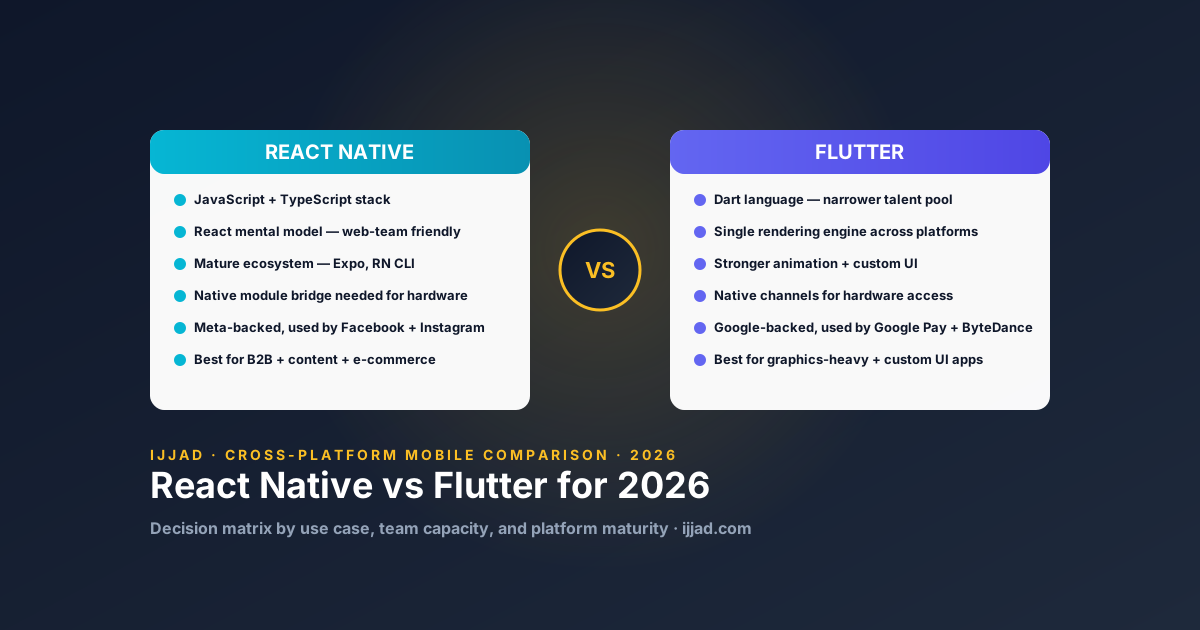
For most healthcare apps, a cross-platform framework is the pragmatic default: it ships iOS and Android from one codebase and covers the common patient features well. Go fully native when you need deep device integration (advanced biometrics, wearables, background health data) or the most demanding security posture. We walk through that trade-off in our React Native vs Flutter comparison, and the broader options on our mobile app development page. As with fintech, the framework matters less than the team’s experience with Saudi standards, with identity and with interoperability.
Do not forget the web surface
A healthcare product is rarely only an app. There is a patient web portal, a marketing site that has to rank, and a help centre that should be discoverable. These web surfaces are where many providers quietly lose trust and traffic, because the team pours everything into the native app and treats the website as an afterthought.
Three things deserve explicit acceptance criteria in 2026. First, measure performance and Core Web Vitals on a device and network matrix derived from the intended users; Google’s web.dev guidance is a useful technical reference. Second, use accurate structured data only where the visible content and page type support it, following Google Search Central and schema.org; schema creates eligibility, not a ranking or AI-citation guarantee. Third, test Arabic and English accessibility with the intended patient journeys and assistive technologies.
We audited the pages ranking for “healthcare app development in Saudi Arabia”
Before writing this, we pulled the pages currently ranking for the term across Google and Bing and measured them. The pattern is clear: the SERP splits into USD cost guides, US-framed (HIPAA) telemedicine posts, and pure legal explainers, with almost nothing that maps the Saudi regulation to the code. That is the gap.
For each ranking page we recorded the word count, the schema types present, whether it maps regulation to real build decisions, and whether it brings any engineering depth. Here is the picture:
| Page type | Word count | Schema | Regulation to build? | Saudi-specific depth? |
|---|---|---|---|---|
| Cost guide (Appinventiv) | ~3,200 | Unknown | Light | Thin on NPHIES/Sehhaty |
| Dev guide (NetSet) | ~2,400 | Unknown | Generic | No NHIC depth |
| Regulations + cost (Abbacus) | ~2,600 | Unknown | Listed, not mapped | No FHIR detail |
| Telemedicine (Cmarix) | ~2,200 | Unknown | US-framed (HIPAA) | Not MOH/NHIC |
| Listicle (MEXC) | ~2,000 | ItemList | No | Overview only |
The lesson is not “write more words”; several of these already run long. It is that a founder who wants to build needs the regulation translated into engineering decisions: which standards, which national integrations, which residency model, and in what order. That translation is what this guide is for.
Five mistakes that stall a Saudi healthcare build
Most delayed health-app builds we have seen in the region share the same root causes. They are the predictable result of treating a regulated clinical product like an ordinary app. Avoid these and you remove most of the risk.
- Copying a US (HIPAA) playbook. Saudi Arabia has its own framework: MOH telehealth regulations, NHIC standards, NPHIES, PDPL. A build designed around HIPAA looks compliant and is not.
- Treating NPHIES as a later integration. Interoperability shapes the data model. Bolting a national exchange onto a model that was never designed for it means reworking the core.
- Hosting data outside the Kingdom. Health data residency is a hard line. Choosing a convenient foreign cloud region first and migrating later is expensive and risky.
- Skipping MOH registration in the plan. A telemedicine service that is not registered cannot legally operate, however polished the app. Build the licensing path into the timeline from the start.
- Choosing a partner on price alone. The lowest quote often comes from a team that has never shipped a regulated Saudi health product. The saving evaporates at the compliance stage. Track record is the cheapest risk reduction you can buy.
The thread running through all five is the same: in Saudi healthcare, the regulation and the engineering are one conversation, and any plan that separates them pays for it later.
How to choose a build partner: the 3S Framework
The cheapest quote is rarely the cheapest project, and in regulated health software a weak partner is expensive in ways that surface at the audit. We score every vendor decision through the 3S Framework (Strategy, Skill, Support):
- Strategy. Do they start with your regulatory path, the national integrations and how Saudi patients behave, before talking stacks? A partner who leads with strategy maps the build to MOH and NHIC correctly the first time.
- Skill. Can they show real engineering (NPHIES/FHIR, identity, security to NHIC standards, accessible bilingual clinical UX), not just mockups? Ask to see a shipped, regulated product.
- Support. Health standards and integrations evolve. A one-time build with no support plan ages into a compliance liability fast.
Proof, not promises
In an anonymized first-party Riyadh case, a nine-week rebuild took an SME website from a PageSpeed score of 42 to 94 and, over the six months that followed, Ijjad reports qualified leads moving from about 3 to 9 a month: the same discipline on performance, on accessibility and on security that a clinical build demands. The anonymized breakdown is in our Riyadh redesign case study.
For context on the publisher: Ijjad is based in Amman, Jordan (+962 79 565 0502), and serves clients across Riyadh, Jeddah, plus the GCC. Ijjad reports 20+ government and enterprise digital products; supporting project and deployment records are private, and those engagements do not prove healthcare compliance for a new app. Our dedicated pages go deeper on healthcare app development in Saudi Arabia and healthcare app development in Jordan. You can read more about founder Karam Abd Al Qader on the founder profile, and the broader app context on our Vision 2030 mobile app guide.
Where this guide might be biased
In the interest of transparency: Ijjad builds digital products for a living, so this guide naturally argues for doing things the way we do them. That is a conflict of interest, even where the reasoning holds up. A few honest caveats. We are a product and engineering team, not a law firm or a licensed medical-regulatory advisor; the regulatory points here are orientation, and you should confirm your specific licensing and registration path with the MOH, the NHIC, or qualified counsel. If your product is a deeply specialized clinical device, a regulatory specialist will know that lane better than any generalist. And we did not benchmark every health-app builder in the Kingdom; this is a framework for evaluating partners, not a ranked directory. Use the 3S Framework to judge us by the same standard.
Free: the Saudi healthcare build readiness checklist
Free Download
The Saudi Healthcare Build Readiness Checklist (PDF)
The five build decisions on one page you can take to any vendor or use to brief your own team: NPHIES interoperability, MOH telehealth licensing, in-Kingdom data residency, NHIC security standards, identity and Sehhaty fit, and accessible bilingual UX, with the exact questions to ask at each stage.
The bottom line
Building a healthcare app in Saudi Arabia in 2026 is a strong bet: the system is connected, the national infrastructure is real, and Vision 2030 is actively pulling digital health forward. But the win goes to teams that respect the order of operations: settle the regulatory and interoperability path first, design residency, security, accessibility in from the start, and choose a partner by their track record with regulated Saudi products rather than by their quote. Get that sequence right and the engineering becomes the straightforward part of the project. Get it wrong and you discover the cost at the audit or the licensing review, when it is most expensive to fix.
Frequently asked questions
How much does it cost to build a healthcare app in Saudi Arabia?
It depends entirely on scope: a simple telehealth MVP and a fully interoperable clinical platform are different projects. Compliance, NPHIES interoperability, security to NHIC standards, and accessibility drive cost more than the UI. We scope after a discovery call so the estimate reflects your actual obligations.
What is NPHIES and does my healthcare app need to integrate with it?
NPHIES is Saudi Arabia’s national platform for health information exchange, a standards-based gateway connecting providers and payers. If your product handles clinical or insurance data, interoperability with NPHIES is very likely on your roadmap, and it shapes your data model.
Do telemedicine apps need MOH licensing in Saudi Arabia?
Yes. Telemedicine is a regulated service: the facility must register its telehealth services with the Ministry of Health and meet the platform and infrastructure standards in the national telemedicine regulations.
Does patient data have to be stored inside Saudi Arabia?
For health data the expectation is in-Kingdom hosting, with encrypted sessions and audit trails to national standards. Treat data residency as an architecture decision made before the build, not a deployment detail.
How do you integrate with Sehhaty or MOH services?
Through the standards and gateways the MOH and NHIC define, with national identity (Nafath) for the user relationship. The right approach depends on whether your app complements Sehhaty or exchanges clinical data via NPHIES.
What standards must a Saudi healthcare app meet?
National digital-health standards set by the NHIC (secure authentication, encryption, audit trails) plus PDPL for personal data and, for clinical exchange, NPHIES interoperability. Accessibility (WCAG 2.1 AA) is also expected for a population-wide service.
Does a Saudi healthcare app need to be bilingual?
For most services, yes. Arabic-first with English is the practical default, and in a health app Arabic clarity is a safety matter; it should be designed in two registers, formal clinical and plain patient language, in a true right-to-left layout.
How long does it take to build a healthcare app in Saudi Arabia?
It depends on scope and integrations. A focused telehealth MVP can take a few months; a fully interoperable, licensed clinical platform runs longer, because the build and the MOH registration and compliance work run in parallel.
Let's turn this into leads.
We build fast, bilingual, conversion-focused sites for SMEs and founders across the region.
Get StartedSource note
Market context: Saudi Arabia's digital economy reached 16.0% of GDP in 2024, according to the General Authority for Statistics, published December 31, 2025. This is why Ijjad treats modern websites, SEO, e-commerce, AI MVPs, and mobile experiences as business infrastructure across Saudi Arabia, Jordan, Iraq, and the GCC.